
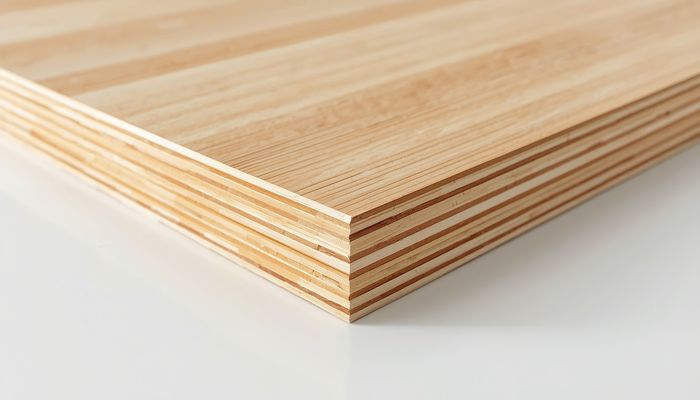
I stood in the Home Depot plywood aisle for 45 minutes last fall. CDX, BC, AC, sanded, sheathing, underlayment, radiata pine, southern yellow pine, birch, oak — the labels blurred together. I had a subfloor to replace in a rental property and the wrong choice meant a bouncy floor that would wreck the LVP going on top. The orange-apron guy walked by twice, probably wondering why I was muttering. I walked out with AdvanTech 23/32 T&G at $47 a sheet. Right call, it turns out. But getting to where I can make that call without the muttering took about 15 years and a few thousand dollars in mistakes.
Plywood seems simple. It’s a 4×8 sheet of wood, right? Except there are roughly 40 different products in that aisle and half of them will fail at whatever you’re trying to do. I’ve used the wrong plywood for a subfloor and had tile crack six months later. I’ve had CDX delaminate on a shed roof because I didn’t know the “X” stands for exposure-rated, not exterior. I’ve built shop cabinets from sanded plywood that cost $72 a sheet when $38 BC would have been invisible under paint.
Here’s what I actually use now, for what, and why.
The Grade Stamp Is the Only Thing That’s Not Lying to You
Every sheet of plywood has a stamp. Most people ignore it. I did for years. The stamp tells you the veneer grades on the face and back, the exposure rating, and the mill number. A-B means A face, B back. C-D means C face, D back — that’s CDX. The letters go A through D, with A being smooth and sanded with no knots or patches, and D being “we’re not even pretending anymore.”
CDX is the workhorse and it’s what I buy most often. The C face has knots up to an inch and a half and maybe some splits. The D face has bigger knots and you’ll find football-shaped patches where knots were filled. The X means the glue is exterior-grade — it won’t delaminate from humidity or occasional wetting. A 4×8 sheet of 3/4-inch CDX runs about $38 to $45 depending on where you live and whether there’s been a hurricane lately. I use it for roof sheathing, wall sheathing, shed floors, concrete forms, and temporary construction. I do not use it anywhere I’m going to see it.
BC plywood is the sweet spot for utility projects where one side needs to look okay. The B face has small tight knots or patches, good enough to paint for garage shelving or workshop cabinets. The C back is whatever. About $48 for 3/4-inch. I built my entire garage storage wall from BC and painted it with a single coat of white latex. Nobody’s ever asked me about my plywood grades.
AC is the stuff you use for cabinet carcasses and visible interiors. A face is sanded smooth, basically flawless. Maybe a few tiny pin knots. I use 3/4-inch AC sanded plywood for built-in shelving and pantry cabinets. About $55 to $65 a sheet for birch veneer core. Worth every dollar when someone opens a cabinet door and sees a flat, smooth back panel instead of a knot farm.
Thickness Is Not What It Says on the Shelf Tag
Here’s something that burned me early on: nominal thickness is not actual thickness. A sheet labeled “3/4-inch” plywood is usually 23/32 of an inch — about 0.718 inches. This matters when you’re matching an existing floor or fitting something into a dado. I once cut 40 dadoes at exactly three-quarters of an inch and then discovered my 3/4-inch plywood was floating in the grooves. Had to shim every single one with veneer strips. Took an extra day. Now I measure every sheet with a digital caliper before I set up the dado stack.
For subfloors, I want 23/32 tongue-and-groove — the sheet I cheaped out on once is the reason I am specific about this. The tongue-and-groove edges lock together so the sheets can’t move independently, which eliminates squeaks. Standard square-edge plywood will develop gaps between sheets over time as the framing dries and shrinks. Those gaps become squeaks. AdvanTech is my go-to for any subfloor I care about. It’s an OSB product, not plywood technically, but it’s denser, flatter, and more water-resistant than CDX. About $47 a sheet for 23/32 T&G. I used it on my last two bathroom renovations and the tile hasn’t cracked yet.
For underlayment under vinyl or sheet flooring, I use 1/4-inch or 3/8-inch sanded plywood rated for underlayment — not sheathing. The difference is the face veneer. Underlayment has a smooth, sanded surface with no knots or voids that could telegraph through thin vinyl. Georgia-Pacific and Roseburg both make good underlayment panels. About $27 for a 1/4-inch sheet.
OSB vs Plywood: The Religious War
People get weirdly emotional about this. I’ve used both and I’ll switch depending on the job. Plywood (actual veneer-core plywood) is stronger in shear, holds fasteners better at edges, and dries out faster after getting wet. OSB is cheaper, flatter, and comes in longer lengths — up to 12 feet for some floor panels, which means fewer seams.
For wall sheathing I use 7/16 OSB every time. It’s $17 a sheet versus $28 for equivalent CDX plywood. On a 2,000-square-foot house that’s hundreds of dollars saved, and the OSB is rated for the same structural loads. My local code office accepts it, so I use it.
For roof sheathing I use 1/2-inch or 5/8-inch CDX plywood, not OSB. The reason is one bad experience: I had OSB roof decking swell at the edges after getting rained on for three days before the roofers could get the underlayment down. The swollen edges telegraphed through the shingles and you could see every seam from the street. Plywood doesn’t swell at the edges the same way. It dries out. OSB holds onto water like a grudge.
For subfloors I use AdvanTech or similar premium OSB over CDX for one reason: flatness. CDX sheets from the big-box stores tend toward the wavy, and a wavy subfloor means you’re pouring self-leveler or sanding high spots before you can lay flooring. AdvanTech comes out of the stack dead flat and stays flat. When I’m putting down $3,000 worth of engineered hardwood, I want the subfloor to be the least of my problems.
What About Marine Plywood and Hardwood Plywood?
Marine plywood is overkill for 99% of home projects. It’s built with waterproof glue and no voids in the core, and a 4×8 sheet of 3/4-inch marine ply costs about $130. I used it once for a dock deck and felt like I was nailing into solid gold. For anything short of boat building or constant water submersion, exterior-grade AB or AC fir plywood works fine. I built an outdoor kitchen cabinet setup from 3/4-inch AC fir and coated it with three layers of spar urethane. Three years in the Texas sun and rain, no delamination.
Hardwood plywood — birch, maple, oak veneer — is for furniture and visible casework. The core can be veneer, MDF, or particleboard. Avoid the particleboard-core stuff. It’s heavy, sags on shelves, and the screws strip out if you look at them wrong. Veneer-core hardwood plywood costs more but you can actually build with it. A 4×8 sheet of 3/4-inch birch veneer-core runs $65 to $85 at a real lumberyard. The same thing with an MDF core might be $55 at a big-box store. The $10 savings is not worth it.
If you need plywood for cabinet drawer boxes, go with Baltic birch — worth knowing before you commit to painting the cabinets you already have instead. It’s sold in 5×5 sheets, has more plies than standard plywood, and the edges look good enough to leave exposed or finish with iron-on edge banding. About $35 for a half-inch 5×5 sheet. I built all my shop cabinet drawers from it ten years ago and they still slide smooth.
I still spend too long in the plywood aisle sometimes. Old habits. But now I walk in knowing what the stamp means and what thickness I’m actually getting. The cashiers probably appreciate that I stopped muttering.


I’ve tried this approach in my own home. Results were good but not miraculous. Solid option for the price point.
Used luxury vinyl in three flips last year. Quick to install and instantly makes a house look updated.