
Three years ago my water heater gave up the ghost. Not a polite drip — a full-on, two-inch-standing-water-in-the-finished-basement situation. The laminate flooring I’d installed two years earlier? Completely destroyed. The planks swelled up like sponge cake and the MDF core turned to oatmeal. I pulled it all up with my bare hands while a Shop-Vac ran in the corner.
That’s when my neighbor Dave, a flooring contractor who’s been doing this since the Carter administration, told me I was an idiot for putting laminate in a basement. “You want SPC,” he said. “Stone plastic composite. Water can sit on that stuff for a week and it won’t care.”
He was right. I’ve now installed SPC flooring in three rooms of my house: the basement, the kitchen, and the mudroom where my two Labs track in half the yard every time it rains. Here’s what I actually learned doing it myself, not what the marketing brochures say.
What SPC Actually Is (Not the Sales Pitch)
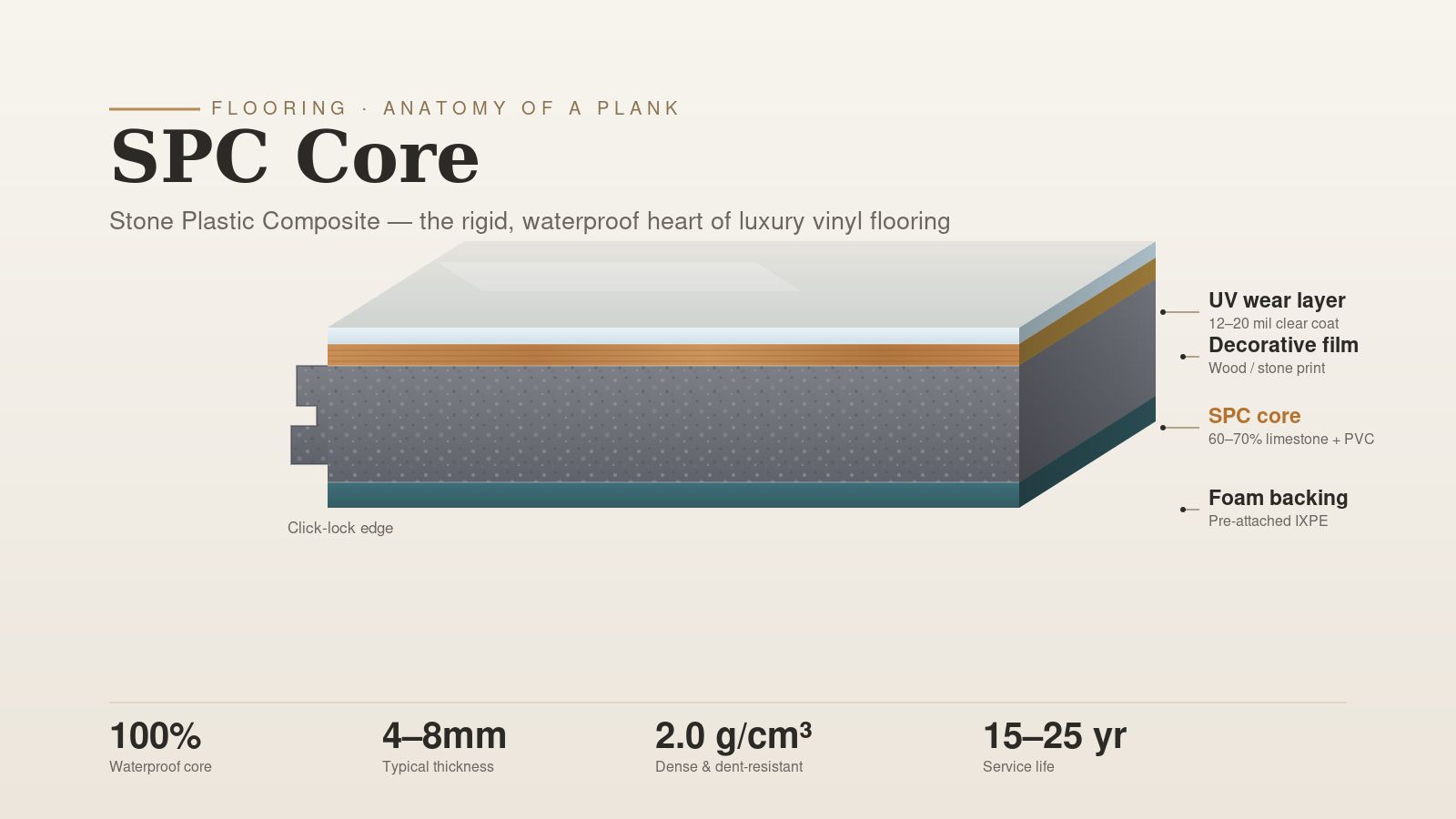
SPC stands for Stone Plastic Composite. The core of each plank is about 60-70% limestone powder mixed with PVC resin and some stabilizers. It gets pressed under heat into a dense board that’s more like a thin tile than a piece of vinyl. When you pick up an SPC plank, it’s noticeably heavier than regular luxury vinyl: a box of Coretec SPC weighs about 28 pounds for 20 square feet versus maybe 18 pounds for standard LVP.
The plank has four layers: a UV-cured wear layer on top (the stuff that takes the abuse), a printed vinyl design layer (what makes it look like oak or slate), the SPC core (the rigid board), and usually a pre-attached cork or foam underlayment on the bottom.
The limestone is the secret. It’s what gives the plank rigidity and density. A good SPC plank — 5mm or thicker — doesn’t flex when you hold it horizontally. You can stand on a scrap piece balanced between two 2x4s and it won’t sag. Try that with WPC (wood plastic composite, the cheaper cousin) and it’ll bow under your weight.
The Brands I’ve Actually Used
I’m not getting paid by anyone, so here’s the real rundown.
Coretec was my first SPC purchase. I used their Pro Plus line in the basement: 7.2mm total thickness with a 20-mil wear layer. Paid $4.89/sq ft at a local flooring shop. The click-lock system is genuinely well-designed; I dropped a plank on the garage floor trying to angle it in (my fault) and the locking edge didn’t crack. Installation was smooth. Two years later, zero issues. The attached cork backing provides decent sound deadening. Walking on it doesn’t sound hollow like cheap laminate.
LifeProof from Home Depot was my kitchen floor. $3.59/sq ft on sale. 6.5mm thick with a 22-mil wear layer, which sounds impressive on paper. The locking system is fine but the planks have a slight bow from the factory — maybe 1/16 inch over 48 inches — which made tapping them tight more work than it should have been. Still, for the price, it’s held up well. I dropped a cast iron skillet from counter height (don’t ask) and there’s a tiny dent in the wear layer but it didn’t crack through.
NuCore from Floor and Decor is what I put in the mudroom. $3.29/sq ft. 5.5mm thick with a 12-mil wear layer. This is the budget option and you can tell: the locking edges feel thinner and I broke two tongues during installation just tapping a bit too aggressively with the mallet. But once it’s down, it’s solid. The 12-mil wear layer worries me a little with two dogs, but after 18 months the only visible wear is right at the door threshold where gravel gets tracked in.
Installation Is Faster Than You Think
The pitch is that SPC floats over subfloor imperfections better than other flooring. That’s true — to a point. The manufacturer specs usually say the subfloor needs to be flat within 3/16 inch over 10 feet. I took that seriously after my laminate disaster, and after learning the hard way what a bad subfloor actually costs you.
My basement concrete slab had a 3/8-inch dip across 6 feet near the sump pump. I spent a Saturday with a bag of self-leveling compound ($28 at Lowe’s) and a long screed board. It wasn’t fun, and I’d recommend renting a mixing paddle for your drill instead of stirring by hand like I did. My forearm was sore for three days.
Once the floor was flat, the actual SPC installation went fast. My basement is about 350 square feet and I laid it in four hours by myself, including cuts. A jigsaw with a fine-tooth blade works fine for cutting planks; you don’t need the fancy guillotine cutter the YouTube guys push. The dust is nasty though. Wear an N95.
One thing nobody told me: SPC needs an expansion gap at the walls, usually 1/4 to 3/8 inch. The stuff does expand slightly with temperature changes — not much (about 0.02 mm per meter per degree Celsius), but enough that if you butt it tight against the wall, it’ll buckle on a hot day. I learned this in my kitchen when the afternoon sun hits the floor and I heard a soft pop. One seam lifted about a millimeter. Nothing major, but I had to pull the baseboard and shave a little clearance with an oscillating tool.
SPC vs Everything Else
I’ve installed laminate, engineered hardwood, glue-down vinyl, and tile over the years. SPC is my go-to for any room that might see water or heavy traffic.
SPC vs laminate: Laminate is cheaper. You can get decent Pergo for $1.50 to $2.50 per square foot. But it’s a ticking time bomb anywhere near moisture. My flooded basement laminate literally turned to mush within 8 hours of water exposure. SPC laughs at water.
SPC vs WPC: WPC has a wood flour core instead of limestone. It’s lighter and slightly softer underfoot, which sounds nice, but it dents more easily. Drop a heavy tool on WPC and you’ll get a dent. SPC doesn’t care. WPC is fine for bedrooms. For anywhere else, spend the extra dollar per square foot on SPC.
SPC vs tile: Tile is more durable in a vacuum. Nothing beats porcelain for hardness. But tile is cold, hard on your feet and knees, and grout lines are a maintenance nightmare. SPC feels warmer, installs faster, and doesn’t crack if the subfloor shifts slightly.
SPC vs hardwood: I love hardwood. I have oak floors upstairs and they’re beautiful — I went back and forth for weeks on engineered versus solid before I laid them. But hardwood is a diva. It needs humidity control, it scratches, it stains, and it costs $8 to $15 per square foot installed. SPC costs $3 to $5 per square foot for materials and you can install it yourself. Hardwood adds resale value; SPC adds sanity.
What I’d Do Differently
If I were starting over tomorrow, I’d buy Coretec again for the basement. The locking system alone is worth the premium. I’d skip NuCore for high-traffic areas and save it for a guest bedroom or home office where the 12-mil wear layer won’t get tested daily.
I’d also buy 10% extra material instead of the recommended 5%. My basement layout was straightforward and I still ended up with more waste than expected from cutting around floor vents and a weird jog in the hallway. Running back to the store mid-project for one more box is soul-crushing.
One last thing: buy good knee pads. Not the $8 foam ones from the paint aisle. Spend $25 to $30 on gel pads. You’ll thank me around hour three.



Thank you for making this easy to understand. So many articles overcomplicate things.
For our flips, LVP gives the best ROI. Looks premium but costs reasonable. Buyers love it.