
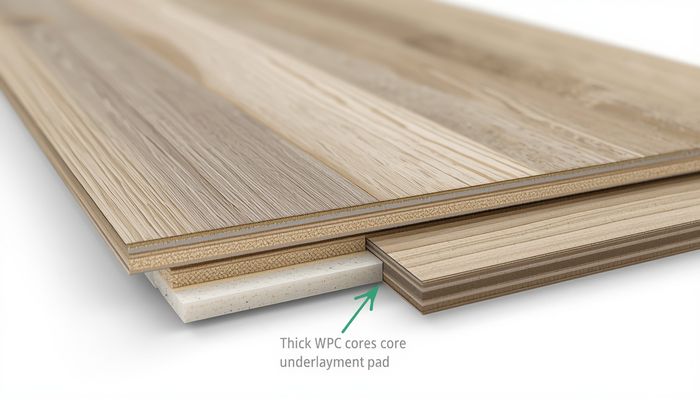
I’ll never forget standing in the flooring aisle at Home Depot, holding a sample of Luxury Vinyl Plank in one hand and a regular laminate board in the other, trying to figure out why the LVP felt so much heavier. The guy working the department — a retired contractor named Rick who’d been doing floors since before I was born — pointed at the cross-section of the sample and said, “See that middle layer? That’s WPC core. That’s what you’re paying for.”
I nodded like I understood. I did not understand. But three basement floods later, I sure do now.
So What Actually Is WPC Core?
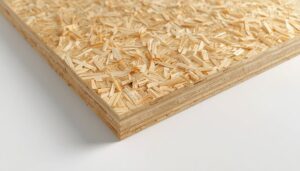
WPC stands for Wood Plastic Composite. What that means in plain English: it’s a dense, rigid slab made from mixing wood fibers (basically sawdust and wood flour) with melted plastic — usually polyethylene or polypropylene — and then extruding the whole mixture through a machine that puffs it up slightly with a foaming agent.
The result is a core layer that’s around 4 to 8 millimeters thick. It feels solid. You can knock on it like a door. But it’s also got tiny air pockets inside the material — a closed-cell structure — which means water can’t travel through it. That’s the magic trick right there.
The core sits sandwiched between a vinyl wear layer on top (the part you see) and a foam or cork backing on the bottom. In WPC decking boards, the whole board is the WPC material — no sandwich required. Companies like Shaw, Mohawk, Coretec, and LifeProof (the Home Depot house brand) all make WPC-core products now. You’ll see them labeled as “rigid core” or “engineered vinyl plank” on the shelf. If the box says WPC anywhere, that’s what you’re getting.
Why I Wish I’d Known About It Sooner
My first house had a finished basement. Beautiful engineered hardwood down there. Looked amazing. Then a heavy spring rain came, the sump pump’s backup battery died while I was at work, and I came home to about an inch of standing water.
The flooring was destroyed. Every plank swelled at the edges like a soggy cracker. $2,800 later — that was the replacement cost, and I did it all myself — I had learned a $2,800 lesson: wood and moisture do not mix.
WPC core flooring would have survived that event. Not “maybe.” Not “probably.” It would have been fine. I’d have mopped up the water, run a dehumidifier for a couple days, and gone on with my life. That’s the whole value proposition.
Beyond just water, WPC doesn’t expand and contract with temperature swings the way real wood or laminate do. I’ve got a buddy in Minnesota who installed WPC planks in his three-season porch — a room that goes from 20°F in winter to 90°F in summer. Three years in, no gaps, no buckling. Try that with laminate and you’ll regret it by February.
Where WPC Shines (And Where It Doesn’t)
If you’re finishing a basement, WPC is basically the obvious answer at this point. You can install it directly over a concrete slab. No vapor barrier needed. The core itself is the vapor barrier. Just make sure the slab is level — any dip deeper than 3/16 inch over a 10-foot span needs to be filled with a self-leveling compound first.
Bathrooms and laundry rooms are another sweet spot. I redid my half-bath with Shaw WPC planks two years ago. It’s a click-lock floating floor — meaning the planks snap together and the whole floor just sits on top of the subfloor, not glued or nailed. My toddler has flooded that bathroom twice (don’t ask). The floor is fine. The seams aren’t perfectly sealed — no click-lock floor truly is — but enough water stays on the surface that you can wipe it up before anything seeps through.
Kitchens too. Ever dropped a cast iron skillet on ceramic tile? One of those things is going to break and it’s usually the skillet. On WPC flooring, the skillet just bounces. The floor might get a small dent but it won’t crack or shatter.
Couple places I wouldn’t use it: unheated sunrooms that see direct, all-day sun in summer. WPC can fade with UV exposure over time unless it’s specifically rated for outdoor use (which most indoor flooring is not). Also, if you’re the type of person who wants a floor you can sand down and refinish in 20 years — WPC isn’t that. The wear layer is what it is. Once it’s worn through, you’re replacing the plank.
WPC vs SPC: The Question Everyone Asks
SPC means Stone Plastic Composite — same idea, but instead of wood fibers, they use limestone powder mixed with plastic. SPC is harder, denser, and more impact-resistant. It’s the flooring equivalent of a tank. WPC is slightly softer and warmer under bare feet.
If you’re doing a commercial space or you have very heavy furniture (pianos, pool tables, massive bookshelves), SPC is probably smarter. For a normal house with normal furniture and normal people walking around in socks, I’d pick WPC every time. It just feels nicer. Plus, walking on WPC in the morning feels warmer than walking on SPC, and in a basement that matters more than you’d think.
Price-wise, you’re looking at roughly $3 to $5 per square foot for decent WPC planks at Home Depot or Lowe’s. The premium brands like Coretec run closer to $6 or $7. SPC is usually in the same range, maybe fifty cents cheaper per square foot on the low end.
Installation: You Can Probably Do This Yourself
Here’s the honest take: if you can assemble IKEA furniture without weeping, you can install click-lock WPC flooring. You need a tape measure, a utility knife, a tapping block, a rubber mallet, and some spacers. That’s it. No saw needed — you score the plank with the utility knife and snap it. Took me about six hours to do a 200-square-foot room my first time, and I was being careful.
The one thing that’ll trip you up: the first row has to be perfectly straight. If your starting row is off by even an eighth of an inch, that error compounds across the whole floor and you’ll end up with visible gaps against the far wall. I learned this the hard way. Use a chalk line. Don’t trust the wall to be straight — because walls are almost never straight.
Also, let the planks acclimate in the room for 48 hours before you install. Yes, the box says you can do it in 24. Wait the full 48. Temperature and humidity matching prevents micro-expansion that can make the seams slightly uneven weeks later. I’ve seen it happen.
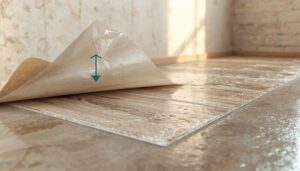
If you’re dealing with a concrete basement floor that has moisture issues — and a lot of older homes do — test the slab first. Tape a square of plastic sheeting to the floor and leave it for 24 hours. If moisture beads up under the plastic, you need to address that before anything goes down. A simple roll-on moisture barrier like RedGard or a similar product is cheap insurance.
WPC core flooring isn’t the fanciest thing in the world. It’s not hand-scraped walnut or imported Italian tile. But it’s practical. It survives the stuff that actually happens in a house — spills, pets, kids, basement dampness, and my own questionable DIY judgment. After living with it for a few years now, I wouldn’t put anything else in a basement or bathroom. The peace of mind is worth the $3 a square foot.
First time working with vinyl plank and I learned you need the right blade. Used a cheap utility knife and got ragged cuts.
I’ve tried this approach in my own home. Results were good but not miraculous. Solid option for the price point.