
The Floor Bounced Every Time My Kid Ran Across the Room
We bought a 1960s house with a “bonus room” that had been added sometime in the 80s. Every time my son ran across it, the floor bounced. Not creaked — bounced. The TV would shake. Water in a glass on the coffee table would ripple like Jurassic Park.
I crawled under the house and found the problem: the joists were spaced 24 inches apart instead of 16, and they were 2x6s spanning 14 feet. A 2×6 joist at 24-inch spacing spanning 14 feet is dramatically undersized. The floor was structurally fine — it wasn’t going to collapse — but it was never going to feel solid.
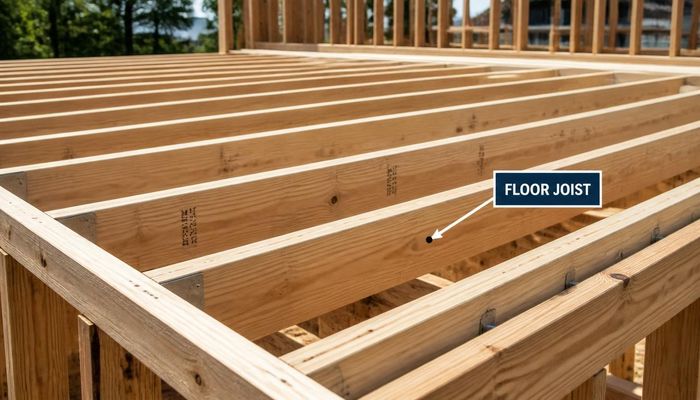
What Joists Actually Do
Joists are the horizontal framing members that support your floor. They run between beams or foundation walls, and the subfloor (plywood or OSB) gets nailed to them. Everything above the joists — the flooring, the furniture, you — transfers weight down through the joists to the foundation.
The three numbers that matter: species of wood, size of the joist (2×6, 2×8, 2×10, 2×12), and the span (distance between supports). A southern yellow pine 2×10 can span about 16 feet at 16-inch spacing. The same 2×10 in spruce can only span about 13 feet. The same 2×10 at 24-inch spacing loses about 20% of its span capacity.
My 2×6 joists at 24-inch spacing spanning 14 feet were about 40% undersized for a living space. That’s why the floor bounced.
How I Fixed It (Without Replacing Every Joist)
Replacing joists is a massive job — it means tearing up the entire floor from above or the ceiling from below. I didn’t have the budget or the time for that. Instead, I sistered the joists.
Sistering means attaching a new joist to the side of the existing one, effectively doubling the strength. I bought 2x8s (one size up from the existing 2x6s), cut them to length, and nailed them to the sides of every joist using 16d common nails in a staggered pattern every 12 inches. I also added construction adhesive (Loctite PL Premium, $7 a tube) between the old and new joist before nailing — this prevents squeaks caused by the two pieces rubbing together.
The materials cost about $400 for a 200-square-foot room. The labor took two weekends. The result: the floor is solid. The TV doesn’t shake. My son can run across the room and the water glass stays still.
What You Can and Can’t Fix
Bouncy floors: Usually fixable with sistering or adding blocking between joists. Blocking is short pieces of the same dimension lumber cut to fit between joists and nailed in place. It ties the joists together and spreads the load. Adding a row of blocking at mid-span can noticeably stiffen a floor.
Sagging floors: A different problem. Sagging means the joist has actually bent over time (creep deflection) or the supports have settled. Sistering can help but you may also need to jack up the low point and add a new beam or support post. If the sag is more than 1/2-inch over the span, get a structural engineer to look at it.
Cracked joists: Not uncommon in old houses. A cracked joist can be sistered or repaired with a plywood gusset (a piece of 3/4-inch plywood glued and nailed over the crack, extending at least 2 feet on either side). If the crack is at the bottom of the joist (the tension side), the joist has partially failed and needs full sistering, not just a patch.
Rot or termite damage: Replace the joist. Sistering next to a rotted joist is a temporary fix at best. The rot can spread to the new wood if you don’t remove the damaged section first.
The One Thing I Wish I’d Checked Before Buying
When you’re looking at a house, walk across every room and feel for bounce. Open a closet and look at how the joists are framed if there’s an access panel. Look at the spacing — you can often see it from the basement. 16-inch spacing is standard and fine. 24-inch spacing is common in older homes and not inherently bad if the joists are properly sized, but it’s worth knowing.
My bonus room is now the best-feeling floor in the house because I overbuilt the fix. The sistered 2x8s next to the original 2x6s created a composite joist that’s stronger than any single 2×10 would be. The TV hasn’t shaken since. The glass of water is safe.

Installed hardwood in our kitchen three months ago and it’s holding up great. Gets the most traffic in the house.
For our flips, LVP gives the best ROI. Looks premium but costs reasonable. Buyers love it.