
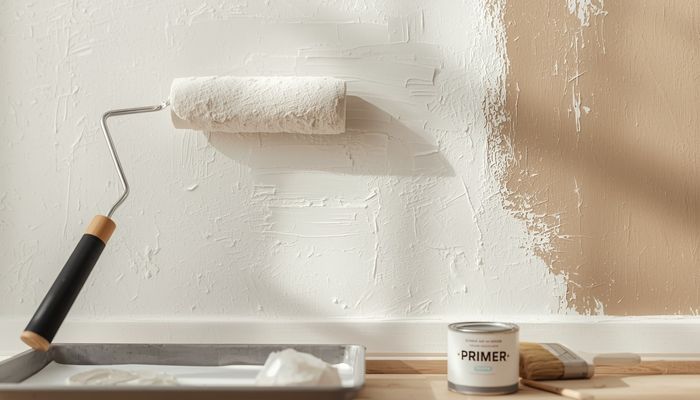
I Skipped Primer Once. I’ll Never Do It Again.
I was painting my first living room. The walls were a dark burgundy and I wanted to go to a light cream — Benjamin Moore’s “White Dove” at $48 a gallon. The guy at the paint counter said I should use primer first. I was 23, I was impatient, I had spent $96 on two gallons of paint and didn’t want to spend another $25 on primer. I figured two coats of the expensive paint would cover just fine.
I was wrong. Three coats later, the burgundy was still ghosting through in patches. The paint was streaky. I’d used almost the entire two gallons on one 12×14 room. What should have been a $120 job with primer became a $96 job with no primer and bad results that I had to redo six months later anyway.
Primer is not just “cheap paint.” It’s a completely different product with a completely different job. Here’s what I now understand.
What Primer Actually Does
Paint is designed to look good. Primer is designed to stick and seal. It has more resin (the binder that creates adhesion) and less pigment than paint. This means it bonds to the surface better than paint does, and it seals porous surfaces so the paint sits on top instead of soaking in unevenly.
The specific jobs primer does:
Blocks stains. Water stains, smoke stains, tannin bleed from wood knots, and marker/crayon will bleed through paint if you don’t prime first. Oil-based or shellac-based primers (Zinsser BIN, $28 a quart) are the only thing that reliably block water and smoke stains. Water-based primers won’t do it — the stain will bleed through within weeks.
Provides adhesion on slick surfaces. Painting over glossy enamel, tile, laminate, or previously oil-painted trim without a bonding primer is how you get paint that peels off in sheets. Bonding primers (Zinsser 1-2-3, $20 a gallon, or Kilz Adhesion, $22) are formulated to grip slick surfaces.
Seals porous surfaces. New drywall, bare wood, and joint compound are porous — they absorb paint unevenly. Primer seals them so the finish coat goes on evenly. Without primer on new drywall, the dried joint compound (mud) will absorb more paint than the paper face, creating “flashing” — visible differences in sheen that show every seam in the room.
Blocks odors. If you’re painting over a room that smells like cigarettes, pets, or curry, an odor-blocking primer seals the smell into the wall. Painting without it just temporarily masks the odor, and it comes back.
When You Can Skip It (And When You Absolutely Can’t)
Skip it: Painting over existing latex paint in good condition with the same color family (light over light, dark over dark). Just clean the walls first — TSP or Krud Kutter, $8 a bottle, wipe down, let dry. If the old paint is flat and you’re going to eggshell or satin, you can get away with no primer if the walls are clean.
Do not skip: New drywall (always — the joint compound will flash through). Dark to light color changes. Painting over wallpaper (if you’re insane enough to paint over it, use an oil-based primer to keep the moisture in the water-based paint from loosening the wallpaper adhesive). Stained surfaces (use shellac). Bare wood (use oil or shellac — water-based primer raises the grain). Painting over oil with latex (bonding primer or you’ll be repainting in a year).
The rule I follow now: If I’m unsure, I prime. A gallon of Kilz 2 ($18) is cheaper than a gallon of Benjamin Moore Regal Select ($54), and it takes the same amount of time to roll on. The math almost always favors priming unless it’s a very specific, low-risk repaint.
My burgundy living room taught me this. The redo — prime plus two coats of White Dove — looked perfect and took half the paint I’d wasted on the failed three-coat attempt. The $25 I tried to save cost me about $200 in wasted time and paint. I prime everything now.
First-time home flipper here: tested for asbestos BEFORE doing anything. Please please test first if your house is pre-1980.
Back-rolling is non-negotiable for cabinets. Failed to do it on my first kitchen spray job and had adhesion issues within 6 months.