

The Fog Coat That Looked Nothing Like the Sample
We had a stucco patch on the front of the house — about a 3×3 foot section where a previous owner had run a new electrical line and the electrician had patched the stucco with what looked like gray cake frosting. The texture was wrong. The color was wrong. It was the first thing you saw walking up to the front door.
The stucco guy I called quoted me $1,800 to re-stucco the entire front wall. For a 3×3 patch. I said no, went to YouTube, and discovered fog coating. It cost me $60 in materials and took a Saturday afternoon. Here’s what it is and when it actually works.
What a Fog Coat Actually Is
A fog coat is a thin, watery mixture of Portland cement, fine sand, and water — think of it as stucco soup. You spray or brush it onto existing stucco to even out the color and fill hairline cracks. It’s not structural. It’s cosmetic. It’s like putting a tinted moisturizer on your walls instead of redoing the foundation.
The mix I use: one part Portland cement (type I/II, $12 for a 94-pound bag — you’ll use maybe 5 pounds), one part fine masonry sand ($6 a bag), and enough water to make it the consistency of thick paint. About 2 parts water to 1 part dry mix. It needs to be thin enough to spray through a hopper gun or roll on with a heavy-nap roller.
The critical step nobody mentions: you have to wet the wall first. Stucco is porous and will suck the water out of your fog coat before the cement has time to cure. I spray the wall with a garden hose until it’s damp but not dripping, then apply the fog coat immediately. If you skip this, the fog coat will cure too fast, turn chalky, and flake off within a year.
When It Works (and When It Doesn’t)
Good for: Color matching between old and new stucco patches. Evening out color variation from sun bleaching or different stucco batches. Filling hairline cracks (anything thinner than 1/16-inch — wider cracks need elastomeric caulk first). Refreshing stucco that’s structurally sound but looks tired. My 3×3 patch matched the surrounding 20-year-old stucco after two fog coats. You can’t tell where the patch was.
Not good for: Structural cracks wider than 1/8-inch (these indicate movement — fog coat won’t stop them from reopening). Covering a completely different texture (fog coat is thin — it won’t change the texture, just the color). Water infiltration problems (fog coat is vapor-permeable — it won’t waterproof anything). Large areas where the stucco is failing or delaminating (the fog coat will fail with it).
The color challenge: Fog coat dries lighter than it looks wet. Significantly lighter. My first batch dried to a color that was about two shades too light. The fix: I added a small amount of liquid cement color (Quikrete liquid cement color, $8 a bottle, in buff) to the second batch. Start with less color than you think you need — you can always add more for a second coat, but you can’t take it out. Test on a small hidden area first.
Application That Doesn’t Make a Mess
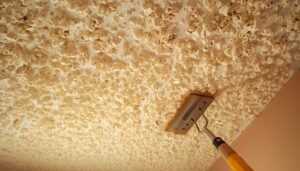
I tried a hopper gun first (the same tool used for popcorn ceilings and knockdown texture). It was too aggressive for a fog coat — it splattered and created an uneven finish. What actually worked: a 1.5-inch heavy-nap roller cover ($6). Roll it on in a random pattern (not straight lines — you don’t want roller marks showing). Let it dry for 24 hours. If the color is still uneven, apply a second coat.
Cover everything near the wall with plastic sheeting. Fog coat is cement — it splatters, it stains, and it’s nearly impossible to get off brick, painted surfaces, or windows once it dries. I spent an hour scraping dried cement splatters off my front walk with a wire brush because I got lazy with the drop cloths.
Total cost for my patch: $12 Portland cement, $6 sand, $8 color, $6 roller, $12 plastic sheeting = $44. Plus a Saturday. The stucco guy wanted $1,800. The patch is invisible. Even I can’t find it anymore.



Does this work well in humid climates? I’m in the South and moisture is always a concern.
This answered questions I didn’t even know I had. Great practical advice here.