
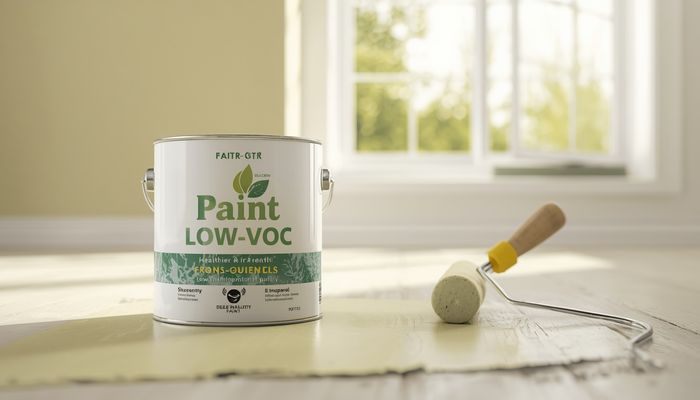
When my wife was six months pregnant with our daughter, nesting mode kicked in hard. The guest room had to become a nursery immediately, and it had to be perfect. Walls needed paint, trim needed fresh white, and the old oak dresser needed refinishing. I was ready to grab whatever was on sale at Home Depot and get to work.
My wife handed me her phone with a browser tab open. “Read this,” she said. It was an EPA page about VOCs and indoor air quality. I read it. Then I put the $22 gallon of Valspar back on the shelf and walked over to the Benjamin Moore display.
That was seven years ago. My daughter is fine, the nursery looked great, and I’ve been a low-VOC paint convert ever since. Here’s what I actually learned — the stuff the paint cans don’t tell you.
What VOCs Actually Are
VOC stands for volatile organic compound. The “volatile” part means these chemicals evaporate into the air at room temperature. They’re what makes fresh paint smell like fresh paint. That smell? That’s solvents off-gassing into your lungs. Common VOCs in paint include benzene, formaldehyde, ethylene glycol, and toluene. None of these are things you want your pregnant wife or newborn breathing.
Traditional paints can contain 150 to 300-plus grams of VOCs per liter. Oil-based paints are the worst offenders — often 300 to 500 g/L. The EPA defines low-VOC paint as under 50 g/L for flat finishes and under 100 g/L for non-flat (eggshell, satin, semi-gloss). Zero-VOC means under 5 g/L.
But the labels are misleading. A “zero-VOC” base paint can become low-VOC the moment you add colorant at the mixing counter. That’s because the universal colorants most stores use contain VOCs. Sherwin-Williams and Benjamin Moore both offer low-VOC colorant systems now, but you have to ask specifically. The teenager at the paint desk isn’t going to volunteer this information.
The Brands I Tested (With My Pregnant Wife’s Nose)
My wife has the nose of a bloodhound, especially when she was pregnant. She could smell the neighbor’s cooking from our living room. So her reaction to paint odors became my official testing protocol.
Benjamin Moore Natura: This was their zero-VOC line before they replaced it with Eco Spec. I painted the nursery walls with Natura in a flat finish — a soft sage green called “Dried Parsley.” Zero detectable odor within about two hours. My wife slept in that room the same night (well, “slept” is generous — she was eight months pregnant and uncomfortable, but the paint smell wasn’t the problem). Natura cost $54 per gallon in 2019. Not cheap, but you’re paying for peace of mind.
Sherwin-Williams Harmony: I used this for the hallway and living room during a later project. Harmony is their zero-VOC line with odor-eliminating technology — it claims to actually reduce household odors. Around $48 per gallon for eggshell finish. It covers better than Natura; I got away with one coat over a light beige with the new color (a warm gray called “Agreeable Gray,” which is basically the default suburban wall color now). The odor was faint — like damp paper — and gone by morning.
Behr Premium Plus: This is Home Depot’s low-VOC workhorse. Under 50 g/L. I’ve used it in three rental properties because at $28 a gallon, it’s the best value. Coverage is decent but you absolutely need two coats. The odor is mild but noticeable for about 24 hours. It’s fine for general use, but I wouldn’t use it in a nursery or a bedroom for someone with asthma.
Clare Paint: A direct-to-consumer brand I tried in my home office. Zero-VOC, Greenguard Gold certified, about $49 per gallon. The colors are well-curated (there are only about 50, which honestly makes choosing easier). Coverage was good; one coat almost did it over white primer. Odor was comparable to Natura — basically nothing after a few hours.
What I Learned the Hard Way
A few things nobody tells you about low-VOC paint:
It dries fast. Sometimes too fast. Low-VOC paints are mostly water-based, and water evaporates fast. If you’re cutting in with a brush and then rolling, you need to work quickly. With traditional paint you have about 15-20 minutes of “wet edge” time. With some low-VOC paints, it’s more like 5-8 minutes. If you go back to touch up a section after it’s started to dry, you’ll get lap marks. I learned this in the nursery the hard way on one wall. The fix was an extra coat.
The curing time is longer than drying time. Low-VOC paint feels dry to the touch in an hour or two. But the chemical curing process — where the binders fully cross-link and harden — can take 2 to 4 weeks. During that time, the surface is somewhat delicate. In the nursery, I hung a small picture frame about three days after painting and the adhesive strip pulled a patch of paint right off the wall. Wait at least two weeks before sticking anything to fresh low-VOC paint.
Don’t forget the primer and the trim paint. I painted the nursery walls with Benjamin Moore Natura (zero-VOC) and then reached for a can of Kilz oil-based primer for the trim. Big mistake. That stuff reeks. I had to open every window in the house in January in Indiana. Use a low-VOC primer — Zinsser Smart Prime or Kilz Klear are both water-based and under 50 g/L. For trim, go with Benjamin Moore Advance (low-VOC, water-based alkyd that lays down like oil) or Sherwin-Williams ProClassic waterborne. Both run about $55+ per gallon.
VOCs are in more than paint. Carpet adhesive, flooring glue, caulk, wood stain, polyurethane — all of these can off-gas VOCs. When we refinished the oak dresser for the nursery, I used Minwax water-based polycrylic instead of traditional polyurethane. Lower odor, lower VOCs, and it dried clear without the amber tint. About $18 for a quart at Home Depot. The trade-off is that it’s not as durable as oil-based poly; I had to be more careful with the application and do an extra coat.
Is Low-VOC Worth It?
For the nursery? Yes. Absolutely yes. I don’t know if my daughter would have had health issues from a room painted with conventional paint. Probably not. Most kids who grew up in houses painted with high-VOC paint are fine. But when you’re about to bring a newborn home, you start thinking about every variable, and this is one you can control for $30 extra per gallon.
For general home projects where nobody is pregnant or has asthma, I still use low-VOC when the price difference isn’t crazy. Behr Premium Plus at $28 per gallon is a no-brainer. You get a decent paint that doesn’t fumigate your house for a week. For high-end projects where finish matters — trim, cabinets, built-ins — I spend the money on Benjamin Moore Advance or Sherwin-Williams Emerald. The low-VOC versions of premium paints are genuinely as good as their conventional equivalents now. The technology has caught up.
If you’re painting a nursery or a room for someone with chemical sensitivities, go zero-VOC: Benjamin Moore Eco Spec, Sherwin-Williams Harmony, or Clare. And make sure the colorant is low-VOC too. Ask at the desk. It matters.




Home stager here — I can ALWAYS tell when someone skipped primer. The finish just doesn’t look professional.
Commercial glue-down LVP is what we use in 90% of our retail jobs. The wear layer bonded with full glue coverage is practically indestructible.