
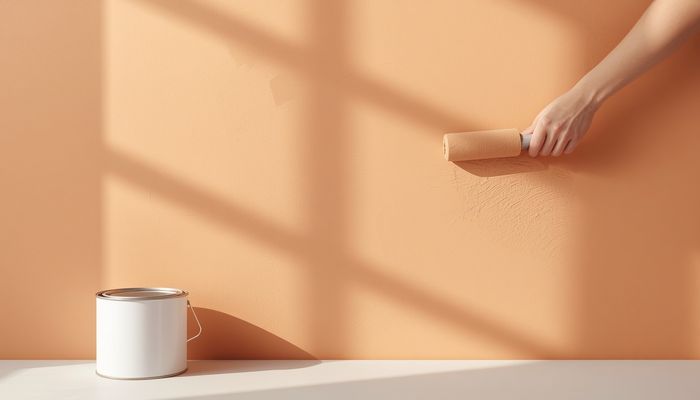
The hallway in our first house was painted flat white when we bought it. I didn’t think about it much — it was just white paint. Then our daughter turned two and discovered the joy of running along the wall with a chocolate-covered hand. I grabbed a damp paper towel, scrubbed, and immediately watched the paint start coming off onto the towel. Underneath was a shiny, lighter patch where I’d essentially washed the pigment right off the wall. That’s when I learned the fundamental truth about flat paint: it hides everything except your attempts to clean it.
I’ve painted every room in two houses now — some twice — and I’ve developed strong opinions about paint sheen. Flat finish has a real place in home improvement, but it’s not the place a lot of people think. If you’re standing in the paint aisle at Sherwin-Williams right now trying to decide between flat, matte, and eggshell, let me save you from making the mistakes I made.
What Flat Paint Actually Is
Flat paint is paint with almost no light reflection. On the sheen scale that paint companies use (0 to 100, with 0 being chalky-nothing and 100 being mirror-gloss), flat sits at roughly 0 to 5. When light hits a flat-painted wall, it scatters in every direction instead of bouncing back at you. That’s why flat walls don’t have shiny spots, even under bright lights or direct sunlight.
The technical reason: flat paint has a high pigment-to-binder ratio. More pigment particles, less resin binder. The pigment sits up on the surface like microscopic sand dunes, breaking up light. The downside is those pigment particles don’t have much binder holding them together, which is why they wipe right off when you try to clean them.
Matte paint (sheen 5-15) is often confused with flat, and honestly, different brands use the terms differently. Benjamin Moore calls their lowest-sheen wall paint “Matte” while Sherwin-Williams calls theirs “Flat.” Behr has both a Flat and a Matte in their Marquee line. It’s confusing. What matters isn’t the name on the can — it’s the actual sheen level. Look at the product data sheet or ask the person at the paint counter what the sheen number is.
The Good Stuff: Why Flat is Still Worth Using
Nothing hides bad drywall like flat paint. Nothing. I’ve patched holes, repaired cracks, and mudded seams that looked terrible under primer. Hit them with two coats of flat ceiling white and they disappeared. The same repairs painted with eggshell would telegraph through — you’d see a slight texture difference, a faint shadow. Flat just swallows all of that.
Ceilings are the obvious application. Every ceiling in my house is flat white (specifically Benjamin Moore Waterborne Ceiling Paint in flat, about $45 a gallon). It covers drywall seams, hides the slight texture variations from skim coats, and doesn’t reflect light from recessed cans or ceiling fans. A glossy ceiling is genuinely unpleasant to be under — you get little hot spots of reflected light everywhere.
Low-traffic adult spaces are the other good use case. Our master bedroom walls are flat (Sherwin-Williams Emerald Flat in Repose Gray) and they look beautiful — velvety, soft, no glare from the windows. Nobody touches those walls except to lean against a headboard. The guest room is flat too. Formal living rooms, dining rooms used twice a year, home offices where you’re the only occupant — these are all reasonable candidates.
Media rooms benefit enormously from flat paint. We turned a spare bedroom into a TV room and painted the walls and ceiling flat dark gray (Behr Marquee Flat in Graphic Charcoal). The difference in screen visibility is real — no light bouncing off shiny walls onto the TV. If you’re serious about your home theater, flat paint on every surface is non-negotiable.
The Bad Stuff: Where Flat Paint Fails
Anywhere that gets touched, wiped, or splattered. Kitchens are the worst offender — cooking grease atomizes into the air and settles on walls, and you cannot wipe flat paint without damaging it. I’ve seen rental kitchens with flat paint that developed permanent grease halos around the stove area. It’s disgusting and there’s no fix short of repainting.
Bathrooms are almost as bad. Between humidity, toothpaste splatter, hair products, and general moisture, flat paint in bathrooms will stain and mildew faster than you’d believe. Use satin or semi-gloss in bathrooms. I don’t care if flat looks better — it won’t look better after six months.
Hallways, stairwells, and entryways see constant incidental contact — hands brushing walls, bags bumping against corners, shoes kicking the baseboard area. Flat paint marks up instantly and can’t be cleaned. Even “washable flat” products struggle here. I use eggshell in hallways (Benjamin Moore Regal Select Eggshell) and it’s held up fine through two kids and a dog.
Kids’ rooms and playrooms: just don’t. You will be repainting within a year.
Washable Flat: the Compromise
In the last few years, paint companies have figured out how to make flat paint somewhat cleanable. They call it “washable flat” or “scrubbable matte” and it works by using different binder chemistry that locks the pigment particles down better without adding sheen.
I’ve tried three of them: Sherwin-Williams Emerald Flat (about $75/gallon), Benjamin Moore Regal Select Matte (about $65/gallon), and Behr Marquee Flat (about $45/gallon). They all clean better than traditional flat — you can gently wipe a spot with a damp microfiber cloth and the paint survives. But “scrubbable” is marketing exaggeration. You still can’t scrub these paints the way you can scrub eggshell or satin. Think of washable flat as “forgiving if you notice a smudge in time” rather than “you can clean this like a kitchen backsplash.”
If you want flat’s look but need more durability, these products are worth the premium. I use the Sherwin-Williams Emerald in our master bedroom and it’s survived two years with very light occasional cleaning. But I still wouldn’t put it in a hallway.
Painting Over Flat: What to Know
Flat paint is porous. If you try to paint eggshell or satin directly over it without priming, the new paint will sink in unevenly and you’ll get lap marks and sheen variation — the dreaded flashing effect. Always prime when switching from flat to a higher sheen. I use Zinsser Bulls Eye 1-2-3 (about $25/gallon) as my go-to primer. One coat of primer, then two coats of your new paint.
Going the other direction — painting flat over eggshell or satin — doesn’t require primer if the existing paint is in good shape, but you should scuff the glossy surface with 220 grit sandpaper or a liquid deglosser first. Flat paint needs some tooth to grip onto.
What I Actually Use Now
After years of trial and error, here’s my setup:
Ceilings: flat, always. Benjamin Moore Waterborne Ceiling Paint.
Master bedroom and guest room walls: washable flat (Sherwin-Williams Emerald).
Living room, dining room, hallways: eggshell (Benjamin Moore Regal Select).
Kitchen and bathrooms: satin (Sherwin-Williams Duration Home).
Trim, doors, and cabinets: semi-gloss (Benjamin Moore Advance, waterborne alkyd).
That’s not the only right answer — it’s just what works for my house, my family, and my tolerance for maintenance. The important thing is matching the sheen to how the room actually gets used, not how it looks in a Pinterest photo.
Flat paint is a tool. It’s the best tool available for hiding imperfections and creating a soft, glare-free surface. It’s also the worst tool for any surface that needs to be cleaned. Use it where those tradeoffs make sense, and use something tougher everywhere else. And if you have small children — keep a magic eraser handy for everything except the flat-painted walls.


This answered questions I didn’t even know I had. Great practical advice here.
Exactly the kind of practical info homeowners need. Clear, concise, and actionable.