
The Crack in My Ceiling That Got Bigger Every Winter
Above the doorway between my living room and dining room, there was a crack in the drywall. It ran straight across the ceiling — a thin, hairline crack that appeared every December and disappeared every June. For three years, I filled it with spackle, sanded it smooth, painted over it, and called it fixed. Every spring, the crack came back. Every spring, I filled it again.
The problem wasn’t the spackle. The problem was that the drywall joints above that doorway were subject to truss uplift — a phenomenon where the roof trusses lift slightly off the interior walls in winter as the top chord of the truss contracts in the cold and the bottom chord (in the warm attic) doesn’t. The ceiling drywall is nailed to the bottom chord of the truss. When the truss lifts, the drywall lifts with it, and the joint over the interior wall cracks.
Spackle can’t fix truss uplift. No amount of spackle can fix truss uplift. Here’s what actually works for different types of drywall cracks.
The Three Types of Drywall Cracks (and What Each One Means)
Hairline cracks along drywall seams (like my ceiling). These are almost always movement cracks — the framing behind the drywall is moving with temperature and humidity changes. Filling them with spackle is a temporary cosmetic fix. The permanent fix is to tape the joint properly. For a recurring crack: cut out the old tape (utility knife along both edges, pull it out), apply new paper tape bedded in all-purpose joint compound (USG green lid, $12/gallon), and feather the compound out 12 inches on each side. Paper tape is stronger than mesh tape for joints that move. The paper fibers bridge the gap and resist cracking better than mesh.
Diagonal cracks from the corner of a door or window. These are settlement cracks. The house settled after it was built — all houses settle — and the drywall cracked along the stress line from the corner of the opening where the framing is weakest. If the crack is less than 1/8-inch wide and hasn’t grown in years, it’s cosmetic. Tape and compound as above. If the crack is wider than 1/8-inch or growing, you have active settlement and need to find out what’s moving before you fix the drywall.
Nail pops. Little circles or bumps where the drywall screw or nail has pushed outward. These happen because the wood stud dried out after construction and shrank slightly, pushing the fastener head out. The fix: drive a new screw about 2 inches above the pop to pull the drywall tight against the stud, then hammer the old nail or screw below the surface, cover both with compound, sand, paint. Do not just hammer the pop back in — it will pop again within a month because the wood has permanently changed shape.
What I Actually Used
For my ceiling crack, after three years of failed spackle repairs:
Step 1: Cut a V-groove along the crack with a utility knife. This gives the compound something to key into. A hairline crack is too narrow for compound to penetrate — widening it to about 1/8-inch creates a mechanical lock.
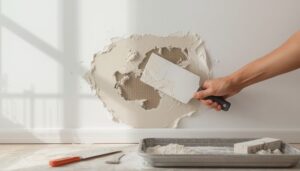
Step 2: Apply paper tape with all-purpose compound. The compound goes on first (about 1/8-inch thick), the tape goes on top, and then you squeegee the excess compound out from under the tape with a 6-inch drywall knife. The tape should be completely embedded — no dry spots, no bubbles. Dry spots under the tape are where the next crack will start.
Step 3: Three coats of compound, each wider than the last. First coat: 6-inch knife, just covering the tape. Second coat: 10-inch knife, feathering out about 6 inches on each side. Third coat: 12-inch knife, feathering about 12 inches. The goal is to make the repair invisible by creating a very gradual hump that catches no light. If you can feel the repair with your eyes closed, you need another coat.
Step 4: Sand with 220-grit, prime, and paint. If you can still see the repair from any angle after painting, the feathering wasn’t wide enough. A good drywall repair is 24 inches wide for a 2-inch crack.
It’s been two winters since I fixed that ceiling crack properly with tape instead of spackle. It hasn’t come back. The truss still lifts every December — I can’t stop that — but the paper tape flexes with the movement instead of cracking. Spackle has no flex. That’s the difference.
I keep a bucket of USG all-purpose compound under my workbench now, next to the spackle. Spackle is for nail holes. Compound is for anything bigger than a dime. Using the wrong one means doing the job twice.