
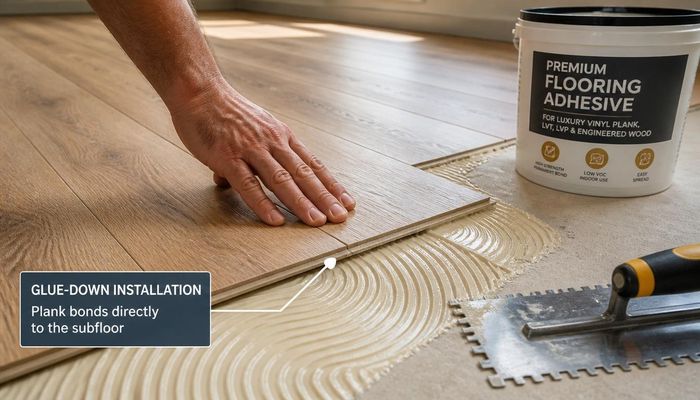
The Bostik adhesive had about four minutes of open time, and I didn’t know that until I was halfway across the living room with a trowel in one hand and my phone flashlight in the other because the sun had set three hours ago. My wife walked in, looked at the 37 half-laid planks, the bucket of rapidly skinning-over glue, and the expression on my face, and just turned around and left. She knew.
That was 2018. The floor was a glue-down luxury vinyl plank from Shaw, a wood-look product that cost about $3.25 a square foot. The adhesive was Bostik’s Best, a urethane-based glue that I chose because the guy at Floor and Decor said it was the good stuff. He wasn’t wrong. It’s excellent adhesive. What he didn’t mention was that the good stuff skins over fast in a 72-degree room with the AC off, and if you spread more than about 15 square feet at a time, you’re going to lose the bond window on the far end before you can lay the planks.
I finished that floor at 2:30 in the morning. It looked fine. Three months later, two planks near the fireplace popped loose. I had hit the glue after it skinned over and the bond was weak. I had to pry them up with a putty knife, scrape the subfloor, and glue down replacements. Nobody noticed except me, but I knew. Every time I walked past that spot I could feel the faint hollow sound under my heel.
I’ve installed flooring four different ways since then and I have opinions.
Glue-Down vs Floating: The Fight Worth Having
Floating floors are the gateway drug of DIY flooring. They click together, they sit on a thin foam underlayment, and you don’t need a trowel or a respirator. I’ve installed floating LVP in three bedrooms and a hallway and it took me a weekend per room with no drama. The planks lock together, the floor floats on the subfloor, and if you mess up a plank you just unclick it and grab another one.
Glue-down is the opposite of that. Every plank is a commitment. You can’t unclick anything. The glue grabs hold within minutes and after about 24 hours of cure time, that plank is now part of the house. You want to change the floor later? You’re going to need a floor scraper — the kind with a 6-foot handle and an 8-inch blade that you ram into the edge of each plank with your body weight. I’ve done it. It took two full days to remove about 400 square feet of glued-down vinyl from a concrete slab, and my back hurt for a week.
So why would anyone glue down a floor? Three reasons, and they’re all real.
First: concrete slabs. If you’re installing over concrete, especially below grade, you have moisture coming up through the slab. A floating floor over a vapor-barrier underlayment can work, but if that moisture barrier gets punctured or the perimeter isn’t sealed properly, moisture wicks up between the underlayment seams and the floor starts cupping or the locking joints fail. Glue-down with the right adhesive seals the slab surface. The glue itself becomes part of the moisture barrier.
Second: heavy stuff. I have a 400-pound gun safe in my office and a 200-pound antique desk in the living room. Floating floors don’t love concentrated weight over time — the planks can separate at the locking joints or develop gaps as the underlayment compresses unevenly. Glue-down doesn’t care. The planks are bonded to the subfloor and they’re not going anywhere.
Third: sound. Floating floors have a hollow tap when you walk on them. It’s not loud, but it’s there, and in a quiet house you hear it. Glue-down floors sound solid because they are solid — there’s no air gap between the flooring and the subfloor. In my basement, which is a converted music room, you can absolutely hear the difference between the glued-down LVP in the main area and the floating laminate in the hallway off to the side.
The Glue Makes or Breaks Everything
I’ve used three adhesives and they’re not interchangeable.
Bostik’s Best is a urethane adhesive, about $45 a gallon, coverage roughly 40 to 50 square feet per gallon with a 1/16 by 1/16 by 1/16 V-notch trowel. It grips like death and it’s moisture-cured, which means it actually needs some humidity to set properly — great for concrete slabs. The downside is the open time. You get 15 to 30 minutes of working time but the surface skins in about 5 to 10. You need to work in small sections and back-lay toward yourself so you’re not reaching over wet glue. The smell is strong. I use a respirator with organic vapor cartridges now, the same one I use for spray finishing. About $35 at Home Depot.
Roberts 2057 is a pressure-sensitive acrylic adhesive, about $28 a gallon. The difference is you spread it, let it dry clear — usually 30 to 45 minutes — and then it’s tacky but not wet. You can lay planks onto it and they stick immediately but you can also peel them back up and reposition them for a few minutes after. This is what I should have used on my first job. The open time is essentially infinite once the glue has flashed off. You can spread the whole room, go eat lunch, come back, and start laying. Much more forgiving for a solo DIYer.
SikaBond-T21 is a two-part epoxy adhesive I used on a commercial kitchen floor that needed chemical resistance. About $90 per unit and you mix it in the bucket with a drill paddle. Overkill for residential but worth knowing about if you have an unusual situation. The bond strength is absurd — I’m pretty sure you could hang a car from a single plank.
Subfloor Prep: The Part Nobody Wants to Hear
Here is the single most useful thing I can tell you about glue-down flooring: if you can feel the subfloor imperfection with your bare foot, it will telegraph through the vinyl. Not maybe. Not sometimes. Always.
I run my hand over every square foot of subfloor before I glue anything down. If I feel a high spot — a drywall mud drip, a nail head proud of the surface, a seam between plywood sheets that’s not dead flush — I sand it or scrape it. If I feel a low spot deeper than about a sixteenth of an inch, I fill it with a cement-based floor patch like Henry 547 or Ardex Feather Finish. The Feather Finish is about $25 for a 10-pound bag and it feathers out to nothing at the edges, which means you don’t get a hump where the patch meets the subfloor.
On concrete, moisture testing is non-negotiable. Tape down a 2×2-foot square of clear plastic sheeting with all four edges sealed tight and leave it for 24 hours. If there’s condensation on the underside or the concrete has darkened underneath, you have a moisture problem. The fix is either a moisture-mitigating primer like Mapei Eco Prim Grip or you switch to a floating floor with a proper vapor barrier. I’ve done both. The primer route works fine but adds about 50 cents a square foot to the job.
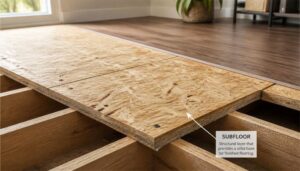
On wood subfloors, you need a smooth, sanded surface. I use 1/4-inch underlayment-grade plywood over the structural subfloor, stapled down with a pneumatic stapler every 4 inches on the perimeter and 6 inches in the field. The seams get filled with floor patch and sanded smooth. Takes about a day for a 12×12 room. Worth it.
Peel-and-Stick vs Full-Spread: Know the Difference
Peel-and-stick vinyl planks and tiles have the adhesive pre-applied on the back. You peel the release paper and press them down. I’ve used them twice — once in a small bathroom and once in a laundry closet. They’re fine for those spaces. The bathroom install took me about three hours and it still looks decent after four years.
But peel-and-stick is not the same thing as full-spread glue-down. The adhesive is pressure-sensitive and less aggressive. Over time, especially in rooms with temperature swings, the corners can start to lift. The laundry closet had a plank curl at one edge after about two years because the dryer vent hose runs behind that wall and the warmth softened the adhesive just enough.
For anything larger than a half bath or a closet, I’m spreading glue with a trowel. And I’m using the Roberts pressure-sensitive stuff unless the situation demands urethane. My back hates me for the scraping I’ll have to do someday, but the floor stays flat.
I still have half a gallon of that Bostik’s Best in the garage, crusted around the lid, hard as a rock. It’s been there since 2018. Every time I see it I remember that night with the phone flashlight and the skinned-over glue and the look on my wife’s face. Some lessons you only need to learn once.
Would you recommend this for a DIYer with moderate experience, or better to hire a pro?
Exactly the kind of practical info homeowners need. Clear, concise, and actionable.