I Installed the Wrong Floor in My Basement
Five years ago I finished my basement and put down laminate flooring. I was proud of myself — it looked great, the click-lock installation went smoothly, and I’d saved a few hundred bucks compared to vinyl plank. Then the water heater leaked. Just a slow seep from the pressure relief valve, barely enough to notice. Within three days, six planks near the utility closet had swollen at the seams and the surface started bubbling. The core — that high-density fiberboard — had soaked up water like a sponge. There’s no fixing that. You pull it up and start over.
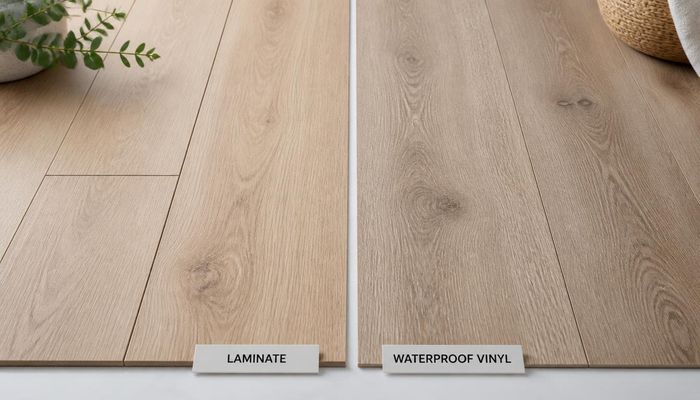
That’s how I learned the hard way: laminate and vinyl plank look similar on the shelf, but they’re completely different materials, and picking the wrong one for the room will cost you.
What They’re Actually Made Of
Laminate is wood-fiber-based. It’s got a melamine wear layer on top, a printed design layer underneath that, a high-density fiberboard core, and a stabilizing backer. The HDF core is what gives laminate its rigidity and solid feel underfoot — and it’s also what swells and crumbles when water gets past the seams.
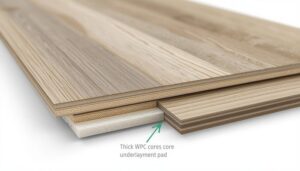
Vinyl plank — what the industry calls LVP or luxury vinyl plank — is plastic through and through. PVC backing, a rigid SPC or WPC core, a printed design layer, and a clear wear layer on top. Water doesn’t affect it. You could submerge it. I’ve seen planks pulled out of a flooded bathroom that snapped right back into place after drying.
What I Actually Paid
Laminate runs $1 to $3 per square foot for material. Installation adds $2 to $4 if you hire it out, so you’re looking at $3 to $7 per square foot installed. I did my basement myself, so material was my only cost — about $600 for 300 square feet of a mid-range AC4-rated laminate.
Vinyl plank costs more. Material is $1.50 to $5 per square foot, and pro installation adds $2 to $5, bringing you to $3.50 to $10 per square foot installed. That extra couple of dollars per square foot is essentially a waterproofing premium. Looking back, I should have paid it.
| Quality Tier | Laminate Installed | Vinyl Plank Installed |
|---|---|---|
| Budget (under 8mm laminate; under 12 mil LVP) | $2-$4 | $3-$5 |
| Mid-range (8-12mm laminate; 12-20 mil LVP) | $3-$6 | $4-$7 |
| Premium (12mm+ laminate; 20+ mil LVP) | $5-$8 | $6-$10 |
How Long They Last in Real Life
Quality laminate with an AC4 rating or higher should last 15 to 25 years in a residential setting. The same goes for vinyl plank with a 20-mil or thicker wear layer. In my experience, most people replace flooring because they’re tired of the look, not because it’s structurally failed. The exception is water. I’ve seen laminate destroyed in a weekend by a dishwasher leak. Vinyl plank in the same situation just needs to be dried off.
Installing It Myself
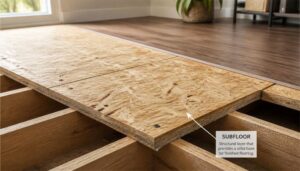
Both materials use click-lock floating installation, and both are genuinely DIY-friendly. I’ve laid about 800 square feet of each over the years. The process is nearly identical: prep the subfloor, roll out underlayment if it’s not pre-attached to the planks, let the material acclimate for 48 hours, then start clicking rows from the longest wall. You need a tapping block, a pull bar, a rubber mallet, and something to make cuts — I use a miter saw with a fine-tooth blade and it cuts through both materials cleanly.
Plan a full day for every 400 square feet. The cuts around door frames and vents take longer than the field. With laminate, I’m more careful about leaving the expansion gap at every wall and obstruction because the HDF core does move with temperature changes. LVP is more forgiving since the rigid core is dimensionally stable.
Where I’d Use Each One Now
After my basement disaster, here’s my personal rule:
| Room | My Pick | Why |
|---|---|---|
| Bathroom | Vinyl plank | Waterproof. No exceptions. |
| Basement | Vinyl plank | Moisture is always a risk below grade |
| Kitchen | Vinyl plank | Dishwasher, fridge, sink — too many water sources |
| Living room | Either | Both work fine here |
| Bedroom | Laminate | Cheaper, warmer feel underfoot |
| Home office | Laminate | Harder surface, chair mats roll better |
The Brands I’ve Actually Used
For laminate, I’ve had good results with Pergo TimberCraft and Mohawk RevWood Premier — both in the $3 to $5 per square foot range for material. For LVP, COREtec Plus and LifeProof Pro are my go-tos at $3 to $6 per square foot. The COREtec I put in my kitchen three years ago still looks brand new, and I have two kids and a dog who doesn’t understand that mud belongs outside.
Water, Hardness, and Looks — My Honest Take
On waterproofing: vinyl plank wins, no contest. Even laminate marketed as waterproof — like Pergo WetProtect — only protects the top surface for 24 to 72 hours. If water gets under a plank or into a damaged seam, the HDF core is done.
On hardness: laminate is firmer underfoot. The HDF core doesn’t give. Vinyl plank with an attached underlayment has a slight cushion. My parents, who are in their late sixties, prefer the vinyl plank in their kitchen because it’s easier on their knees. I prefer the laminate in my office because my chair doesn’t leave dents.
On looks: at the premium tier, laminate actually looks more realistic. The embossed-in-register texture — where the surface grain lines up with the printed pattern — is harder to achieve in vinyl. But at budget tiers, honestly, neither looks convincing. You get what you pay for.
On repairs: vinyl plank is easier to swap individual boards. You lift the row from the nearest wall and replace the damaged plank. Laminate can be swapped the same way, but the HDF core often cracks when you try to remove it, so you end up replacing the whole row anyway.
I still have laminate in my upstairs bedrooms and it’s fine. But anywhere water might show up, I’m team vinyl plank for life.