
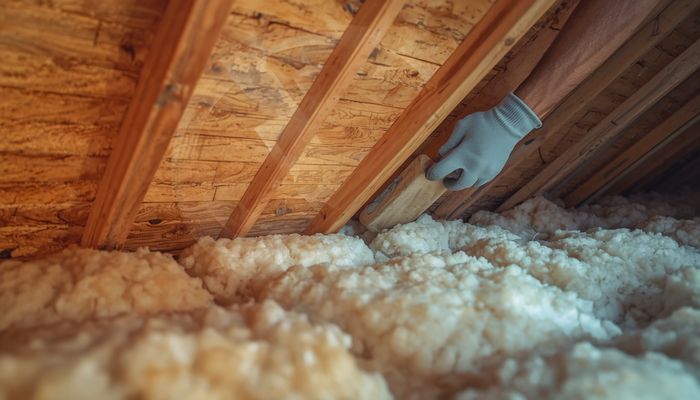
I used to think insulation was a solved problem. Buy the highest R-value that fits, stuff it in, enjoy lower bills. I did this three times in three different houses and got it wrong in three different ways before I understood that R-value is just one number in a much more complicated equation.
The first house, a 1920s bungalow with an unfinished attic, I bought 22 rolls of R-38 fiberglass from Lowe’s — Owens Corning pink batts, about $1,100 worth. I spent a weekend unrolling them across the attic floor, careful to butt the seams tight and not compress them. I skipped the air sealing. I didn’t caulk around the dozen recessed can lights poking through the plaster ceiling, didn’t foam the plumbing vent penetrations, didn’t box around the bathroom fan exhaust that was just dumping into the attic. I figured the insulation itself would block the airflow.
That winter, my heating bill barely moved. Maybe 8 percent lower. I went back up with a flashlight and found black streaks in the pink fiberglass — dust staining from air moving through the batts. Warm air from the house was literally blowing through the insulation. Fiberglass is an air filter, not an air barrier. Air was carrying heat right around the R-38 rating on the label. The R-value wasn’t the problem. The air leaks were.
That’s the first thing nobody tells you about R-value: it only works if the air isn’t moving. R-value measures resistance to conductive heat transfer — the slow migration of heat through a solid material. It says nothing about convective heat transfer, which is warm air physically moving through gaps and cracks. Convective losses can dwarf conductive losses. A 1/8-inch gap around a recessed light can move more heat than 10 square feet of R-38 insulation. One unsealed attic hatch is like leaving a window cracked open all winter.
I went back, pulled up all the batts, spent a full day with Great Stuff Pro foam and aluminum tape sealing every penetration, built an insulated box around the attic hatch, and reinstalled the fiberglass. The heating bill dropped 22 percent that month. Same R-value. Different house.
The Second Mistake: Compressing Batts
House number two was a 1970s split-level with 2×4 exterior walls. I tore out the old R-11 batts — they were full of mouse droppings and had slumped to about R-8 over 40 years — and bought R-15 batts (Owens Corning EcoTouch, high-density fiberglass designed for 2×4 cavities). I figured the label said R-15 for a 3.5-inch cavity, so I was getting R-15.
Here’s what I didn’t account for: wiring, plumbing, blocking, and the simple fact that batt insulation never fits perfectly. There were gaps along the sides of electrical boxes, compressed spots where wires ran diagonally through stud bays, voids behind blocking. Those small imperfections — maybe 5 percent of the total wall area — reduce the effective R-value by 25 to 30 percent according to studies from the Department of Energy and Oak Ridge National Lab. A wall that should be R-15 performs more like R-10 or R-11 in real conditions. That’s not the manufacturer lying. That’s physics.
The fix was not more expensive insulation. It was better installation. I paid a guy $400 to dense-pack cellulose into the walls instead — Owens Corning ProPink blown through holes in the drywall, which was then patched. Cellulose fills around wires and boxes. It self-settles to cover the irregular shapes. Installed density of 3.5 pounds per cubic foot gives about R-3.7 per inch, so a 2×4 wall hits about R-13 actual — and more importantly, it hits that R-value everywhere, not just between the studs. The thermal bridging through the studs (wood is about R-1.25 per inch) means a 2×4 wall with cavity insulation maxes out at roughly R-10 to R-12 effective anyway, regardless of what the batt label says.
The Third Mistake: Ignoring Thermal Bridging
This one I learned at a friend’s new construction. He used 2×6 walls with R-23 mineral wool batts — premium stuff, about double the cost of fiberglass. The calculated center-of-cavity R-value was R-23, which sounds great. But the studs in a standard-framed wall occupy about 20 to 25 percent of the wall area. Wood is roughly R-1.25 per inch, so a 2×6 stud is about R-6.8. Every stud is a thermal short circuit from inside to outside. The whole-wall R-value — the number that actually determines heat loss — was closer to R-16 or R-17.
If he’d added one inch of rigid foam on the outside of the sheathing (continuous insulation that covers the studs), even R-5 foam, the effective whole-wall R-value would have jumped by more than the foam’s R-value alone because the thermal bridge gets interrupted. This is why building codes are increasingly requiring continuous insulation — the IRC calls for R-5 continuous on the exterior in climate zone 5 and higher for new construction.
What R-Value Actually Tells You
Here’s what matters, stripped of the marketing:
R-value per inch is real and useful. Closed-cell spray foam at R-6.5 per inch means 3 inches delivers R-19.5. You need 6 inches of fiberglass or cellulose to hit the same number. In a tight space where you can’t add thickness — like a cathedral ceiling with limited rafter depth — R-value per inch is the deciding factor.
Aged R-value matters, especially in cold climates. Blowing agents in closed-cell foam and XPS rigid foam leak out over time. XPS (Dow Styrofoam, Owens Corning Foamular) starts at R-5 per inch but drifts down to about R-4.2 to R-4.5 over 20 years as the blowing agent dissipates and is replaced by air. Polyisocyanurate (polyiso) has a similar drift. EPS (expanded polystyrene) doesn’t have this problem because it uses air as the blowing agent from the start. It’s R-3.8 to R-4 per inch and stays there. If you’re comparing rigid foam prices, the aged R-value is the real number, not what’s on the label.
R-value doesn’t measure air sealing. This is the lesson from my bungalow attic. Fiberglass batts have excellent R-value per dollar — maybe the best of any insulation product. They’re also the most dependent on perfect air sealing because air moves right through them. Spray foam has a lower R-value per dollar but brings its own air barrier. Cellulose sits somewhere in the middle. You have to budget for air sealing separately with fiberglass and cellulose, or pay the premium for foam and get it included.
Moisture kills R-value. Wet fiberglass loses 30 to 50 percent of its insulation value. Wet cellulose more than that because it slumps. Wet spray foam — properly installed closed-cell, anyway — doesn’t lose its R-value because water can’t get into the cells. That doesn’t mean foam is always the answer. It means you need to think about moisture management as part of your insulation plan, not as an afterthought.
What I Actually Choose Now
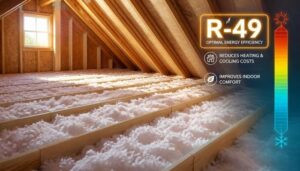
Attic floors: air seal every penetration and top plate, then blow in R-49 to R-60 of cellulose. It’s cheap — about 60 cents per square foot for the depth I need — and it does a better job filling around trusses and odd framing than fiberglass batts ever can. I rent the blower from Home Depot for free when you buy enough bags.
Rim joists: 2 inches of closed-cell spray foam from a pro. R-13 plus air sealing plus vapor barrier. About $1,400 for a typical basement. Worth every dollar if you have cold floors above.
Above-grade walls in a reno: if the drywall is off, I use mineral wool batts (Rockwool R-15 for 2×4 walls) because they’re rigid enough to friction-fit tightly, they’re hydrophobic so they don’t hold moisture, and they have better sound absorption. If I’m doing new construction, I add exterior continuous insulation — at least R-5 of polyiso or EPS — to break thermal bridging.
Basement walls: rigid XPS foam against the concrete first, then a stud wall with unfaced batts. I don’t chase the highest R-value here. I chase moisture safety first, then reasonable insulation.
The number I actually care about is the one on my heating bill, not the one on the insulation package. Chasing R-value without fixing air leaks is like buying a thicker coat but leaving it unzipped. I’ve done it. It doesn’t work.

Can insulation be added without tearing down walls? Our house is finished and we don’t want to open everything up.
We always upgrade insulation in flips. The cost is minimal and it’s a big checkbox for home inspectors.