The first January in our new house, I woke up to ice on the inside of my bedroom window. Not condensation — actual ice crystals, feathery and delicate, growing on the glass like something from a Christmas card. The thermostat was set to 72 but the furnace had been running for three hours straight and the room still felt like a walk-in cooler. When the heating bill arrived at the end of the month, it was $390. For a 1,600-square-foot ranch house. I knew right then that something was deeply wrong with the insulation.
I grabbed a flashlight, pulled down the attic ladder in the hallway ceiling, and climbed into a space I had avoided since the home inspection. What I found made me angry. The attic had maybe three inches of fiberglass batt insulation — thin, matted, and discolored from years of air movement and what looked like mouse traffic. In some spots I could see the drywall of the ceiling below. I was essentially paying to heat the sky above my roof.
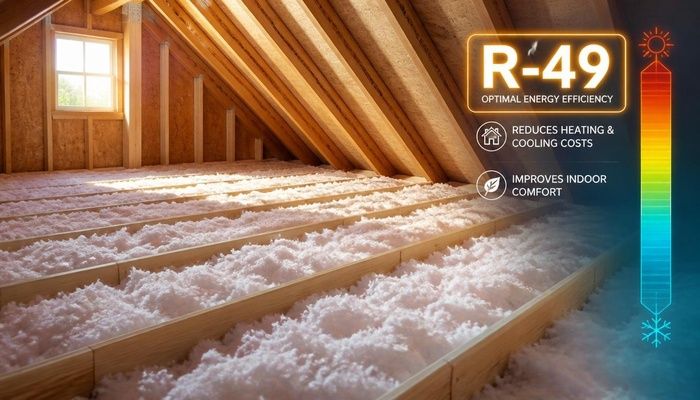
That discovery sent me down the R-value rabbit hole. R-value, if nobody has ever explained it to you, is simply the measure of how well a material resists heat trying to pass through it. The higher the number, the better the insulation. Think of it like the warmth rating on a sleeping bag — a summer bag might be rated for 40 degrees; a winter bag for zero. My attic, with its sad three inches of ancient fiberglass, was about R-11. For my climate zone, the Department of Energy recommends R-49 to R-60. I was operating at roughly twenty percent of where I needed to be.
The Department of Energy divides the country into climate zones. If you live in the Deep South, your attic needs R-30 to R-49. The middle of the country needs R-38 to R-60. The northern tier needs R-49 to R-60. I live in zone five, right in that middle band where winter is real but not brutal. R-49 was my minimum. I had R-11. The math was not complicated.
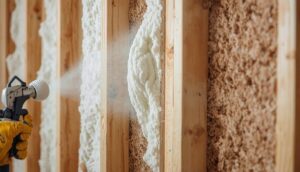
I got two quotes from insulation contractors. The first was $2,600 for blown-in cellulose. Nobody quoted spray foam, which is just as well — I had already ruined my rim joists with a DIY foam kit. The second was $3,100 for blown-in fiberglass. Both would bring my attic to R-49. Both seemed reasonable for a professional job, but I am the kind of person who sees a price tag and immediately wonders whether I can do it myself for a third of the cost. The answer, as it turned out, was yes.
Home Depot sells blown-in fiberglass insulation by the bag. Owens Corning Atticat, the brand I used, covers about 41 square feet per bag at R-49 on top of existing insulation. For my 1,600-square-foot attic, I needed 22 bags at roughly $32 each — about $700 total. The store lends you the blowing machine for free when you buy a minimum number of bags, which I easily met. I also picked up two sheets of plywood to use as a crawling platform, a box of soffit vent baffles at $1.80 each, goggles, an N95 respirator, and work gloves. All in, I spent about $810.
The baffles matter more than you would think. Soffit vents are those little slots under your eaves that let outside air circulate through the attic. If you blow insulation right over them, you trap moisture, your roof decking rots, and you have a five-figure problem a few years down the road. The baffles are foam channels that staple between the rafters and keep a clear airway from the soffit up into the attic. Installing them meant I had to crawl to the very edge of the roof where the attic meets the eaves — the most cramped, dusty, spider-filled part of the entire project. It took an hour. It was unpleasant. It was also the best eighty dollars I have ever spent on preventive maintenance.
My wife fed the bags into the hopper in the garage while I crawled through the attic with the hose. We worked out a communication system with the framing hammer — two taps on a joist meant stop the machine, three taps meant send the next bag. The machine roars like a jet engine and you cannot hear a human voice over it, but the joist is a solid piece of wood and the vibrations travel beautifully. The actual blowing is weirdly satisfying. A stream of fluffy gray insulation shoots out of the hose like a snow machine, and you just walk it back and forth across the joist bays, watching it pile up. I had marked lines on the joists with a Sharpie at 14 inches — the depth I needed to hit R-49 on top of the existing batts. When the insulation reached the line, I moved on.
I made one catastrophic mistake. About three hours in, tired and sweaty in my Tyvek suit and respirator, I stepped off the plywood and put my foot directly through the drywall into the bedroom below. My wife heard the crunch from the garage and later described it as the sound of a large bag of potato chips being stepped on. The hole was about the size of a dinner plate. Fixing it required a drywall patch kit, joint compound, and a very sheepish apology. I bought two more sheets of plywood the next day and never stepped on an unshielded joist again. Learn from me: the plywood you stand on is just as important as the insulation you are installing.
We finished all 22 bags in about five hours. I showered for so long the hot water ran out. The attic went from a sad, patchy layer of dingy pink to a deep, even blanket of fresh gray fluff that rose well above my ankles. When I closed the attic hatch that evening, I could feel the difference standing in the hallway — the ceiling did not feel cold to the touch anymore.
The results were not subtle. The upstairs bedrooms, which had always run five to seven degrees colder than the rest of the house, felt comfortable within two days. The furnace, which used to cycle on every fifteen minutes in cold weather, now stayed off for an hour at a time — and a smart thermostat took another slice off the bill after that. The next full-month heating bill was $218 — down from $390. That is a forty-four percent reduction. Over the course of a year, including summer air conditioning savings I had not even considered, I estimate the project saves me between nine hundred and twelve hundred dollars annually. It paid for itself before the snow melted.
If you are reading this and wondering whether your attic needs more insulation, go look. Right now, if you can. Measure the depth of what is there. Multiply by the R-value per inch for your material — fiberglass batts are about R-3.2, blown-in cellulose is R-3.5, rockwool is R-3.3. Compare that number to what your climate zone requires. If the gap is anything like mine was, you are burning money every month the furnace runs. A Saturday in the attic, a few hundred dollars in bags, and a partner willing to feed the hopper can change your entire relationship with winter.