
The Outlet That Shocked Me Because I Didn’t Check the Other One
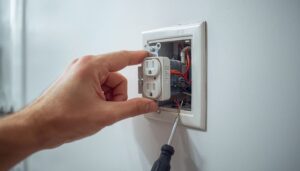
I was replacing a worn-out outlet in my son’s bedroom. I turned off the breaker, tested the outlet with my voltage tester (dead), unscrewed the faceplate, and pulled the outlet out of the box. Then I touched the side of the metal box with the back of my hand and felt a sharp tingle — not a full shock, but an unmistakable “something is still live” warning.
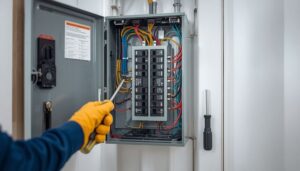
The outlet was on a three-way circuit. One breaker controlled the top half, another circuit passed through the box to feed the next room. I had turned off one breaker, not both. The wires from the second circuit were still live inside the box. This is how people get hurt doing “simple” outlet replacements. Here’s how to avoid it.
What I Check Before Touching Any Wire
Turn off the breaker and test every wire. Not just the outlet — every wire in the box. Use a non-contact voltage tester (Klein NCVT-2, $20) and touch it to every wire, every screw terminal, and the metal box itself. A glowing red light and beeping means the circuit is live. No light, no sound — and then I double-check by testing a known live circuit to make sure the tester is working.
Understand split outlets. In kitchens and sometimes bedrooms, the top and bottom of a duplex outlet may be on different circuits. Look for the little metal tab between the two brass screws on the side of the old outlet — if it’s broken off, the outlet was split. You may need to turn off two breakers.
Watch for pass-through wiring. An outlet box is often a junction point where wires from one circuit pass through to feed downstream outlets. Just because the outlet is dead doesn’t mean the box is safe. If you see wire nuts with multiple wires bundled together, those may be on a different circuit. Test them.
The Actual Replacement
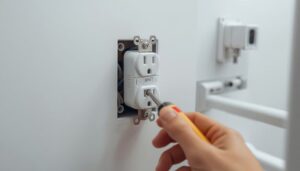
Replacing an outlet takes about 10 minutes once the power is confirmed off. Remove the old outlet (unscrew the top and bottom screws, pull it out), note which wire goes where (take a picture with your phone — the one time you don’t is the time you’ll forget), and transfer the wires to the new outlet.
Back-wiring vs side-wiring: New outlets have two ways to connect wires. Back-wiring (or “back-stab”) means pushing the stripped wire into a hole in the back of the outlet — it’s fast but unreliable. The spring clamp inside loosens over time and creates loose connections that arc and overheat. Side-wiring means wrapping the wire around the screw terminal and tightening it down — it’s slower but much more secure. I side-wire everything now. The screw should be tight enough that you can’t wiggle the wire loose with your fingers.
Pigtails vs daisy-chaining: If there are two sets of wires in the box (incoming power and outgoing to the next outlet), don’t rely on the outlet itself to pass the current through. Create a pigtail — a short piece of wire connecting the incoming, outgoing, and a lead to the outlet, all joined with a wire nut. If the outlet fails, the downstream outlets still work. This is code in many places and good practice everywhere.
GFCI and AFCI: When to Use Which
Standard outlets ($2 each) are fine for bedrooms and living rooms. GFCI outlets ($15-20) are required anywhere near water — kitchens (within 6 feet of a sink), bathrooms, laundry rooms, garages, outdoors. They have “Test” and “Reset” buttons and trip when they detect current leaking to ground (like through a person standing in water).
AFCI outlets ($25-30) detect arc faults — the kind of electrical arcing that causes house fires. They’re required in bedrooms and living areas in new construction. If your house was built before 2014, you probably don’t have them. They’re worth adding in kids’ rooms and anywhere with old wiring.
Tamper-resistant outlets: Required by code everywhere now. They have internal shutters that block a child from sticking something into one slot. They cost about $3 each instead of $2. Buy them even if you don’t have kids — they’re code-compliant and the price difference is too small to argue about.
The outlet in my son’s room is now tamper-resistant, side-wired, and pigtailed. The voltage tester confirmed no power before I touched anything. The box is properly grounded (I added a grounding pigtail to the metal box — the old outlet was grounding through the mounting screws, which is allowed by code but unreliable). It took 15 minutes and cost $4 in parts. The tingle in my hand faded after about an hour. The lesson has lasted years.