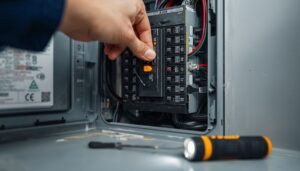
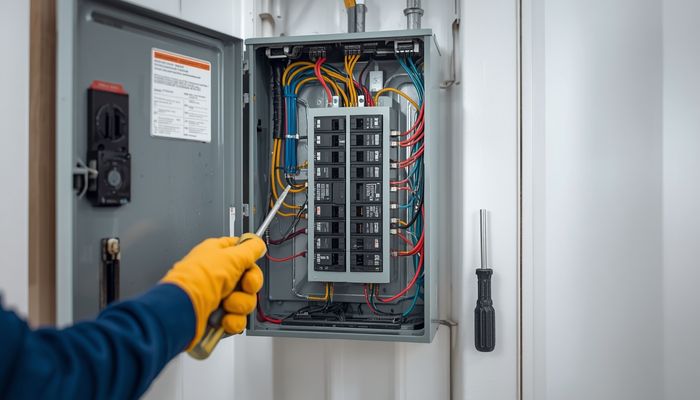
I’m not an electrician and I don’t pretend to be one. But when I bought my 1963 ranch house, the home inspector mentioned the electrical panel was “original equipment” and “worth keeping an eye on.” That was five years ago, and like most homeowner warnings, I filed it under “things I’ll deal with eventually.” Last summer, eventually came knocking. Literally — I heard a faint buzzing from the hallway closet where the panel lives, followed by a smell that I can only describe as hot fish. An electrician came out the next morning and showed me the charred bus bar behind one of the breakers. “You’re lucky,” he said. “These old Federal Pacific panels don’t always trip when they should.” He was right. That breaker had been carrying a load from our new mini-split AC and instead of tripping, it had been cooking.
What an Electrical Panel Actually Does
Your electrical panel — sometimes called the breaker box or load center — is the hub where power from the utility transformer enters your house and gets distributed to every outlet, light, and appliance. The main breaker at the top controls the whole thing; the individual breakers below each protect one circuit. Old homes often have 60-amp service, which was plenty in 1960 when nobody had air conditioning or microwaves. Modern homes typically have 100 or 200 amps, and large all-electric homes sometimes need 400. If you’re tripping breakers regularly, your lights dim when the AC kicks on, or you’re running extension cords because you don’t have enough outlets, your panel is probably undersized.
But it’s not just about amperage. Some older panel brands are genuinely dangerous. Federal Pacific Stab-Lok panels — which were installed in millions of homes from the 1950s to the 1980s — have a documented failure rate where breakers fail to trip under overload conditions. Zinsco and certain older Pushmatic panels have similar problems. If you’ve got one of these, replace it regardless of whether it seems to be working. The failure is silent until it isn’t.
What It Cost Me
I got three quotes for my upgrade. The job was a 100-amp to 200-amp service upgrade, which is the most common residential upgrade. The quotes ranged from $3,200 to $5,100. I went with the middle quote at $4,200 from a licensed electrician who’d done several houses in my neighborhood. That covered the new Square D QO panel with 40 spaces, a new meter base, new service entrance cable from the weatherhead down through the mast, all new breakers including AFCI breakers for the bedrooms (required by current code), the permit, and coordination with the utility to disconnect and reconnect service.
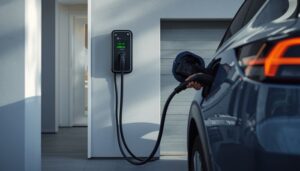
What blew my budget was the extras. The existing grounding system was inadequate — just a single ground rod that had corroded. Adding a second rod and bonding to the water main added $400. The drywall patch where the new larger panel went in cost another $350. And because we’d added circuits for the mini-split and an EV charger in the garage, those had to be done at the same time for another $900. Total came to $5,850. Painful, but still within the typical range: a 100A to 200A upgrade runs $2,500 to $5,500, and once you add code-mandated upgrades it can push higher.
If you just need a same-amperage swap — say replacing a dangerous 200A panel with a new 200A panel — you’re looking at $1,800 to $3,500. Adding a subpanel in a garage or workshop runs $1,000 to $2,500. Going from 200A to 400A is a major job at $4,500 to $10,000, and underground service conversion adds another $3,000 to $8,000 on top of everything else.
The Brands Worth Paying For
Square D dominates residential in the US — their QO line is the gold standard with a visual trip indicator and copper bus bars, while Homeline is the budget-friendly version that’s still perfectly solid. Eaton makes the CH and BR lines, both well-respected. Siemens rounds out the big three. Any of these properly installed will last 30 to 50 years. Individual breakers should be replaced after 20 to 40 years because thermal-magnetic mechanisms wear out from heat cycling and vibration.
One thing I learned from the electrician: don’t mix brands in a panel. Using an Eaton breaker in a Square D panel technically violates the UL listing and can give your insurance company an excuse to deny a claim if something goes wrong. Stick with what the panel is rated for.
Don’t Even Think About DIY
I do a lot of my own home repairs, but electrical panel work is in a different category. In every US jurisdiction, a service upgrade requires a licensed electrician, a permit, and an inspection. The utility company has to come out and physically disconnect the service drop before anyone touches the panel. Then they have to come back to reconnect after inspection. There is no legal pathway to DIY this. Even swapping a single breaker in an existing panel is pushing it for most homeowners — the exposed bus bars inside a live panel carry lethal current. Hire this one out and sleep at night.
That buzzing sound from my hallway closet is gone now. So is the fish smell. The new panel hums quietly and I don’t give it a second thought — which is exactly how it should be. If you’ve got an old panel, especially one of the known-dangerous brands, call an electrician for a quote before your house reminds you the hard way.