My wife plugged in the vacuum. The bedroom circuit went dead. I walked to the basement, reset the AFCI breaker, walked back upstairs. She plugged the vacuum in again. Pop. Walked back downstairs. Reset. Upstairs. Vacuum. Pop. Downstairs. This went on six times before I realized the breaker wasn’t faulty — it was doing exactly what it was designed to do.
Our vacuum was a fifteen-year-old Hoover with a brushed motor that threw electrical noise back onto the circuit like a tiny radio jammer. The AFCI in my Square D QO panel was interpreting that noise as an arc fault and killing the power because that’s its job. I didn’t know any of this at the time. I just knew I’d spent $55 on a breaker that wouldn’t let me clean the bedroom.
That was my introduction to AFCI breakers. I’ve since replaced six of them in my 1970s house, diagnosed three nuisance-tripping circuits, and learned enough to know when I’m over my head. Here’s what I wish someone had told me before I started.
What an AFCI Actually Does
An arc-fault circuit interrupter doesn’t care about overloads. Your standard breaker handles that — too many amps, bimetal strip heats up, breaker trips. AFCIs are looking for something completely different: the electrical fingerprint of an arc.
An arc happens when electricity jumps through air between two conductors that should be touching — or through a broken conductor that’s barely hanging on. Think frayed lamp cord inside a wall, a staple that pierced the Romex when some electrician got careless in 1987, or a loose wire nut that’s been vibrating for twenty years. The arc generates intense heat at a tiny point, thousands of degrees, enough to ignite wood framing or insulation in milliseconds. Your standard breaker will never catch this because the current draw isn’t high enough to trip it.
The AFCI has a tiny microprocessor inside that’s constantly sampling the AC waveform. Normal current looks smooth and sinusoidal. An arc is chaotic — it has high-frequency spikes and flat spots where the arc extinguishes and restrikes 120 times a second. The breaker’s algorithm looks for that chaos signature. When it sees it, it trips in under a tenth of a second. Before the fire starts.
These things have been required in bedrooms since NEC 2002, expanded to most living spaces in 2014, and now cover practically every indoor 120-volt circuit in new construction. If your house was built before 2002, you probably don’t have any. If it was built after 2017, you’ve got them on almost everything.
The Nuisance Tripping Problem Is Real
My vacuum wasn’t the only problem. My treadmill on the living room circuit tripped the AFCI every third run. My circular saw on the garage circuit tripped it on startup roughly half the time. And for about two weeks, the upstairs lights would randomly trip at 4 PM — turned out to be a dimmer switch failing in a way that looked exactly like arcing to the breaker.
Nuisance tripping is the reason a lot of electricians hated AFCIs when they first appeared. The early ones from the mid-2000s were terrible — they’d trip on ceiling fans, power tools, even some LED bulbs. Modern units, especially Square D’s QO series and Eaton’s CH series, are dramatically better. The filtering algorithms improved a lot after 2015. If you have first-generation AFCIs that are over 15 years old and they’re tripping constantly, replacing them with modern units usually solves the problem.
When I get a tripping AFCI now, I diagnose it systematically. First, I unplug everything on the circuit and see if it still trips. If it doesn’t, I plug things in one at a time until I find the culprit — circuit analyers are great for this, but the “unplug everything” method is free. If it does trip with nothing plugged in, the problem is in the wiring itself. That’s when I call an electrician, because finding an intermittent arc in a wall is not a homeowner game.
One thing I learned the hard way: shared neutrals will drive an AFCI insane. In older houses, it was common to run two circuits sharing one neutral wire back to the panel. AFCIs can’t handle this — they see current going out on the hot that isn’t coming back on their own neutral and they trip instantly. If you install an AFCI and it trips immediately with nothing on the circuit, check for a shared neutral. You’ll probably need to pull new wire, and that’s definitely electrician territory.
What They Cost and What I’d Pay For
A single-pole AFCI breaker runs $45 to $70 depending on brand and where you buy it. I paid $55 for my Square D HOM115AFC at Home Depot. The combination AFCI/GFCI units — which give you arc protection and ground-fault protection in one breaker — run $65 to $110. Eaton’s BR series is usually the cheapest; Siemens QP falls in the middle; Square D QO is the most expensive but has the lowest nuisance trip rate in my experience.
Electricians charge $100 to $200 per circuit to install one, including the breaker. A whole-house retrofit of 15 to 25 circuits runs $1,500 to $2,500. That sounds like a lot until you compare it to what a house fire costs.
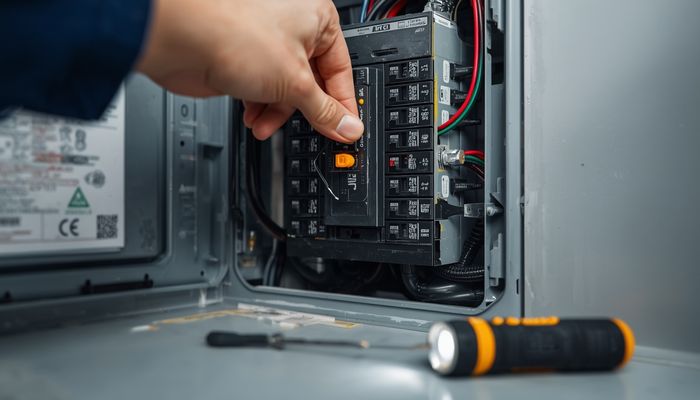
I’ve installed five of my own and I’m comfortable doing it, but I won’t recommend it to anyone else. Even with the main breaker off, the lugs where the service entrance cable connects to the panel are still live. Touch one of those and you won’t get a second chance. Most jurisdictions require a licensed electrician for panel work anyway. If you do it yourself anyway, at minimum, wear rubber-soled shoes, stand on a dry board, work with one hand in your pocket, and use an insulated screwdriver. And don’t touch anything except the breaker you’re swapping.
When to Call an Electrician
Call one if you’re not 100% sure your panel is dead. Call one if the breaker trips immediately with nothing plugged in — that’s a wiring fault. Call one if you have a Federal Pacific or Zinsco panel, because those panels are fire hazards and nothing you do to them will make them safe. And call one if you’re selling your house and the inspector flags the lack of AFCIs — let the electrician handle the retrofit paperwork.
The AFCIs in my house have tripped maybe three times in the past two years, and all three times it was a real thing: a frayed extension cord behind the couch, a loose outlet where the wire had backed out of the stab-in terminal, and a lamp switch that had been arcing internally for who knows how long. The breakers caught all three before I noticed anything was wrong. That’s the thing about AFCIs — when they work right, you never know they’re there. You just don’t have an electrical fire.
I still have my old Hoover. I just run it on the bathroom circuit now, which isn’t on an AFCI. Some problems you solve with knowledge. Others you solve by plugging the vacuum in somewhere else.