Ceiling Fan Installation Tips for DIYers
TL;DR: A ceiling fan provides air circulation that lets you raise summer thermostat settings 4-7 degrees without losing comfort, cutting cooling costs 8-12%. Installed cost is $200-$700 for the fan and $100-$400 for labor, totaling $300-$1,100. Modern DC-motor fans last 15-25 years. Top brands: Hunter, Casablanca, Big Ass Fans, Hampton Bay, and Minka Aire. Replacing an existing ceiling fan in a fan-rated box is a confident DIY project; installing a fan where only a light fixture box existed requires a fan-rated box upgrade and is sometimes a job for an electrician.
What Is Ceiling Fan Installation?
A ceiling fan is a motor-driven blade assembly mounted to a ceiling junction box, moving air via downdraft or updraft to improve perceived comfort. Modern fans use either AC induction motors (60-80 watts, lower cost) or DC motors (15-35 watts, premium, quieter, smart-compatible). Standard residential blade spans are 42-60 inches; great rooms and outdoor patios use 72-84 inch fans.
How Much Does Ceiling Fan Installation Cost?
A ceiling fan installation totals $300-$1,100, with the fan at $100-$700 and electrician labor at $100-$400. Replacing an existing fan with a similar-style fan is $150-$300 in labor. Adding a new fan where only a light existed requires upgrading to a fan-rated junction box and may require rewiring; $250-$600 in labor.
| Job | Total Installed |
|---|---|
| Replace existing fan, same controls | $250-$500 |
| New fan in existing light box (upgrade box) | $400-$700 |
| New fan + wall control + remote | $500-$900 |
| Premium DC motor fan (Big Ass, Casablanca) | $600-$1,500 |
| Outdoor / wet-rated patio fan | $400-$900 |
How Long Does Ceiling Fan Installation Last?
Quality ceiling fans last 15-25 years. AC motors typically wobble or develop bearing noise at 10-15 years; DC motors run quietly for 20+ years. Pull chain switches fail at 5-10 years and are inexpensive to replace ($10-$20 part). Light kits with integrated LEDs may need replacement at 10-15 years (the bulbs are not user-replaceable in many modern fans).
Can I DIY Ceiling Fan Installation?
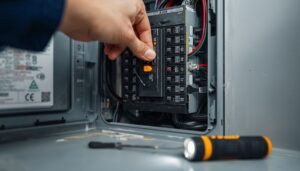
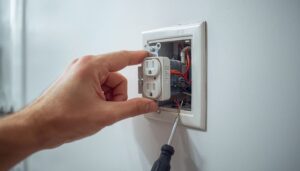
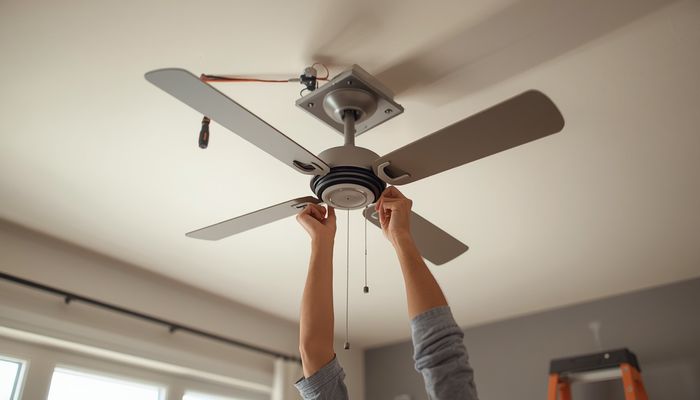
Replacing an existing ceiling fan with a similar style fan is a strong DIY project. Plan 60-90 minutes: turn off the breaker, remove the old fan (canopy, then the down-rod or flush mount, then the bracket from the box), verify the existing junction box is fan-rated (stamped with the maximum fan weight, typically 35 or 70 lbs), install the new bracket, wire per the diagram (black-to-black, white-to-white, ground to ground, plus blue or red for separate light control), hang the motor housing, attach blades, install the light kit, restore power.
Upgrading a non-fan-rated box to a fan-rated box requires opening the ceiling drywall and installing a fan-rated brace box (Westinghouse, Carlon, Slater work for retrofit through small holes). New fan circuits or moving the switched wire location to support a wall-mounted fan control require electrician work in most jurisdictions.
What Are the Best Ceiling Fan Installation Options?
Hunter and Casablanca (same parent company) dominate the U.S. ceiling fan market for residential. Big Ass Fans (Haiku) lead the premium and great-room category. Hampton Bay is the Home Depot value brand; Hunter is the mainstream quality pick at most price points. For most homeowners, a Hunter Builder 52-inch with light kit at $80-$140 covers a 10×15 bedroom; a Hunter Newsome or Casablanca Stealth 52-inch DC at $200-$350 is the quiet premium pick.
| Brand | Notable Model | Span | Motor Type | Price |
|---|---|---|---|---|
| Hunter | Builder Series | 52 in | AC | $80-$140 |
| Hunter | Newsome | 52 in | DC | $200-$350 |
| Casablanca | Stealth DC | 54 in | DC | $300-$500 |
| Big Ass Fans | Haiku | 52-84 in | DC | $700-$1,500 |
| Minka Aire | Light Wave | 52 in | DC | $300-$500 |
When Should I Replace or Upgrade Ceiling Fan Installation?
Replace a ceiling fan when: wobble cannot be balanced (blade balance kits should solve mild wobble; severe wobble after balancing means bent blades or worn bearings), the motor hums loudly even on the lowest speed (failing capacitor or motor), the light kit no longer functions and bulbs are non-replaceable, the remote or wall control no longer reliably triggers the motor, or you are remodeling for a different look.
What size ceiling fan do I need?
Match blade span to room size: rooms up to 75 sq ft use 29-36 inch fans; 76-144 sq ft use 36-42 inch; 144-225 sq ft use 44-50 inch; 225-400 sq ft use 50-54 inch; over 400 sq ft consider 60-72 inch or two smaller fans. Ceiling height matters too: 8-9 foot ceilings use flush or hugger mount; 9-10 foot ceilings use short downrod; over 10 feet use long downrod for proper blade-to-floor clearance.
AC motor vs DC motor: which should I buy?
DC motors are quieter, use 60-70% less electricity, run cooler, and integrate better with smart controls and remotes. They cost $100-$200 more upfront. For bedrooms (noise matters) and high-use fans, DC pays back in 5-10 years through electricity savings. For occasional-use fans, AC is fine.
Which direction should my ceiling fan rotate?
In summer (cooling mode), rotate counterclockwise viewed from below to push air down for direct cooling. In winter (warming mode), rotate clockwise at low speed to pull cool air up and push warm air at the ceiling down along the walls. Most fans have a switch on the motor housing to reverse direction.
Why does my ceiling fan wobble?
Most often: unbalanced blades. Use a fan balance kit ($5-$10): rotate the fan slowly and identify the wobble direction, attach the included clip to a blade tip and test; move the clip until the wobble is reduced. Other causes: warped blade (replace as a matched set), worn motor bearings (replace fan), or improperly seated mounting bracket.