Outlet Replacement Safety and Tips
TL;DR: Replacing a worn or outdated electrical outlet is one of the most common minor electrical jobs. DIY cost is $2-$10 for the outlet and $2-$5 for a replacement cover plate. Professional cost is $80-$200 per outlet. Standard 15A outlets last 15-30 years. Top brands: Leviton, Eaton, Pass & Seymour (Legrand), and Hubbell. Replacing an existing outlet is a confident DIY project for any homeowner who has worked with a breaker box; modern codes (2008+) require tamper-resistant outlets (TR) throughout the home, GFCI in wet locations, and AFCI in most living areas.
What Is Outlet Replacement?
A standard residential outlet (receptacle) is a duplex 120V device installed in a junction box and connected to a branch circuit via the hot, neutral, and ground wires. Modern outlets are typically 15A (most rooms) or 20A (kitchen counter, bathrooms, garage). Code requires tamper-resistant (TR) outlets, which have spring-loaded shutters preventing object insertion. Wet locations require GFCI; bedrooms and living areas require AFCI protection (either at the outlet or breaker).
How Much Does Outlet Replacement Cost?
A standard 15A TR outlet costs $2-$8; a 15A GFCI costs $15-$30; a USB-C charging outlet costs $25-$50; a smart outlet costs $25-$70. Cover plates cost $1-$5. Electrician labor is $80-$200 per outlet for replacement, $150-$300 for new outlet runs. A typical whole-house outlet refresh (30 outlets) runs $2,500-$6,000 with an electrician.
| Outlet Type | Per Unit | Total Installed Per Outlet |
|---|---|---|
| Standard 15A TR | $2-$8 | $80-$170 |
| GFCI 15A | $15-$30 | $100-$200 |
| 20A duplex | $3-$10 | $90-$180 |
| USB + USB-C | $25-$50 | $120-$220 |
| Smart Wi-Fi outlet | $25-$70 | $120-$250 |
How Long Does Outlet Replacement Last?
Standard duplex outlets last 15-30 years. The internal contacts wear from repeated plug insertion; outlets where plugs fall out by gravity are at end-of-life and a fire hazard from arcing. Tamper-resistant shutters typically fail at 10-20 years (the spring weakens). GFCI outlets last 15-25 years before the sensor circuitry degrades.
Can I DIY Outlet Replacement?
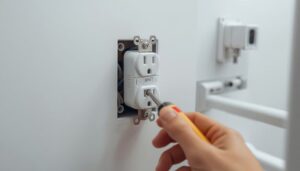
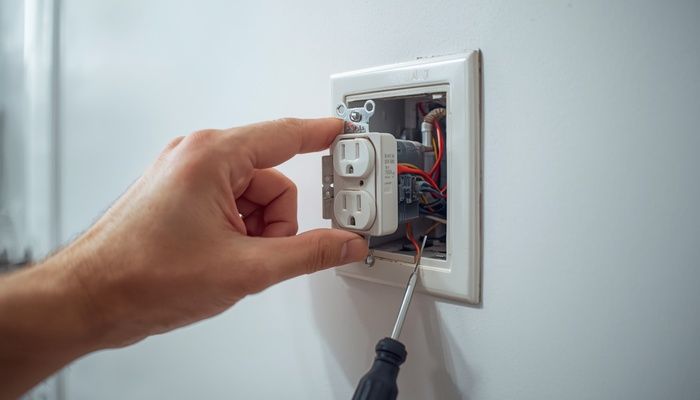
Replacing an existing outlet is a strong DIY project for confident homeowners. Plan 15-30 minutes per outlet: turn off the breaker, verify dead with a non-contact tester, remove the cover plate and outlet screws, pull the outlet from the box, note wire colors and connections, transfer wires to the new outlet (black/hot to brass screw, white/neutral to silver screw, bare/green to green screw), secure to the box, restore power, test with a plug-in outlet tester.
Common DIY errors: reverse polarity (hot and neutral swapped, fire hazard), open ground (no ground wire connected, electrocution risk), and over-tightening that breaks the outlet body. Always use a plug-in outlet tester ($10) after install to confirm correct wiring. New outlet runs (new circuits or new box locations) typically require an electrician.
What Are the Best Outlet Replacement Options?
Leviton, Eaton, and Pass & Seymour (Legrand) make the most reliable residential outlets. Avoid no-name 10-for-$10 bulk packs; their internal contacts wear out at 5-7 years and the materials can fail tamper-resistance code tests. For premium needs, choose commercial-grade (15A 5252 specification grade) at $5-$10 per outlet.
| Brand | Notable Model | Type | Price |
|---|---|---|---|
| Leviton | T5325 | 15A TR commercial grade | $3-$6 |
| Leviton | T7599 | USB + USB-C 15A TR | $25-$45 |
| Eaton | TR8300 | Heavy duty 15A TR | $4-$7 |
| Pass & Seymour | TR63HW | Hospital grade 15A TR | $8-$15 |
| Lutron | CAR-15-TG | Smart outlet | $25-$45 |
When Should I Replace or Upgrade Outlet Replacement?
Replace an outlet when: plugs fall out under their own weight (worn contacts, fire hazard), there is scorching or discoloration on the face (heat damage from arcing), the cover plate area is loose (worn mounting tabs), the outlet does not pass a plug-in tester (incorrect wiring or end-of-life), tamper-resistant shutters no longer block plastic test probes (failed TR), or the outlet is older than 25 years and you are upgrading the home. Modern code requires TR throughout; replacing pre-2008 outlets with TR is good practice during any kitchen or bathroom renovation.
Are tamper-resistant outlets required?
Yes in new construction and substantial renovations per NEC 2008+ in nearly all jurisdictions. Tamper-resistant outlets have spring-loaded shutters preventing object insertion (a major cause of child electrical injuries). TR outlets cost $1-$3 more than non-TR; there is no reason to buy non-TR for new work.
Why are my outlets warm to the touch?
Common causes: (1) the breaker is undersized for the load (likely if you have plugged a space heater into a 15A circuit); (2) loose internal contacts (worn outlet); (3) loose terminal screws (poor connection generating heat); (4) too many devices on one outlet (overload). Any warm outlet should be investigated immediately; arcing in worn outlets is a fire cause.
Can I install a 20A outlet on a 15A circuit?
Yes, but it does not increase the circuit’s capacity. The breaker is still 15A; a 20A outlet on a 15A circuit will not trip until 15A is drawn. The 20A outlet is identified by a horizontal slot crossing the neutral; this allows 20A-rated plugs to fit. Some appliances (window AC, microwaves) require 20A outlets and 20A circuits.
What is the difference between back-wired and side-wired outlets?
Side-wired uses screw terminals; back-wired uses a push-in hole behind the outlet. Side-wired connections are more reliable long-term (back-wired push-in connections fail at 10-15 years). For new work and replacements, use the screw terminals.