
SPC Core Explained: What It Is and Why It Matters
TL;DR: SPC (Stone Plastic Composite) core is a rigid, waterproof flooring core made from limestone and PVC. It’s the toughest type of luxury vinyl flooring, offering superior dent resistance, sound reduction, and dimensional stability compared to standard vinyl. Homeowners choose SPC core for basements, kitchens, and high-traffic areas where moisture and impact are concerns.
What Is SPC Core?
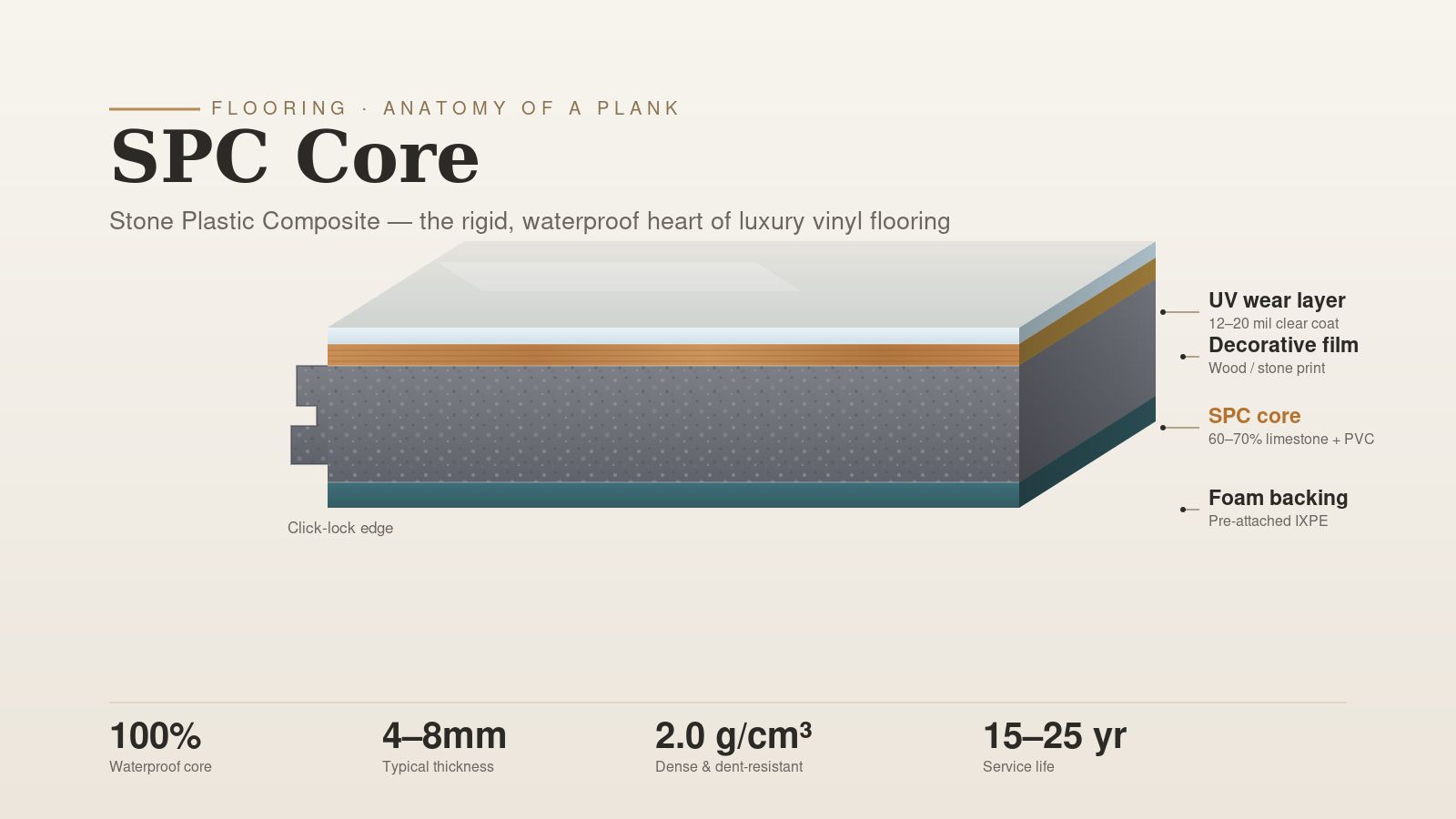
SPC core stands for Stone Plastic Composite core. It’s the middle layer of a luxury vinyl flooring plank, sandwiched between a printed design layer on top and a backing layer underneath. Unlike traditional vinyl flooring, which uses a flexible PVC core, SPC core is a rigid, stone-reinforced composite that gives the plank its shape and strength.
The core is made by blending limestone powder (about 60–70% of the mix) with PVC resin and stabilizers. This mixture is heated and pressed into a dense, solid board that doesn’t flex, warp, or dent easily. The result is a flooring product that feels and performs more like engineered hardwood or tile than traditional sheet vinyl.
Key characteristics:
- Thickness: Typically 4mm to 8mm (1/8 to 5/16 inch)
- Density: 1.8–2.2 grams per cubic centimeter (heavier than standard WPC)
- Waterproof: 100% impervious to water—won’t swell, rot, or mold
- Rigidity: Holds its shape without underlayment in most cases
How SPC Core Works
SPC core’s performance comes from its unique structure. The limestone filler creates a stone-like rigidity that prevents the plank from bending under weight, while the PVC binder provides flexibility and impact resistance. Here’s what happens at a microscopic level:
- Compression strength: The limestone particles create a dense matrix that resists compression. When you drop a heavy pan or push furniture across the floor, the core distributes the force evenly, preventing dents or punctures.
2. Thermal stability: Unlike wood-based cores, SPC doesn’t expand or contract significantly with temperature changes. The coefficient of thermal expansion is about 0.02 mm/m/°C—roughly 1/10th that of solid hardwood. This means fewer gaps or buckling in rooms with heating/cooling cycles.
3. Moisture barrier: The solid PVC-limestone mix has zero porosity. Water sits on top—it cannot penetrate or wick into the core. This is why SPC flooring can be installed directly on concrete slabs (which often release moisture) without a vapor barrier.
4. Acoustic dampening: The dense core absorbs sound vibrations. A 5mm SPC plank with attached underlayment reduces impact noise by 18–22 decibels—enough to meet most condo or apartment noise requirements.
The locking mechanism (typically a click-lock or drop-lock system) is integrated into the core itself. Because the core is rigid, the locking edges stay aligned and don’t deform over time, preventing gaps from forming between planks.
Why SPC Core Matters in Home Improvement
SPC core has become the default choice for luxury vinyl flooring in residential projects. Here’s why homeowners and contractors prefer it:
Waterproof performance: Unlike laminate (which swells when wet) or hardwood (which stains and warps), SPC can handle standing water for days. This makes it ideal for:
- Basements (even below-grade concrete slabs)
- Bathrooms and laundry rooms
- Kitchens near sinks or dishwashers
- Mudrooms and entryways
Dent resistance: Traditional vinyl flooring (especially glue-down tiles) can dent from heavy furniture or dropped objects. SPC’s rigid core resists indentations from chair legs, appliance feet, and pet claws. A 4mm SPC plank can withstand a static load of 200+ pounds per square inch without permanent deformation.
Installation ease: Because SPC is rigid, you don’t need to flatten subfloor imperfections as aggressively. The planks bridge small dips or bumps (up to 1/8 inch) without telegraphing them through the surface. This saves time on subfloor prep—a major cost in flooring projects.
Long-term stability: Wood-based flooring expands and contracts with humidity changes. SPC doesn’t. This means fewer callbacks for gaps or buckling, especially in rooms with radiant heating or large temperature swings.
SPC Core vs Related Terms
SPC vs WPC (Wood Plastic Composite)
WPC core was the first rigid vinyl core, using wood flour (sawdust) instead of limestone. Key differences:
| Feature | SPC Core | WPC Core |
|---|---|---|
| Material | Limestone + PVC | Wood flour + PVC |
| Density | 1.8–2.2 g/cm³ | 1.2–1.5 g/cm³ |
| Dent resistance | Excellent (stone) | Good (wood) |
| Thermal expansion | Very low | Low |
| Weight | Heavier (more stable) | Lighter |
| Cost | –/sq ft | .50–/sq ft |
| Best use | High-traffic, moisture-prone | Bedrooms, low-traffic areas |
Which is better? SPC wins for moisture resistance and dent resistance. WPC is slightly softer underfoot and cheaper, but not as durable.
SPC vs Laminate Flooring
Laminate uses a fiberboard core (HDF or MDF) that is *not* waterproof. SPC is fully waterproof. If you spill water on laminate and don’t clean it up quickly, the core swells and the planks cup. SPC doesn’t care—it’s waterproof forever.
SPC vs Solid Hardwood
Hardwood is beautiful but requires careful maintenance, refinishing every 5–10 years, and humidity control. SPC is maintenance-free (sweep and mop), waterproof, and won’t scratch as easily. Hardwood adds more resale value, but SPC wins on practicality.
When to Use SPC Core
SPC core is the right choice when you need waterproof durability but want the look of wood or stone. Use it for:
- Basements: Below-grade concrete slabs are notoriously damp. SPC’s waterproof core and low thermal expansion mean it won’t buckle or mold.
- Bathrooms and kitchens: Expect spills, splashes, and humidity. SPC handles it all without damage.
- High-traffic hallways: Kids, pets, and daily wear won’t dent or scratch the surface.
- Radiant heated floors: SPC’s thermal stability (expansion coefficient ~0.02 mm/m/°C) means it won’t gap or buckle when heated. Verify the manufacturer’s max temperature (usually 85°F).
- Entryways and mudrooms: Dirt, moisture, and heavy boots—SPC shrugs it off.
When NOT to use SPC:
- If you want a soft, warm feel underfoot (SPC is hard—like tile or hardwood)
- If you’re on a tight budget (SPC costs more than standard vinyl or laminate)
- If you need to install over very uneven subfloors (SPC requires subfloor flatness within 3/16 inch over 10 feet)
Frequently Asked Questions About SPC Core
Q: Is SPC flooring waterproof?
A: Yes, 100%. The core is made from limestone and PVC—neither absorbs water. Water sits on the surface and can be wiped up without any damage to the flooring.
Q: Does SPC flooring need underlayment?
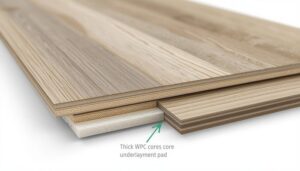
A: Most SPC planks come with a pre-attached foam underlayment (usually 1–2mm thick). If not, you may need a separate underlayment for sound reduction or moisture protection. Always check the manufacturer’s instructions—some warranties require specific underlayment.
Q: Can SPC flooring be installed over tile?
A: Yes, if the existing tile is flat, clean, and well-adhered. SPC’s rigid core bridges small grout lines and tile edges. But deep grout lines (wider than 1/8 inch) should be filled with a leveling compound first.
Q: How long does SPC flooring last?
A: With proper installation and care, SPC flooring lasts 15–25 years. The wear layer (usually 12–20 mils) protects against scratches and stains. High-traffic homes may see 12–15 years before visible wear.
Q: Is SPC flooring toxic?
A: Reputable SPC brands are phthalate-free and low-VOC. Look for FloorScore or GreenGuard Gold certification. The limestone and PVC are inert once cured—no off-gassing after installation.
Q: Can SPC flooring be refinished?
A: No. SPC has a printed wear layer, not a solid wood surface. Once the wear layer is scratched through, you can’t sand or refinish it. You must replace the affected planks (which is easy with click-lock systems).
Now that you understand SPC core, check our guide on How to Install SPC Flooring Over Concrete Slabs for step-by-step instructions on your next project.
Flooring Industry Standards: For official grading standards and installation guidelines, consult the National Wood Flooring Association (NWFA) and the World Floor Covering Association (WFCA). The Family Handyman also offers excellent DIY flooring installation guides.
Thank you for making this easy to understand. So many articles overcomplicate things.
For our flips, LVP gives the best ROI. Looks premium but costs reasonable. Buyers love it.