TL;DR: Installing laminate flooring is a weekend-friendly DIY project that can save you hundreds in labor costs. This guide covers everything from choosing materials to clicking the last plank into place, with clear steps for beginners. You’ll need basic tools, patience for prep work, and about 8–12 hours for a 200-square-foot room.
What You’ll Need
| Tool / Material | Estimated Cost | Notes |
|---|---|---|
| Laminate flooring planks (click-lock) | $1.50 – $4.00 per sq. ft. | Buy 10% extra for waste; underlayment often attached |
| Underlayment (if not pre-attached) | $0.20 – $0.50 per sq. ft. | Foam or felt; reduces noise and moisture |
| Measuring tape (25 ft) | $10 – $20 | Essential for layout |
| Utility knife with extra blades | $10 – $15 | For cutting underlayment and planks |
| Pull bar | $8 – $15 | Tightens last rows |
| Spacers (1/4-inch or 1/2-inch) | $5 – $10 | Maintain expansion gap along walls |
| Rubber mallet | $10 – $20 | Gently taps planks into place |
| Tapping block | $5 – $10 | Protects plank edges when hammering |
| Jigsaw or circular saw with fine-tooth blade | $50 – $120 | For cutting planks; can rent for ~$20/day |
| Safety glasses and dust mask | $10 – $15 | Protect eyes and lungs from dust |
| Knee pads | $10 – $25 | Highly recommended for comfort |
| Pry bar and hammer | $15 – $25 | For removing baseboards (optional) |
| Level (4-foot) | $15 – $30 | Check subfloor flatness |
| Total approximate cost (excluding flooring) | $150 – $300 | Tools you may already own |
How Long Does This Take?
For a beginner installing laminate in a standard 12×16-foot room (192 sq. ft.):
- Prep and removal of old flooring: 1–2 hours
- Subfloor inspection and leveling: 30 minutes–1 hour
- Acclimation of planks: 48 hours (do this before starting)
- Laying the first row: 1 hour
- Laying subsequent rows: 30–45 minutes per row
- Cutting and fitting final row: 1 hour
- Installing trim and transitions: 1–2 hours
- Total active work time: 8–12 hours
Plan for a full weekend, including acclimation time.
Safety First
Wear safety glasses and a dust mask when cutting laminate planks. The fine dust can irritate your lungs and eyes. Use ear protection if using power saws for extended periods. Keep your work area well-lit and free of tripping hazards. Always cut on a stable surface—never on your lap or an unsteady table. If using a utility knife, cut away from your body and use a sharp blade to avoid slips. Lift heavy boxes with your legs, not your back. Laminate boxes can weigh 40–60 lbs.
Step-by-Step Instructions
- Acclimate your laminate planks. Stack the boxes in the room where you’ll install them, open the ends, and leave them for 48 hours. This lets the planks adjust to the room’s temperature and humidity, preventing gaps or buckling later.
- Remove baseboards (optional but recommended). Use a pry bar and hammer to gently remove baseboards. Number each piece on the back with a pencil so you know where it goes. This gives a cleaner look than adding quarter-round trim. If you skip this, you’ll need to install quarter-round afterward.
- Clean and inspect the subfloor. Sweep or vacuum the subfloor thoroughly. Check for high spots using a 4-foot level—gaps under the level greater than 1/8 inch need to be sanded down or filled with floor leveler. Do not install over uneven subfloors; it will cause planks to separate.
- Lay the underlayment. If your laminate doesn’t have pre-attached underlayment, roll out foam underlayment across the subfloor. Overlap seams by 2–4 inches and tape them with underlayment tape. Trim excess with a utility knife. Do not overlap underlayment on the walls—keep it flat.
- Set up spacers along the starting wall. Place 1/4-inch or 1/2-inch spacers (check your laminate’s instructions) between the wall and the subfloor every 12–18 inches. This creates the required expansion gap for the flooring to move with temperature changes.
- Install the first row of planks. Start in the left corner of the room, with the tongue side facing the wall. Place the first plank, then connect the next plank by angling the short end into the previous plank’s groove and pressing down until it clicks. Continue across the room. Cut the last plank in the row to fit—measure the remaining space, subtract the expansion gap, and cut the plank with a jigsaw or circular saw (face down to avoid chipping).
- Stagger the seams. For the second row, cut a plank to at least 12 inches shorter than the first plank in the previous row. This offsets the seams by at least 6–8 inches for strength. Connect the long side of the new plank by angling it into the groove of the first row, then lower it and tap with a tapping block and rubber mallet until it clicks. Work in a staggered pattern—like a brick wall.
- Continue laying rows. Repeat step 7 for each row. Use a pull bar to tighten the last few planks in a row if needed. Check alignment every 3–4 rows by measuring from the wall; adjust if rows start to drift.
- Fit the final row. Measure the width of the remaining space (from the last installed row to the opposite wall), subtract the expansion gap, and cut planks lengthwise. Use a jigsaw or circular saw with a guide. Install these planks using a pull bar to lock them into place.
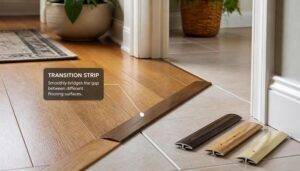
- Remove spacers and install transitions. Take out all spacers. Install transition strips (T-molding) at doorways and between rooms. Nail or glue them according to the manufacturer’s instructions. Do not nail through the laminate planks—only into the subfloor.
- Reinstall baseboards or add quarter-round. If you removed baseboards, nail them back in place. If not, install quarter-round molding along the bottom of the baseboards to cover the expansion gap. Paint or stain to match.
- Final cleanup and inspection. Vacuum the floor thoroughly. Check for any loose planks or gaps. If a plank isn’t fully clicked, use a tapping block to gently tap it into place. Let the floor settle for 24 hours before moving furniture onto it.
Common Mistakes to Avoid
- Skipping acclimation. Installing laminate straight from a cold garage or truck can cause planks to expand or contract after installation, leading to gaps. Always acclimate for 48 hours in the room.
- Ignoring the expansion gap. Forgetting spacers or butting planks tight against walls will cause buckling when the floor expands. Leave at least 1/4 inch around all walls, pipes, and door frames.
- Not staggering seams enough. Placing seams too close together (less than 6 inches apart) weakens the floor and looks unprofessional. Use leftover cutoffs from previous rows to start new rows.
- Cutting planks face up with a saw. Cutting laminate face up can chip the top surface. Always cut face down with a circular saw or jigsaw to protect the finish.
- Rushing the first row. A crooked first row throws off every subsequent row. Take your time, measure twice, and use a straight edge or chalk line to ensure the first row is perfectly parallel to the wall.
When to Call a Professional
While laminate installation is beginner-friendly, some situations call for an expert:
- Severely uneven subfloor. If your subfloor has dips deeper than 1/4 inch over 6 feet, you may need self-leveling compound or plywood underlayment—a messy and precise job.
- Concrete subfloor with moisture issues. Laminate on concrete requires a vapor barrier and moisture testing. If you see dampness or efflorescence, consult a pro.
- Complex room shapes. Rooms with multiple corners, curved walls, or many doorways require advanced cutting and layout skills. A pro can save you material and frustration.
- Radiant floor heating. Not all laminate is rated for radiant heat. Incorrect installation can damage the system or warp the floor. Check manufacturer specs and consider professional help.
- Large or multi-room projects. For areas over 500 square feet, the physical demand and need for precise alignment increase. A pro can finish faster and with fewer errors.
Frequently Asked Questions
Q: Can I install laminate over existing tile or hardwood?
A: Yes, as long as the existing floor is flat, clean, and stable. You can install over tile (grout lines must be level) or hardwood (remove any squeaky boards first). Do not install over carpet or vinyl with cushioned backing.
Q: Do I need to remove the old baseboards?
A: It’s optional but recommended. Removing baseboards gives a cleaner finish and avoids adding quarter-round trim. If you’re short on time, you can leave them and install quarter-round to cover the expansion gap.
Q: How do I cut laminate around door frames?
A: For door frames, you can either undercut the frame by placing a scrap plank on the floor and sawing the frame above it, or cut the plank to fit around the frame using a jigsaw. The first method is easier for beginners—watch a video on how to undercut door frames for flooring.
Q: What’s the best way to cut laminate planks lengthwise?
A: Use a circular saw with a fine-tooth blade (80–100 teeth) or a table saw. Mark your cut line, clamp a straight edge as a guide, and cut with the finished side down. For small cuts, a sharp utility knife can score and snap some laminates—check your brand’s instructions.
Q: Can I install laminate flooring in a bathroom or basement?
A: Only if the laminate is specifically rated for moisture (look for water-resistant or waterproof labels). Standard laminate swells and warps in damp areas. For bathrooms or basements, consider luxury vinyl plank flooring instead, which is fully waterproof.
Q: How do I fix a gap between planks after installation?
A: Small gaps can sometimes be tapped closed with a tapping block and mallet. For larger gaps, you may need to disassemble the section and reinstall. If the gap is near a wall, use a pull bar to tighten it. For persistent issues, check the common causes of laminate floor gaps guide.
Q: What’s the difference between laminate and engineered hardwood?
A: Laminate is a multi-layer synthetic product with a photographic image layer, while engineered hardwood has a real wood veneer. Laminate is more scratch-resistant and cheaper, but cannot be refinished. For more details, see our laminate vs. engineered hardwood comparison.