TL;DR: Install low-voltage landscape lighting yourself this weekend with basic tools and no electrician — this guide covers transformer sizing, fixture placement, wiring methods, and common mistakes to avoid for a professional-looking outdoor lighting system.
Outdoor lighting transforms your yard after dark. It highlights trees and garden beds, lights walkways for safety, extends evening entertaining, and adds curb appeal that prospective buyers notice. The best part? Low-voltage (12V) landscape lighting is safe enough for DIY installation — no need for a licensed electrician or a building permit for most residential systems.
A typical front-yard installation with 8 to 12 fixtures costs between $200 and $500 in materials, compared to $800 to $1,500 for professional installation. With basic tools and a weekend afternoon, you can have a system that looks professionally installed. This guide walks through every step, from designing your layout to burying cables and adjusting fixtures.
What You Will Need
| Item | Estimated Cost | Notes |
|---|---|---|
| Low-voltage transformer (150W–300W) | $40–$100 | Choose a model with a photocell timer or smart control |
| Landscape lighting fixtures (8–12) | $15–$40 each | Path lights, spotlights, well lights, or floodlights |
| 12/2 or 10/2 direct-bury cable | $20–$60 | 50–100 ft. 12/2 for runs under 200W; 10/2 for longer runs |
| Wire connectors (gel-filled or silicone-sealed) | $8–$15 | Must be rated for outdoor direct-bury use |
| Stakes for path lights | Included with fixtures | Most path lights come with plastic or metal stakes |
| Shovel or edging tool | $15–$30 | For burying cable 3–6 inches deep |
| Wire strippers | $8–$15 | 20–18 AWG setting for landscape cable |
| Voltage tester or multimeter | $10–$25 | Optional but helpful for troubleshooting |
How Long Does This Take?
Plan on 3 to 5 hours for a typical front-yard installation of 8–12 fixtures. The bulk of the time goes into laying out fixtures (which you should do after dark for best effect) and trenching or hiding the cable runs. The electrical connections themselves take about 15 minutes per fixture.
Step 1: Design Your Lighting Layout
Walk your property at night before you buy anything. Use a flashlight to simulate different light angles and note which features you want to highlight. Common targets include:
- Walkways and steps — Path lights spaced 6–8 feet apart on both sides
- Trees and large shrubs — Upward-facing spotlights at the base
- House facade — Wide floodlights aimed at the siding from ground level
- Garden beds — Well lights recessed into the soil or accent lights on short stakes
- Entryways and driveways — Flanking lights for safety and visibility
Sketch a rough yard map marking each fixture location, the transformer location (near a GFCI outdoor outlet), and the cable paths. Keep total cable runs under 100 feet from the transformer to prevent voltage drop — past 100 feet, lights at the end of the run will be noticeably dimmer.
Step 2: Size Your Transformer
Add up the wattage of every fixture you plan to install. For example, eight 10W path lights plus two 20W spotlights equals 120W total. Multiply by 1.25 to get your minimum transformer capacity: 120W × 1.25 = 150W. Always buy a transformer rated 20–30% higher than your calculated load — this prevents overloading and leaves room to add fixtures later.
Most residential transformers come in 150W, 200W, and 300W sizes. A 200W unit costs around $60–$80 and handles most typical installations with 10–15 fixtures. Look for a transformer with:
- Built-in photocell (turns lights on at dusk, off at dawn)
- Timer or programmable schedule
- Weatherproof NEMA 3R rated enclosure
- Multiple output taps (12V, 13V, 14V) to compensate for voltage drop on long cable runs
Step 3: Mount the Transformer
Mount the transformer near an exterior GFCI outlet. Most units have a mounting bracket that screws into siding or masonry. Keep it at least 12 inches off the ground to stay clear of snow and sprinklers, and avoid direct sun exposure which can overheat the unit in summer.
Safety note: Never use a standard extension cord with a landscape transformer. If the outlet is more than 3 feet from the transformer location, hire an electrician to install a dedicated outdoor GFCI receptacle. The transformer must remain plugged in directly — no daisy-chaining or indoor-rated cords exposed to weather.
Step 4: Lay Out Fixtures and Cable
Place each fixture at its intended location before connecting anything. Insert path light stakes into the ground and set spotlights on temporary bricks. Walk the entire path and adjust positions until the layout looks balanced. This is the time to reposition — once cable is buried, moving a fixture means digging again.
Run the main cable from the transformer, past each fixture location, in a continuous loop. Do not cut the cable at each fixture. Low-voltage landscape lighting uses a daisy-chain (or parallel) wiring method: the main cable passes each fixture, and short pigtail wires tap into the main cable at each location. This keeps voltage more consistent than cutting and splicing at every fixture.
For the cleanest look, route cable along the base of walls, fence lines, or the edge of garden beds where it can be hidden under a thin layer of mulch or soil.
Step 5: Make the Wire Connections
At each fixture location, strip about ½ inch of insulation from both the main cable and the fixture pigtail wires. Use the gel-filled wire nuts or push-in connectors rated for direct burial:
- Match colors: connect the two copper or silver wires together, and the two striped or ribbed wires together
- Twist the gel-filled connector onto each pair until the gel completely surrounds the exposed wire
- Give each connection a gentle tug to verify it is secure
- Push the connector down into the soil or into a protective junction box if local code requires
Standard twist-on wire nuts are not suitable for outdoor direct-bury use — moisture seeps in within weeks and causes corrosion. Always use gel-filled or silicone-filled connectors designed for underground landscape wiring. They cost about $0.50–$1.00 each at any home center.
Step 6: Bury the Cable
Use a flat-blade shovel or an edging tool to cut a slit trench 3–6 inches deep along the cable path. Push the cable into the slit and tamp the soil back down with your foot. In garden beds, 3 inches is sufficient. In lawn areas where you might aerate or till, go 6 inches deep. Check with your local utility marking service (811) before digging to avoid buried gas lines or sprinkler pipes.
For cable that crosses a lawn, consider using a cable-laying tool (sometimes called a “lawn edger” or “trencher”) that slices a narrow slit without removing a divot. This leaves a cleaner line that heals faster.
Step 7: Connect the Transformer and Test
Once all fixtures are connected, plug the transformer into the GFCI outlet. Attach the main cable wires to the transformer terminals: the copper/silver wire goes to the terminal marked “COM,” and the ribbed/striped wire goes to the terminal marked for your chosen voltage tap (12V for runs under 50 feet, 13V or 14V for runs of 50–100 feet).
Turn the transformer on and walk the full circuit. Every fixture should light up. If some are dim or off:
- Dimmer lights at the end of the run: Move the wire to a higher voltage tap (e.g., 13V instead of 12V) on the transformer
- One fixture off: Check the wire connection at that fixture — the gel cap may not have pierced the insulation completely
- Entire circuit off: Check the GFCI outlet (it may have tripped) and verify the main cable connections at the transformer terminals
Step 8: Adjust Fixture Angles and Aiming
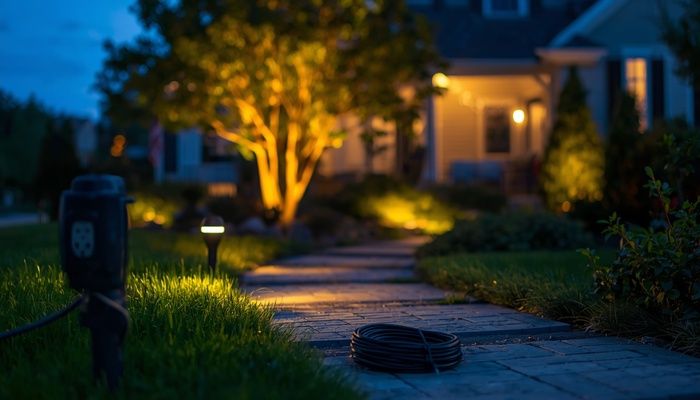
Once the system is lit, wait for full darkness and make final adjustments. Path lights should cast a pool of light about 4–6 feet in diameter — overlap these pools slightly for continuous coverage. Spotlights aimed at trees should illuminate the trunk and lower canopy without blasting light into the sky (which creates glare and disturbs neighbors).
A well-placed landscape lighting system uses the principle of “layering”: ambient light from path fixtures at ground level, accent light from spotlights on features, and subtle highlight from well lights in garden beds. Avoid the common mistake of over-lighting — you want the landscape to be visible and inviting, not bathed in stadium-bright light.
Common Mistakes to Avoid
- Under-sizing the transformer: Adding Christmas lights or extra fixtures later without upgrading the transformer can overload the circuit and cause the GFCI to trip repeatedly
- Using standard wire nuts outdoors: They corrode in weeks. Always use gel-filled connectors rated for direct burial
- Mixing fixture types on the same cable run: A 20W spotlight on the same line as six 4W path lights will cause voltage drop issues for the smaller lights. Group similar-wattage fixtures on separate runs, or use a multi-tap transformer
- Skipping the photocell: Without automatic on/off control, lights left on all night burn 10–12 hours instead of the typical 5–6 hours, more than doubling your electricity cost over a year
- Not checking local codes: Some municipalities require low-voltage cable to be enclosed in conduit when crossing driveways or walkways, or limit the total wattage to 300W without a permit
When to Call a Professional
While most low-voltage installations are fully DIY, call a licensed electrician if:
- You need a new outdoor GFCI outlet installed (this requires running line-voltage wiring through exterior walls)
- Your total system load exceeds 300W, which may trigger local permit requirements
- You want to integrate lighting into a home automation system beyond simple smart plugs
- You are uncomfortable working with electrical connections, even low-voltage ones
Professional installation typically costs $800 to $1,500 for 8–12 fixtures, including transformer, cable, and labor. The DIY route saves $500–$1,000 and gives you full control over fixture placement and future expansion.
Frequently Asked Questions
Can I use LED bulbs in existing landscape fixtures?
Yes, and you should. Most landscape fixtures now come with integrated LEDs that last 25,000 to 50,000 hours. If you have older fixtures with halogen bulbs, switching to LED reduces energy use by 80–90% and eliminates the need for frequent bulb changes. Replace the entire fixture if the LED is sealed; for screw-base sockets, swap to an LED landscape bulb rated for wet locations.
How deep should I bury landscape lighting wire?
3 inches is adequate in garden beds and mulched areas. 6 inches is recommended in lawns where you might aerate, till, or use a power edger. Low-voltage cable does not require conduit under the National Electrical Code, but local amendments may require it in certain conditions such as under driveways or in public walkways.
Do low-voltage lights use a lot of electricity?
No. A typical 10-LED path light uses 4–6 watts. Running 10 such lights for 6 hours a night costs about $1.00–$1.50 per month at the national average electricity rate of $0.14/kWh. That is less than a single 60W incandescent bulb running the same hours.
What happens if it rains?
Low-voltage systems are designed for outdoor use. Gel-filled connectors and weatherproof fixture housings keep water out. However, check each fixture’s IP rating: look for IP65 or higher for ground-level fixtures and IP44 at minimum for path lights. If water pools inside a fixture after rain, the gasket is damaged and should be replaced.
Can I add smart controls to landscape lighting?
Yes. Many modern transformers have Wi-Fi or Bluetooth connectivity, or you can add a smart outdoor plug between the GFCI outlet and the transformer. This lets you control lights via smartphone app, set schedules, and integrate with Amazon Alexa or Google Home for voice control. Smart controls add $20–$50 to the total cost but offer significant convenience.