TL;DR: Building a shed yourself saves thousands of dollars but requires careful planning, proper tools, and about 2-3 weekends of work. This guide covers everything from foundation to roofing, with step-by-step instructions for a 8×10-foot gable shed that a confident DIYer can complete for under $2,000 in materials.
What You’ll Need
| Category | Item | Estimated Cost |
|---|---|---|
| Tools | Circular saw (7-1/4″ blade) | $60–$120 |
| Tools | Cordless drill/driver with bits | $80–$150 |
| Tools | Level (4-foot and torpedo) | $25–$50 |
| Tools | Tape measure (25-foot) | $10–$20 |
| Tools | Framing hammer or nail gun | $30–$200 |
| Tools | Speed square | $10–$15 |
| Tools | Shovel and post hole digger | $25–$40 |
| Tools | Chalk line | $8–$12 |
| Tools | Safety glasses and hearing protection | $15–$30 |
| Materials | Pressure-treated 4×4 skids (4 pieces, 10 ft) | $60–$80 |
| Materials | Pressure-treated 2×6 joists (12 pieces, 10 ft) | $70–$100 |
| Materials | 2×4 studs (50 pieces, 8 ft) | $150–$200 |
| Materials | 3/4″ plywood (8 sheets, 4×8 ft) | $200–$280 |
| Materials | 7/16″ OSB sheathing (12 sheets, 4×8 ft) | $180–$240 |
| Materials | Asphalt shingles (3 bundles) | $90–$120 |
| Materials | 15 lb roofing felt (1 roll) | $25–$35 |
| Materials | Galvanized nails, screws, and hardware | $50–$80 |
| Materials | Door kit (pre-hung or barn style) | $100–$250 |
| Materials | Gravel for foundation (2 cubic yards) | $60–$100 |
| Total | $1,248–$1,912 |
How Long Does This Take?
Plan on 2-3 full weekends (about 40-60 hours total) for a first-time builder. Here’s the breakdown:
- Weekend 1 (Saturday): Site prep and foundation – 6-8 hours
- Weekend 1 (Sunday): Floor frame and decking – 6-8 hours
- Weekend 2 (Saturday): Wall framing and sheathing – 8-10 hours
- Weekend 2 (Sunday): Roof trusses and sheathing – 8-10 hours
- Weekend 3 (Saturday): Roofing and doors – 6-8 hours
- Weekend 3 (Sunday): Trim, siding, and finishing – 6-8 hours
Safety First
Always wear safety glasses when using power tools. Flying debris can cause permanent eye damage. Use hearing protection when running saws or nail guns for extended periods.
Never work on a roof without proper fall protection. Use a harness anchored to a secure point if the roof pitch exceeds 4/12. Check for underground utilities before digging. Call 811 in the U.S. at least 3 days before you start excavating.
Lift with your legs, not your back. Plywood sheets and pressure-treated lumber are heavy—get a helper for lifting wall sections and roof panels.
Step-by-Step Instructions
-
Prepare the site and lay the foundation (6-8 hours).
Mark an 8×10-foot rectangle using stakes and string. Remove grass and topsoil to a depth of 4 inches. Fill with 4 inches of compacted gravel, sloping slightly away from the shed for drainage. Place four pressure-treated 4×4 skids parallel to the 10-foot sides, spaced evenly (about 2 feet apart). Use a level to make sure all skids are flat and level—shim with gravel if needed. Verify the skids are square by measuring diagonals; they must be equal. -
Build the floor frame (4-6 hours).
Cut 2×6 joists to 10 feet long. Place them across the skids at 16-inch on-center spacing. Attach joist hangers to a 2×6 rim joist at both ends, then nail the joists into the hangers. Add blocking between joists at mid-span for stability. Cover the frame with 3/4-inch plywood, screwing it down every 8 inches along the edges and 12 inches in the field. Wear a dust mask when cutting plywood. -
Frame the walls (8-10 hours).
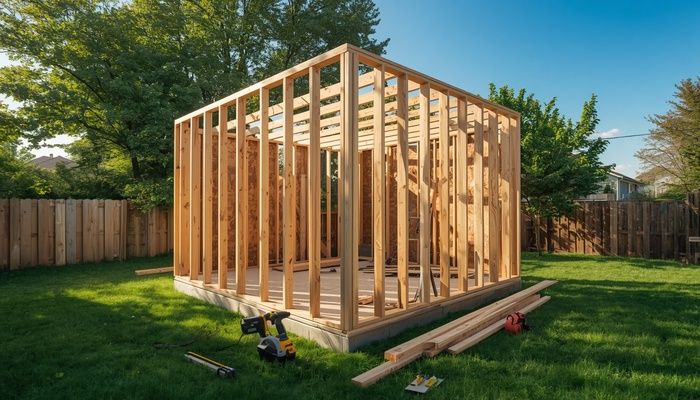
Build wall sections flat on the floor deck. For each wall, cut top and bottom plates to length (8 ft for front/back walls, 10 ft for side walls). Mark stud locations at 16-inch centers. Cut studs to 92-1/4 inches (for an 8-ft ceiling with a double top plate). Nail studs between plates. Build a rough opening for the door (typically 36 inches wide) by adding jack studs and a header. Have a helper lift each wall section into place. Plumb each wall with a level, then nail the bottom plate to the floor and brace temporarily. Connect corners by toenailing studs together. -
Add the top plates and sheathing (4-6 hours).
Nail a second top plate over the first, overlapping corners to tie walls together. Cut 7/16-inch OSB sheets to fit the walls. Start at one corner, making sure the sheet is square. Nail every 6 inches along edges and 12 inches in the field. Cut out window and door openings with a jigsaw or circular saw set to the correct depth. -
Build and install roof trusses (8-10 hours).
For an 8-ft wide shed, cut rafters from 2x4s. Each rafter needs a birdsmouth cut to sit on the top plate. Use a speed square to mark the angle (usually 4/12 pitch). Cut two rafters for the first truss, then use a 2×4 ridge board to connect them. Build 5 trusses total (one every 2 feet). Work from a ladder or scaffolding—never from the top plate. Lift each truss into place, nail through the birdsmouth into the top plate, and brace diagonally until all are up. Install a ridge board and collar ties. -
Sheath the roof (4-6 hours).
Starting at the bottom edge, nail 7/16-inch OSB sheets across the rafters. Stagger seams between rows. Overhang the sheets by 1 inch at the eaves for drip edge. Use a roof bracket or safety harness when working at height. -
Install roofing (6-8 hours).
Roll out 15 lb roofing felt over the OSB, overlapping each row by 4 inches. Staple every 6 inches. Install drip edge metal along the eaves and gable ends. Starting at the bottom, nail asphalt shingles with 4 galvanized roofing nails per shingle. Overlap each course by 5 inches. Cut shingles at the ridge with a utility knife. Never walk on a wet roof—it’s extremely slippery. -
Install doors and trim (6-8 hours).
Hang the pre-hung door or build a barn-style door. Shim the door frame level and plumb, then screw through the jamb into the rough opening. Install door hardware. Add 1×4 trim around the door and windows. Install corner boards and fascia along the eaves. Caulk all gaps and paint or stain the shed to protect the wood.
Common Mistakes to Avoid
- Skipping the foundation leveling. An uneven foundation will cause the shed to rack and doors to jam. Spend extra time getting the skids perfectly level—it’s the most critical step.
- Using untreated lumber on the ground. Pressure-treated wood is essential for skids and bottom plates. Regular lumber will rot within 2-3 years when in contact with soil or gravel.
- Overdriving nails in sheathing. Nails sunk too deep weaken the panel. The nail head should be flush with the surface, not countersunk.
- Ignoring local building codes. Many areas require permits for sheds over 100 square feet. Check with your city or county before starting—you may need setbacks or wind-load calculations.
- Forgetting ventilation. Without ridge vents or gable vents, moisture will build up inside and cause mold. Install at least one gable vent on each end of the shed.
When to Call a Professional
Building a shed is a rewarding DIY project, but some situations warrant hiring a contractor:
- If you need a concrete slab foundation. Pouring and leveling concrete requires experience and heavy equipment. A professional will cost $500–$1,000 but ensures a flat, permanent base.
- If your shed exceeds 120 square feet. Larger structures often require engineered trusses and deeper footings. Permits may demand stamped drawings from an engineer.
- If the roof pitch exceeds 6/12. Steep roofs are dangerous to walk on and require specialized safety gear. A roofer can install the shingles in half the time.
- If you’re uncomfortable with electrical work. Adding lights or outlets inside the shed should be done by a licensed electrician to avoid fire hazards.
For more on foundation options, check out how to choose the right shed foundation. If you’re planning a larger structure, read when to build vs. buy a shed for cost comparisons.
Frequently Asked Questions
Q: Do I need a permit to build a shed?
A: Most municipalities require a permit for sheds over 100 square feet. Even smaller sheds may need a zoning permit for setbacks. Always check with your local building department before starting.
Q: Can I build a shed on grass instead of gravel?
A: No. Grass will rot the floor frame and attract pests. A gravel base provides drainage and prevents wood-to-soil contact. For more details, see how to prepare a gravel shed foundation.
Q: What’s the best wood for a shed?
A: Use pressure-treated lumber for anything touching the ground (skids, bottom plates). For walls, roof, and siding, kiln-dried spruce or fir is affordable and strong. Cedar or redwood is more expensive but naturally rot-resistant.
Q: How do I prevent my shed from blowing away in a storm?
A: Anchor the skids to the ground with 12-inch spiral ground anchors (shed anchors) at each corner. Nail the floor frame securely to the skids. Use hurricane ties on rafters to the top plate. Learn more in how to secure a shed against high winds.
Q: Can I build a shed by myself?
A: You can handle most of the work solo, but you’ll need help lifting wall sections (which weigh 100+ pounds) and roof trusses. Enlist a friend or family member for the heavy lifting days. For tips on working alone, read DIY shed building tips for solo builders.