
Joist Explained: What It Is and Why It Matters
TL;DR: A joist is a horizontal structural beam that supports a floor or ceiling in a home. Typically made of wood, engineered lumber, or steel, joists run parallel to each other and transfer weight from the floor above to the walls, beams, or foundation below. Understanding joists is critical for any flooring, ceiling, or remodeling project because mistakes can lead to sagging floors, cracked drywall, or even structural failure.
What Is a Joist?
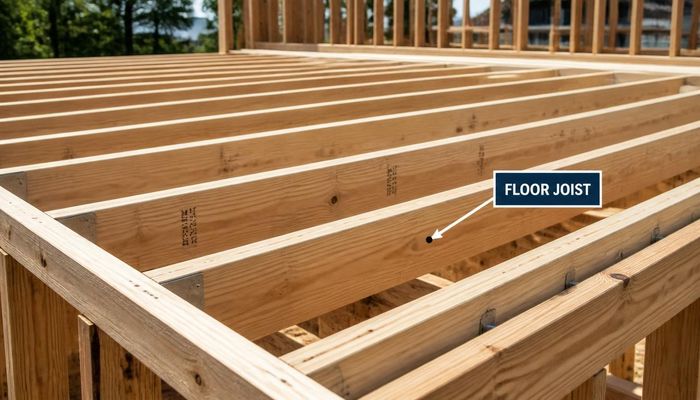
A joist is a long, horizontal framing member that provides structural support for a floor or ceiling. Think of joists as the skeleton beneath your feet or above your head—they span across open spaces (like a room) and carry the weight of everything above them, including people, furniture, appliances, and the finish flooring or ceiling material.
Joists are typically installed in a parallel, evenly spaced pattern. Common spacing is 16 inches on center (measured from the center of one joist to the center of the next), though 12-inch and 24-inch spacing is also used depending on load requirements and building codes. Standard joist depths range from 2×6 inches (for short spans with light loads) to 2×12 inches (for longer spans or heavier loads).
In residential construction, joists are most commonly made of:
- Solid lumber (e.g., Douglas fir, Southern yellow pine) – traditional and affordable
- Engineered wood (e.g., I-joists, LVLs, or glulam beams) – stronger, lighter, and less prone to warping
- Steel – used in commercial buildings or for specific high-load applications
How Joists Work
Joists work by transferring loads (weight) vertically downward through a home’s structure. Here’s the basic load path:
- Live loads (people, furniture, snow on a roof) and dead loads (the weight of the joists themselves, subfloor, drywall, insulation) press down on the floor or ceiling.
2. The joists span between two supports—usually exterior walls, interior load-bearing walls, or beams.
3. Each joist bends slightly under load (like a diving board), but because they’re closely spaced and connected to a subfloor or ceiling, they work together to distribute the weight evenly.
4. The ends of the joists transfer the load to the supporting walls or beams, which then transfer it to the foundation.
For example, a typical 2×10 joist made of Douglas fir can safely span about 14 feet when spaced 16 inches on center and supporting a standard residential floor load of 40 pounds per square foot (live load) plus 10 psf (dead load). If you need to span longer distances, you must use deeper joists, closer spacing, or stronger materials.
Key technical detail: Joists are designed to resist bending (flexure) and deflection (sagging). Building codes limit deflection to L/360 for floors (meaning a 12-foot joist can sag no more than 0.4 inches under full load) to prevent cracking in tile or drywall.
Why Joists Matter in Home Improvement
Understanding joists is essential for several common home improvement scenarios:
- Flooring installation: If you’re installing hardwood, tile, or laminate, you need to know joist spacing and direction to choose the right subfloor thickness and underlayment. For tile, joists must be stiff enough to prevent flexing that cracks grout.
- Open floor plans: Removing a load-bearing wall requires understanding which joists it supports. A contractor must install a beam or header to carry the joist ends—a mistake here can cause the floor above to sag or collapse.
- Adding heavy features: Installing a bathtub, kitchen island, or home gym requires checking if the joists can handle the extra weight. You may need to sister (add) extra joists or install blocking.
- Basement or attic finishing: When finishing a basement, you’ll often work with floor joists above your head. Running electrical, plumbing, or HVAC through joists requires careful notching or drilling—building codes limit hole size and location to avoid weakening the joist.
- Sagging floors: If you notice a dip or bounce in a floor, the joists may be undersized, damaged (by rot, termites, or improper notching), or too widely spaced. Reinforcement may involve sistering new joists alongside existing ones.
Joist vs Related Terms
| Term | Definition | How It Differs from Joist |
|---|---|---|
| Beam | A large horizontal structural member that supports joists or other loads | Beams are bigger and carry heavier loads; joists rest on beams. A beam spans between columns or walls, while joists span between beams or walls. |
| Rafter | A sloped structural member that supports a roof | Rafters are angled (for roof pitch) and carry roof loads; joists are horizontal and support floors/ceilings. |
| Truss | A pre-engineered framework of triangles (often used for roofs or floors) | Trusses are assembled from multiple smaller members; they can replace joists but are typically used for longer spans. |
| Sill plate | A horizontal board that sits on the foundation and anchors the wall frame | The sill plate supports the bottom of wall studs, not floor joists directly. Joists often sit on or are nailed to the sill plate. |
| Blocking | Short pieces of lumber installed between joists to prevent twisting or provide nailing surfaces | Blocking is not a primary load-bearing member; it’s a secondary component that stabilizes joists. |
—
When to Use Joists
You don’t “use” joists as a homeowner—they’re already part of your home’s structure. But you’ll encounter joists in these situations:
- During new construction or additions: A contractor will specify joist size, spacing, and material based on span, load, and local building codes.
- When repairing or reinforcing: If a floor sags or bounces, you may need to install new joists (sistering) alongside existing ones. Use the same depth or slightly deeper lumber.
- When running utilities: If you need to run a pipe or wire through a joist, drill holes only in the center third of the joist’s depth (not within 2 inches of the top or bottom edge) and keep hole diameter to 1/3 of the joist depth or less (e.g., max 1.5-inch hole in a 2×10).
- When installing heavy fixtures: For a jetted tub or large aquarium, consult a structural engineer to determine if joists need reinforcement.
Pro tip: Before cutting or drilling any joist, check with your local building department. Unauthorized modifications can violate code and compromise safety.
Frequently Asked Questions About Joists
Q: Can I cut a notch in a floor joist?
A: Generally, no—notching weakens the joist significantly. If absolutely necessary, building codes allow notches only in the top or bottom edge of the outer third of the span (near the ends), and the notch depth cannot exceed 1/6 of the joist depth (e.g., 1.5 inches deep on a 2×10). Never notch the middle third of the span.
Q: What’s the difference between a joist and a beam?
A: A joist is one of many parallel members that directly support the floor or ceiling. A beam is a larger, stronger member that supports multiple joists. Think of joists as the “ribs” and the beam as the “spine” of the floor system.
Q: How do I find which direction my floor joists run?
A: Look at the subfloor in an unfinished basement or attic—joists run perpendicular to the subfloor panels. In a finished room, look for nail pops in the ceiling (they often align with joists) or use a stud finder on the ceiling. Joists typically run the shortest distance between walls.
Q: Can I remove a joist to create an opening?
A: Never remove a joist without proper support. If you need an opening (e.g., for a staircase or skylight), a contractor must install a double header and double trimmer around the opening to redistribute the load. This requires engineering and permits.
Q: What size joist do I need for a 12-foot span?
A: For a standard residential floor (40 psf live load, 10 psf dead load), a 2×10 joist spaced 16 inches on center can typically span up to 14-15 feet (depending on wood species and grade). Always consult a span table or structural engineer for your specific situation.
Now that you understand what a joist is and how it works, check our guide on how to reinforce sagging floor joists for step-by-step repair instructions—or read about load-bearing walls vs. non-load-bearing walls to avoid costly mistakes in your next remodeling project.
Flooring Industry Standards: For official grading standards and installation guidelines, consult the National Wood Flooring Association (NWFA) and the World Floor Covering Association (WFCA). The Family Handyman also offers excellent DIY flooring installation guides.

Installed hardwood in our kitchen three months ago and it’s holding up great. Gets the most traffic in the house.
For our flips, LVP gives the best ROI. Looks premium but costs reasonable. Buyers love it.