
Floating Floor Explained: What It Is and Why It Matters
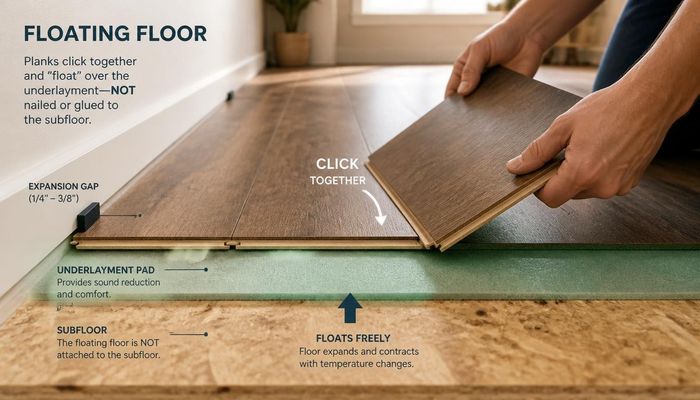
TL;DR: A floating floor is a type of flooring installation where planks or tiles click together without being glued or nailed to the subfloor. Instead, the entire floor “floats” as a single, interlocking layer on top of an underlayment. This method is popular for laminate, luxury vinyl plank (LVP), and engineered wood because it’s faster to install, easier to replace, and more forgiving of minor subfloor imperfections.
What Is a Floating Floor?
A floating floor is a flooring system where individual planks or tiles are connected to each other—typically via a click-lock or tongue-and-groove mechanism—but are not attached to the subfloor beneath them. The entire floor assembly rests on an underlayment (a thin foam or rubber pad) and is held in place by its own weight and the pressure of baseboards or trim around the room’s perimeter.
This is different from traditional flooring methods like nail-down hardwood (where planks are nailed to a wooden subfloor) or glue-down vinyl (where tiles are adhered directly to the concrete). Floating floors are designed to expand and contract as a single unit with changes in temperature and humidity, which prevents buckling or gaps.
Common types of floating floors include:
- Laminate flooring (high-density fiberboard core with a photographic wear layer)
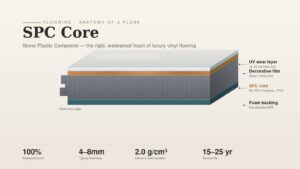
- Luxury vinyl plank (LVP) and luxury vinyl tile (LVT) (rigid or flexible vinyl cores)
- Engineered wood flooring (a thin layer of real wood over a plywood or HDF core)
- Some cork and bamboo flooring (often click-lock systems)
How a Floating Floor Works
Floating floors rely on a simple mechanical connection. Most modern products use a click-lock system—a patented tongue-and-groove profile with a locking tab that snaps planks together at an angle, then flattens them into place. Once locked, the planks form a continuous sheet that can move slightly as a single unit.
Here’s the step-by-step process:
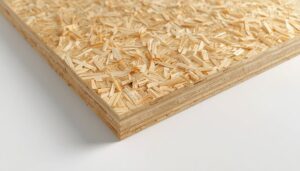
- Prepare the subfloor – The existing floor (concrete, plywood, or old tile) must be clean, dry, and relatively flat (typically within 3/16-inch over 10 feet).
2. Install an underlayment – A foam, cork, or rubber pad is rolled out over the subfloor. This provides cushioning, moisture protection, and sound dampening. Some flooring products have the underlayment pre-attached.
3. Lay the first row – Planks are placed with a spacer (usually ¼ to ½ inch) between the plank and the wall to allow for expansion. The first row is laid with the tongue facing the wall.
4. Click the planks together – Each subsequent plank is angled into the previous one, then lowered flat until it clicks. Rows are staggered (like brickwork) for stability and appearance.
5. Continue across the room – The floor is installed in rows, with planks cut to fit at the ends using a saw or scoring knife.
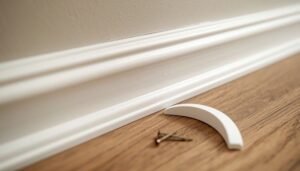
6. Remove spacers and install trim – Once the floor is complete, the expansion gaps are covered by baseboards, quarter-round, or transition strips.
The key principle: the floor is mechanically connected to itself, not to the subfloor. It can slide slightly (usually less than ¼ inch across a 40-foot room) as it expands and contracts.
Why Floating Floors Matter in Home Improvement
Floating floors have become a dominant choice in residential remodeling for several practical reasons:
1. Easier DIY installation – No glue, no nails, no special tools beyond a saw, tapping block, and spacers. A 200-square-foot room can often be installed in a single weekend by a homeowner with basic skills.
2. Lower cost – Floating floors are typically cheaper than solid hardwood or tile, both in materials (laminate starts around $1.50–$3 per square foot) and installation (no professional labor needed for DIY).
3. Faster renovation – Because there’s no drying time for adhesives or waiting for mortar to set, you can walk on a floating floor immediately after installation.
4. Easy repairs and replacement – If a plank gets damaged, you can often disassemble the floor from the nearest wall and replace individual planks. This is much harder with glued or nailed floors.
5. Compatible with concrete slabs – Floating floors work directly over concrete without needing to nail into it, making them ideal for basements, condos, and slab-on-grade homes.
6. Quieter and more comfortable – The underlayment provides cushioning underfoot and reduces sound transmission to rooms below—a big plus for upstairs bedrooms or apartments.
Floating Floor vs. Related Terms
Floating floors are often confused with other installation methods. Here’s how they compare:
| Term | How It’s Installed | Key Difference from Floating |
|---|---|---|
| Glue-down floor | Adhesive applied to subfloor, then planks/tiles pressed into it | Permanent; harder to remove or replace; requires adhesive drying time |
| Nail-down floor | Planks nailed or stapled to a wooden subfloor | Requires a wood subfloor; more labor-intensive; not suitable for concrete |
| Snap-together floor | Planks click together (same as floating) | Essentially the same; “snap-together” is a marketing term for click-lock |
| Engineered wood | Can be floating, glue-down, or nail-down | The material itself (real wood veneer) is not an installation method; check product specs |
| Laminate flooring | Almost always floating (click-lock) | Laminate is a specific product type; floating is its default installation method |
| Sheet vinyl | Glue-down or loose-lay (not floating) | Sheet vinyl is one piece; floating floors are multiple interlocking planks |
Important nuance: Some engineered wood floors are advertised as “floating” but require glue on the tongue-and-groove joints (called “glue-assist”). True floating floors use a mechanical lock only—no adhesive between planks.
When to Use a Floating Floor
Floating floors are an excellent choice in these scenarios:
- Over concrete slabs – Especially in basements, garages, or condos where nailing is impossible.
- In rental properties – Tenants can install floating floors without damaging the subfloor, and you can remove them later.
- For DIY homeowners – If you want to save money on labor and have moderate handyman skills.
- In rooms with uneven subfloors – The underlayment and floating system can smooth out minor dips (up to 1/8-inch per 6 feet).
- When you want easy future updates – Floating floors can be taken up and reused in another room (if careful).
Avoid floating floors when:
- The room has high moisture (e.g., bathrooms, laundry rooms) unless the product is specifically rated waterproof.
- The subfloor has major unevenness (more than 3/16-inch over 10 feet) that requires self-leveling compound.
- You want full soundproofing – Floating floors are better than nail-down but still transmit impact noise. For maximum sound reduction, use a glue-down cork or rubber underlayment.
- You have heavy furniture – Some floating floors can dent under point loads (like piano legs) unless you use protective pads.
Frequently Asked Questions About Floating Floors
Q: Can you install a floating floor over tile or vinyl?
A: Yes, as long as the existing floor is flat, clean, and in good condition. You don’t need to remove old tile or vinyl—just install underlayment over it. Avoid installing over carpet or heavily uneven surfaces.
Q: How long does a floating floor last?
A: Laminate typically lasts 15–25 years; luxury vinyl plank can last 20–30 years; engineered wood may last 25–50 years depending on wear layer thickness. Proper maintenance (avoiding standing water, using furniture pads) extends lifespan.
Q: Do floating floors need expansion gaps?
A: Yes. You must leave a ¼- to ½-inch gap around all walls, doorways, and fixed objects (like cabinets or pipes). This gap is covered by baseboards or quarter-round. Without it, the floor can buckle in hot or humid weather.
Q: Can you sand and refinish a floating floor?
A: Only engineered wood with a thick veneer (usually 4mm or more) can be sanded once or twice. Laminate and LVP cannot be sanded—they must be replaced if the surface wears out.
Q: Are floating floors waterproof?
A: Some are, but not all. Look for “waterproof” or “100% waterproof” labels on LVP or laminate. Standard laminate is water-resistant (not waterproof) and can swell if wet. Engineered wood is not waterproof. Always check the product’s warranty for moisture exposure.
Now that you understand what a floating floor is and how it works, check our guide on how to choose the best underlayment for your floating floor — it’s the single most important decision for comfort, sound, and longevity.
`json
{
“
Flooring Industry Standards: For official grading standards and installation guidelines, consult the National Wood Flooring Association (NWFA) and the World Floor Covering Association (WFCA). The Family Handyman also offers excellent DIY flooring installation guides.
Thanks for this breakdown. Bookmarked for my upcoming project — exactly what I needed.
Would you recommend this for a DIYer with moderate experience, or better to hire a pro?