What to Consider When Buying Cordless Drills
TL;DR: A cordless drill is the most versatile homeowner power tool, capable of drilling holes and driving screws in wood, metal, and masonry. Quality 18V or 20V brushless cordless drills cost $100-$300 for the bare tool and $150-$450 for a full kit with battery and charger. They last 8-15 years of homeowner use. Top brands: DeWalt, Milwaukee, Makita, and Ryobi. Drilling and driving is genuinely DIY; mounting heavy objects, driving long structural screws, and demolition-style hammer drilling may require a more capable tool than a basic drill driver.
What Is Cordless Drills?
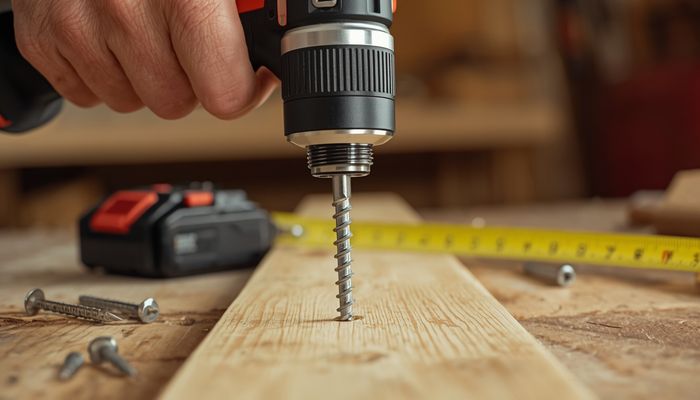
A cordless drill driver is a battery-powered tool with a variable-speed motor, a clutch that disengages at a set torque to prevent over-tightening, and a chuck that accepts drill bits and driver bits. Modern brushless motors (introduced 2010) deliver 30-50% more runtime and lifespan than brushed motors. Voltage refers to battery cells: 12V drills are compact and light (good for trim work), 18V/20V are standard homeowner size, and 36V/40V are for heavy-duty users.
The distinction between a drill driver, hammer drill, and impact driver matters: a drill driver has a clutch and is best for screws and drilling in wood and metal. A hammer drill adds a percussive hammering action for masonry and concrete. An impact driver uses rotational impacts to drive long screws and lag bolts without the user fighting torque reaction.
How Much Does Cordless Drills Cost?
A quality 18V or 20V brushless drill driver kit (drill, battery, charger, case) costs $150-$300 for mid-range and $300-$500 for premium. Bare-tool prices (drill only, for users who already own batteries on the same platform) run $80-$200. Avoid sub-$50 brushed drills; their motors burn out at 100-200 hours of use.
| Tier | Voltage | Bare Tool | Full Kit |
|---|---|---|---|
| Budget brushless | 18V/20V | $80-$130 | $150-$220 |
| Mid-range homeowner | 18V/20V | $130-$200 | $200-$320 |
| Premium prosumer | 18V/20V | $180-$300 | $280-$450 |
| Compact 12V | 12V | $70-$120 | $120-$200 |
| Heavy duty 36V/40V | 36V/40V | $200-$350 | $350-$600 |
How Long Does Cordless Drills Last?
A quality brushless cordless drill lasts 8-15 years of homeowner use. The drill body and motor typically outlast the original battery (3-5 years on lithium-ion, replaceable). Chucks wear or develop runout at 1,000+ hours of heavy use. Premium brands (DeWalt, Milwaukee, Makita) honor 3-year tool warranties; Ryobi offers 3-year tool plus 2-year battery.
Can I DIY Cordless Drills?
Cordless drills are the foundation of homeowner DIY and are designed for owner use. Hang shelves, assemble furniture, build decks, hang doors, drive screws, drill pilots, mix paint, drive lag bolts, and bore holes. The main DIY skill is matching the bit to the material (twist bits for metal and wood, spade or auger for large wood holes, masonry bit for concrete, self-tapping for sheet metal), and managing the clutch to avoid stripping screws.
What Are the Best Cordless Drills Options?
DeWalt, Milwaukee, and Makita are the top tier. Ryobi is the value pick for homeowners who do not need pro-grade duty cycles. Bosch and Metabo HPT are strong specialty picks. Most importantly, pick a battery platform and commit to it: switching brands later means rebuying batteries at $80-$150 each.
| Brand | Notable Model | Voltage | Kit Price |
|---|---|---|---|
| DeWalt | DCD800 Atomic | 20V max brushless | $200-$300 |
| Milwaukee | M18 FUEL 2904 | 18V brushless | $250-$380 |
| Makita | XFD13 | 18V LXT brushless | $200-$330 |
| Ryobi | HP Brushless P252 | 18V brushless | $130-$200 |
| Bosch | GSR18V-535 | 18V brushless | $180-$280 |
For most homeowners doing occasional projects (a few hours per month), Ryobi 18V One+ is the right pick. The tool quality is 80% of a DeWalt at 50% of the price, and the battery platform now spans 280+ tools. For 5+ hours per week or any pro use, step up to DeWalt 20V max or Milwaukee M18.
When Should I Replace or Upgrade Cordless Drills?
Replace a cordless drill when the motor brushes are worn through on a brushed drill (no longer holds speed under load), the chuck wobbles visibly (runout exceeds 0.01 inch), the trigger no longer modulates speed smoothly, the gearbox makes grinding noises, or the housing has cracked structurally. Battery failures are usually a battery replacement ($60-$150), not a tool replacement.
18V vs 20V max: what is the difference?
Marketing. 20V max is the same thing as 18V; the 20V figure is the peak unloaded voltage of a fully charged 18V battery pack. DeWalt and other US brands started calling 18V batteries 20V max in 2011 as a marketing differentiator. Performance is identical.
Do I need a hammer drill or just a regular drill?
For occasional masonry work (anchoring shelves to concrete or brick a few times a year), a standard drill with a quality masonry bit will work, slowly. For repeated masonry drilling or anchoring to concrete block, a hammer drill is much faster and easier on the bit. For breaking concrete or extensive masonry, you need a rotary hammer (SDS chuck), not a hammer drill.
Should I get an impact driver, drill, or both?
Both, if budget allows. The impact driver excels at driving long screws and bolts (it cannot drill). The drill driver excels at drilling and at delicate screw tasks where the clutch is useful. Most pros carry both. For a single tool, choose the drill driver.
How long do cordless drill batteries last?
Lithium-ion battery packs last 3-5 years or about 1,000-1,500 charge cycles, whichever comes first. Storing batteries at 40-60% charge in cool conditions extends life. Storing fully charged or fully drained for months reduces capacity permanently. Replacement batteries cost $60-$150.