What EV Charger Installation Entails for Homeowners
TL;DR: A home Level 2 EV charger installation costs $1,200-$3,500 for the unit plus a 40-50A circuit run, with most homeowners paying around $1,800. The charger itself runs $400-$1,200; electrician labor is $500-$1,500. Top brands: Tesla Wall Connector, ChargePoint Home Flex, Wallbox Pulsar Plus, and Grizzl-E. A typical Level 2 charger adds 25-40 miles of range per hour of charging. Installation requires a 240V 40-50A dedicated circuit, a licensed electrician, and a permit; this is not a DIY project except for simple plug-in models on existing 240V outlets.
What Is EV Charger Installation?
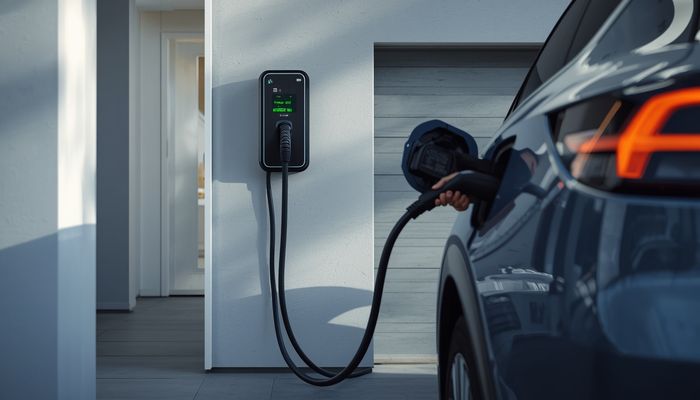
A Level 2 EV charger (technically EVSE, electric vehicle supply equipment) delivers 240V power at 16-80 amps to your EV, charging at 6-19 kW. Most home installations use a 40A or 50A circuit delivering 7.7-9.6 kW, adding 25-40 miles of range per hour. Chargers come in two types: hardwired (permanently mounted, required for some units over 40A) and plug-in (using a NEMA 14-50 or 14-30 outlet, the same outlet style as an electric range or RV).
How Much Does EV Charger Installation Cost?
Total installed cost for a residential Level 2 charger runs $1,200-$3,500, with the median around $1,800. The charger unit costs $400-$1,200; electrician labor and materials for a 40-50A circuit run $500-$1,500. Long runs from the panel (over 50 feet) or panel upgrades push costs to $3,000-$7,000.
| Component | Cost Range |
|---|---|
| Level 2 EVSE unit | $400-$1,200 |
| Short circuit run (panel within 15 ft) | $300-$600 |
| Medium circuit run (15-50 ft) | $500-$1,200 |
| Long circuit run (50-100 ft, conduit) | $1,000-$2,500 |
| Panel upgrade (if needed) | $2,500-$5,500 |
| NEMA 14-50 outlet only (DIY-friendly) | $200-$500 install only |
Federal tax credit (Section 30C, restored in 2023) covers 30% of installation cost up to $1,000 per residence. Many states and utilities offer additional rebates of $200-$1,500. Check your utility’s EV program before purchasing; some require specific brands or networking features.
How Long Does EV Charger Installation Last?
Quality Level 2 chargers last 8-15 years. Outdoor-rated chargers in cold or wet climates fail slightly faster (cracked enclosures, corroded connectors). The J1772 connector itself (the plug end) wears with use and is typically replaceable. Software-defined chargers (ChargePoint, Wallbox) receive ongoing firmware updates and can outlast their physical components.
Can I DIY EV Charger Installation?
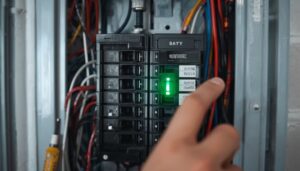
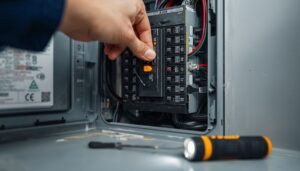
Installing a plug-in Level 2 charger into an existing NEMA 14-50 outlet (used by RV plugs and some electric ranges) is genuinely DIY: mount the bracket, plug in, configure via app. Installing the 14-50 outlet itself, or hardwiring a charger, is not DIY. It requires a 40-50A double-pole breaker, 6 AWG copper wire (or 8 AWG aluminum), conduit per code, GFCI protection (NEC 2020/2023 requirement on 14-50 outlets), and a permit in every U.S. jurisdiction.
What Are the Best EV Charger Installation Options?
Tesla Wall Connector is the bestseller and works with non-Tesla EVs via included J1772 adapter (and with NACS port directly). ChargePoint Home Flex offers the strongest scheduling and utility integration. Wallbox Pulsar Plus is the most compact. Grizzl-E is the budget pick. For most homeowners, the Tesla Wall Connector at $475 with the bundled adapter is the best value.
| Brand | Model | Max Output | Price |
|---|---|---|---|
| Tesla | Wall Connector | 48A / 11.5 kW | $425-$475 |
| ChargePoint | Home Flex | 50A / 12 kW | $600-$700 |
| Wallbox | Pulsar Plus | 48A / 11.5 kW | $550-$700 |
| Grizzl-E | Classic | 40A / 9.6 kW | $400-$500 |
| Emporia | EV Charger | 48A / 11.5 kW | $400-$500 |
Most homes do not need the full 48-50A output. A 32A charger (7.7 kW) adds about 25 miles per hour, sufficient to fully charge most EVs overnight. Down-sizing to 32A allows installation on a 40A circuit with cheaper 8 AWG wire, often saving $200-$500 on the install.
When Should I Replace or Upgrade EV Charger Installation?
Replace an EV charger when the J1772 (or NACS) connector latch is broken, the cable insulation is cracked or damaged, the unit displays repeated charging faults that survive a power-cycle, the firmware is no longer supported, or the manufacturer has been acquired or discontinued (orphaned hardware loses scheduling and app features). Charging speed degradation alone is usually a vehicle battery issue, not a charger issue.
Do I need a Level 2 charger if I drive less than 40 miles a day?
Probably not. A standard 120V Level 1 outlet (the cable that comes with most EVs) adds 3-5 miles of range per hour, or about 40-50 miles overnight. That is sufficient for the average U.S. commute of 30 miles. Level 2 becomes worth it if your daily driving exceeds 40 miles, you have two EVs, or you sometimes need to top up quickly mid-day.
Can I install an EV charger without upgrading my electrical panel?
Often yes. A 100A service can typically support a 40A EV charger if the existing load calculation has headroom (most homes do, especially with gas appliances). A licensed electrician runs the calc per NEC Article 220 and recommends. Load-management chargers (Wallbox, Emporia) can also share an existing circuit by throttling when the dryer or AC is running.
Hardwired vs plug-in: which is better?
Hardwired is cleaner aesthetically and avoids the recent NEC requirement for GFCI protection on 14-50 outlets (which causes nuisance trips with some chargers). Plug-in is portable, easier to replace, and qualifies the charger as portable equipment in some warranty contexts. For permanent home use, hardwire.
What is the difference between Level 1, Level 2, and Level 3 charging?
Level 1 is standard 120V household power, 1.4 kW, adds 3-5 miles per hour. Level 2 is 240V residential or workplace, 7-19 kW, adds 25-50 miles per hour. Level 3 (DC fast charging) is 400-800V high-power infrastructure, 50-350 kW, adds 100-300 miles in 30 minutes; not available for residential install due to power requirements.