
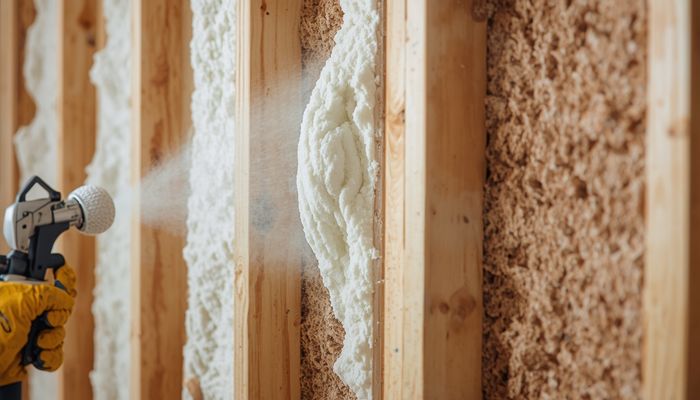
Defining Spray Foam Insulation: What Homeowners Need to Know
TL;DR: Spray foam insulation is a high-performance insulation material sprayed on-site that expands to seal gaps and provide superior thermal resistance. It offers R-values of R-6 to R-7 per inch (closed-cell) or R-3.5 to R-4 per inch (open-cell), blocks air and moisture, and can reduce energy bills by 30–50%. It costs $0.50–$2.50 per board foot installed, but pays for itself in energy savings and structural reinforcement.
What Is Spray Foam Insulation?
Spray foam insulation is a two-component polyurethane or polyisocyanurate foam that is applied as a liquid and rapidly expands into a solid insulating layer. Unlike traditional fiberglass batts or cellulose, spray foam forms a continuous, seamless barrier that fills every crack, crevice, and irregular cavity. It is widely considered the gold standard in home insulation due to its exceptional air-sealing properties and high R-value per inch.
There are two primary types:
- Closed-cell spray foam (CCSPF): Dense, rigid foam with tiny sealed cells. R-value: R-6 to R-7 per inch. Acts as a vapor barrier and adds structural strength.
- Open-cell spray foam (OCSPF): Softer, lighter foam with open cells that allow some moisture permeability. R-value: R-3.5 to R-4 per inch. Best for interior applications and soundproofing.
Spray foam is commonly used in attics, crawl spaces, walls, rim joists, and metal buildings. It is applied by trained professionals using specialized spray equipment and requires protective gear during installation.
How Spray Foam Insulation Works (Technical)
The chemistry behind spray foam is a precise reaction between two liquid components—an isocyanate (A-side) and a polyol resin (B-side). When these chemicals meet at the spray gun tip, they react exothermically, creating a foaming polymer that expands 30–60 times its liquid volume within seconds.
The expansion process is critical: as the foam cures, it fills every void, sealing air leaks and creating a monolithic insulating layer. The thermal performance comes from the millions of tiny gas-filled cells (in closed-cell) or interconnected air pockets (in open-cell) that reduce conductive heat transfer.
Key technical metrics:
- R-value per inch: R-6.5 for closed-cell (typical); R-3.8 for open-cell (typical).
- Air permeability: Closed-cell is <0.02 L/s·m² at 75 Pa (effectively an air barrier). Open-cell is more permeable but still reduces air movement by ~90%.
- Water vapor permeance: Closed-cell 10 perm (vapor permeable).
- Compressive strength: Closed-cell ~20–40 psi; open-cell ~1–5 psi.
- Expansion ratio: Typically 1:30 to 1:60, depending on formulation.
Once cured (typically within 24 hours), spray foam becomes inert, non-toxic, and resistant to mold, pests, and moisture.
Why Spray Foam Matters (Real Examples)
Consider a typical 2,000 sq. ft. home in a cold climate (Zone 5) with an uninsulated attic. Before spray foam: air leaks cause drafts, ice dams form on the roof, and heating bills average $300/month. After installing 4 inches of closed-cell spray foam (R-26):
- Heating bills drop to $150/month—a 50% reduction.
- Ice dams disappear because the attic stays cold, preventing snow melt.
- The home is noticeably quieter, with reduced outside noise.
- Indoor humidity stabilizes, reducing the risk of mold.
Another example: a homeowner in Houston, Texas (hot-humid climate) with leaky ductwork in an unconditioned attic. By spray foaming the roof deck (unvented attic assembly) with 5 inches of closed-cell foam (R-33), they:
- Eliminated condensation on ducts (reducing mold risk).
- Cut cooling costs by 35%.
- Gained usable attic storage space (no need for vent chutes).
Spray foam also adds structural strength. In hurricane-prone areas, closed-cell foam can increase a wall’s racking strength by up to 300%, helping resist wind forces.
Spray Foam vs Related Terms (Comparison Table)
| Property | Spray Foam (Closed-Cell) | Spray Foam (Open-Cell) | Fiberglass Batt | Cellulose (Blown-in) | Rigid Foam Board |
|---|---|---|---|---|---|
| R-value per inch | R-6 to R-7 | R-3.5 to R-4 | R-2.9 to R-3.8 | R-3.2 to R-3.8 | R-4 to R-6.5 |
| Air barrier? | Yes (seals leaks) | Partial (reduces airflow) | No (requires separate air sealing) | No (requires air sealing) | Yes (if joints taped) |
| Vapor retarder? | Yes (Class II) | No (vapor permeable) | No (unless faced) | No | Varies (foil-faced = Class I) |
| Moisture resistance | Excellent (closed cells) | Moderate (can absorb moisture) | Poor (absorbs water, loses R-value) | Poor (absorbs water, settles) | Good (closed cell) |
| Soundproofing | Good | Excellent (absorbs sound) | Fair | Good | Fair |
| Installed cost (per board foot) | $1.50–$2.50 | $0.50–$1.00 | $0.30–$0.60 | $0.40–$0.80 | $0.80–$1.50 |
| DIY possible? | No (professional only) | No (professional only) | Yes | Yes (with machine rental) | Yes |
| Lifespan | 80+ years (no settling) | 80+ years (no settling) | 20–30 years (can sag) | 20–30 years (can settle) | 50+ years |
Learn More: The U.S. Department of Energy offers detailed guides on all insulation types and their recommended applications. For professional standards, visit the Spray Polyurethane Foam Alliance (SPFA) or the North American Insulation Manufacturers Association (NAIMA).
Note: Costs vary by region, thickness, and accessibility. Board foot = 1 sq. ft. at 1 inch thick.
When to Use Spray Foam Insulation
Spray foam is ideal for specific scenarios where high performance and air sealing are priorities:
- Attics (unvented assemblies): Spray foam directly onto the underside of the roof deck to create a conditioned attic. Eliminates need for vent chutes and prevents ice dams.
- Crawl spaces: Seal and insulate crawl space walls and floor joists to prevent moisture, pests, and cold floors.
- Rim joists and band boards: These are notorious leak points. A 2-inch layer of closed-cell foam seals them completely.
- Walls in new construction or major renovations: Provides continuous insulation with no gaps, especially in stud cavities with complex shapes.
- Metal buildings and pole barns: Closed-cell foam prevents condensation on metal surfaces and adds structural rigidity.
- Soundproofing interior walls: Open-cell foam excels at reducing airborne noise between rooms.
Avoid spray foam when: you need a quick, cheap fix (use caulk or fiberglass instead); the area is prone to standing water (foam can trap moisture against wood); or you have a strict budget and cannot afford professional installation.
FAQ
Is spray foam insulation worth the cost?
Yes, for most homes. While upfront costs are 2–3 times higher than fiberglass, the energy savings (30–50% reduction) and longevity (80+ years) often deliver an ROI of 100–200% over 10 years. Plus, it increases home resale value.
Can I install spray foam myself?
Not recommended. DIY spray foam kits (e.g., Froth-Pak) exist but are small-scale (200–600 board feet) and often result in poor mixing, off-ratio foam, or incomplete curing. Professional installers have the equipment, training, and safety gear to apply it correctly.
Does spray foam cause roof rot?
Only if installed incorrectly in a vented attic without proper vapor management. In unvented attic assemblies (foam on roof deck), the foam prevents warm, moist air from reaching the cold roof sheathing, actually reducing condensation risk. Always follow building codes and insulation trained professionals.
How thick should spray foam be?
For closed-cell: minimum 2 inches for air sealing (R-13), 4–5 inches for walls (R-26–R-33), 6–8 inches for attics (R-39–R-52). For open-cell: typically 3–6 inches (R-12–R-24). Check local energy code requirements for your climate zone.
Is spray foam safe after it cures?
Yes. Once fully cured (24–48 hours), spray foam is inert, non-toxic, and does not off-gas. However, during installation, the chemicals are hazardous—installers must wear full PPE, and occupants should vacate the home for at least 24 hours.
Does spray foam attract pests?
No. Spray foam is not a food source for insects or rodents. However, mice can chew through it (as they can any foam). Use metal mesh or copper wool to seal large gaps before foaming in areas prone to rodent entry.


Can insulation be added without tearing down walls? Our house is finished and we don’t want to open everything up.
We always upgrade insulation in flips. The cost is minimal and it’s a big checkbox for home inspectors.