Interior Painting Tips and Techniques
TL;DR: Painting a room is the highest-ROI improvement project most homeowners can make. DIY material cost is $50-$200 per room; professional painting costs $2-$6 per square foot of wall area or $400-$1,500 per average room. Quality paint lasts 7-15 years in most rooms, 3-7 years in kitchens and bathrooms. Top brands: Sherwin-Williams, Benjamin Moore, Behr, Valspar. Interior painting is one of the most accessible DIY projects; the difference between amateur and pro work comes down to surface prep, cut-in technique, and paint quality.
What Is Interior Painting?
Interior painting is the application of a primer and topcoat finish to interior walls, ceilings, and trim. Modern interior paints are water-based latex or acrylic with very low VOC. Sheen levels range from flat (most matte, hides imperfections) to high gloss (most reflective, durable). Each room typically uses one sheen for walls (flat or eggshell), one for ceilings (flat or matte), and a higher sheen for trim and doors (satin or semi-gloss).
How Much Does Interior Painting Cost?
DIY interior painting costs $50-$200 per average bedroom or living room: 2 gallons of mid-range paint ($60-$120), brushes and rollers ($25-$50), drop cloths and painter’s tape ($15-$30), and primer if needed ($25-$50). Professional painting runs $2-$6 per square foot of wall area, $400-$1,500 per average room, or $3,500-$12,000 for whole-house interior.
| Job | DIY Materials | Pro Cost |
|---|---|---|
| Single bedroom (10×12 ft) | $50-$150 | $400-$900 |
| Living room (15×20 ft) | $100-$250 | $600-$1,500 |
| Bathroom (5×8 ft) | $40-$100 | $300-$700 |
| Kitchen (cabinets + walls) | $200-$500 | $2,500-$8,000 |
| Whole-house interior (2,000 sq ft) | $400-$1,200 | $3,500-$10,000 |
How Long Does Interior Painting Last?
Quality interior paint lasts 7-15 years in low-traffic rooms (bedrooms, formal dining), 5-10 years in high-traffic areas (hallways, living rooms with kids), and 3-7 years in kitchens and bathrooms (moisture and grease). Premium paints (Benjamin Moore Aura, Sherwin-Williams Emerald) last 50-100% longer than budget paints in equivalent conditions.
Can I DIY Interior Painting?
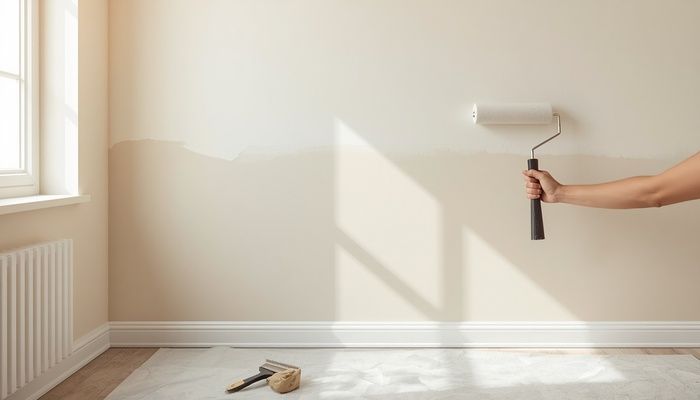
Interior painting is one of the most DIY-friendly projects in home improvement. Plan a weekend per room: clear and cover furniture, repair holes with spackle, sand and wipe walls, tape trim, prime any patches or stains, cut in edges with a 2-inch angled brush, roll the bulk of the wall with a 3/8 or 1/2 inch nap roller, apply two coats. The two skills that separate DIY from pro: clean cut-in lines at trim and ceiling, and even coverage without lap marks.
Cabinets, doors, and trim require more skill and time than wall painting. Plan 2-4 days for kitchen cabinet painting: degrease thoroughly, sand all surfaces, prime with shellac or oil primer, apply 2-3 coats of cabinet-grade paint (Benjamin Moore Advance, Sherwin-Williams Emerald Urethane). The cured finish takes 14-21 days to fully harden; gentle use only during that period.
What Are the Best Interior Painting Options?
Sherwin-Williams Duration, Benjamin Moore Regal Select, and Behr Marquee are the workhorses of mid-range interior paint. Premium picks: Benjamin Moore Aura (the gold standard for color depth and one-coat coverage) and Sherwin-Williams Emerald (washable, durable, low odor). Budget picks: Behr Premium Plus and Valspar Signature.
| Brand | Mid-Range Line | Premium Line | Price per gallon |
|---|---|---|---|
| Benjamin Moore | Regal Select | Aura | $50-$80 |
| Sherwin-Williams | SuperPaint / Duration | Emerald | $55-$95 |
| Behr | Premium Plus Ultra | Marquee | $30-$55 |
| Valspar | Signature | Reserve | $35-$55 |
| Farrow & Ball | Estate Emulsion | – | $110-$140 |
When Should I Replace or Upgrade Interior Painting?
Repaint when the existing finish shows scuffs and stains that no longer clean (especially on flat paints), color has faded or yellowed (most common on south-facing walls and oil-based paints), peeling or cracking has begun (usually a moisture or adhesion issue requiring scraping and primer), or you simply want a new color. A two-color change (light to dark or dark to light) requires a coat of primer plus two coats of finish; same-tone change typically needs only two coats of finish.
Flat vs eggshell vs satin: which sheen should I use?
Bedrooms and living rooms: flat or eggshell (hides wall imperfections, modest washability). Hallways and kitchens: satin or eggshell (more washable, slight sheen). Bathrooms: satin or semi-gloss (moisture resistant). Trim and doors: semi-gloss or gloss (high durability, easy to clean). Ceilings: flat (most matte hides imperfections; no fingerprints to worry about).
Do I need to prime before painting?
Yes if you are painting over: fresh drywall or patches, glossy existing paint (sand first too), bare wood, stains or water marks, or a dramatic color change (dark to light especially). Same-color refresh or recent flat-to-eggshell change can usually skip primer; most quality paints today are ‘paint-and-primer-in-one’ which is real for these scenarios.
How much paint do I need for one room?
Rule of thumb: 1 gallon covers 350-400 sq ft of wall area in one coat. A 10×12 ft bedroom with 8 ft ceilings has about 350 sq ft of wall, needing 1 gallon per coat, 2 gallons total. Always round up; running out mid-coat creates lap marks where wet paint dries before joining the next stroke.
Why are my brush strokes showing after painting?
Most often: paint dried too fast (high temperature, low humidity, or thinned paint) or you used a wrong brush. Use a quality brush (Purdy Clearcut or Wooster Silver Tip) for cut-in. For rolling, use a 3/8 to 1/2 inch nap microfiber roller cover and avoid overworking; once you’ve rolled a section, leave it. Lap mark prevention also means keeping a wet edge by working across the wall continuously.