
It Took Me Three Weeks to Paint My Kitchen Cabinets and I’d Do It Again Tomorrow
I spent three weekends painting my kitchen cabinets. Not three days — three weekends. Friday night through Sunday evening, times three. My wife and I ate takeout for 21 days straight. The kitchen was a disaster zone of sanded cabinet doors leaning against every wall, drop cloths duct-taped to the floor, and the permanent smell of paint.
It was the best home improvement decision I’ve ever made. The cabinets went from 1990s golden oak to a clean, modern white that made the entire kitchen look like a $20,000 renovation. It cost me about $300 in materials. The quotes I got from painters were $3,500 to $5,000. Here’s exactly what I did.
The Prep That Makes or Breaks the Job
If you skip prep, your cabinets will look good for about six months and then the paint will start peeling at the edges where fingers touch. Cabinet painting is 80% preparation and 20% actual painting.
Remove everything. Take off every door, every drawer front, every hinge, every knob. Label each door and its location with painter’s tape and a number (1 through however many you have). Draw a diagram of which door goes where. You will forget. I forgot. I spent 45 minutes holding doors up to empty cabinet frames like I was trying to solve a wooden puzzle.
Clean like you’re preparing for surgery. Kitchen cabinets have years of cooking grease, hand oils, and whatever aerosolized bacon fat is floating around your kitchen. Paint does not stick to grease. I cleaned every surface with Krud Kutter ($8/bottle) and a Scotch-Brite pad. Then I wiped everything down with clean water. Then I let it dry overnight. If you can feel any slickness on the surface with your fingers, it’s not clean enough.
Sand everything. You’re not sanding to bare wood — you’re sanding to create texture for the primer to grip. I used 220-grit sandpaper on a sanding block for flat surfaces and a sanding sponge for the detailed areas (inside corners of raised-panel doors) — the same prep that finally got me a clean finish on my trim. After sanding, vacuum everything and wipe down with a tack cloth ($2). The surface should feel slightly rough, like an eggshell.
The Paint System I Used
Primer: Zinsser BIN shellac-based primer ($28/quart). It’s expensive, it smells like a chemical factory, and it dries in about 45 minutes. It also blocks tannin bleed from the oak (golden oak will bleed yellow through latex primer within a month) and bonds to the old finish better than any water-based primer. I applied one coat with a 4-inch foam roller and a 2-inch angled brush for corners. Wear a respirator — the fumes are real.
Paint: Benjamin Moore Advance in satin ($54/gallon). This is the water-based alkyd I mentioned in the article on sheen. It levels like oil paint — brush marks disappear as it dries — but it cleans up with water. The catch: it takes 16 hours to recoat. That’s why the job took three weekends. I applied two coats, sanding lightly with 320-grit between coats.
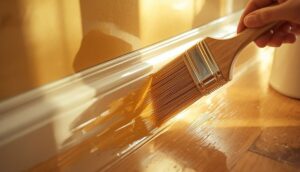
Application method: 4-inch foam roller for flat areas, 2.5-inch Purdy angled sash brush for corners and detailed profiles. Roll first to get an even coat without brush marks, then “tip off” immediately — run the dry brush very lightly over the wet paint in one direction to pop any air bubbles from the roller. This gives you a finish that looks sprayed-on.
The Timeline, Which Is the Whole Reason It Took Three Weeks
Cabinet paint fails on the clock far more often than on technique. These are the intervals I worked to, and the ones I would hold anyone to.
| Step | Wait before the next step | What happens if you rush it |
|---|---|---|
| Degrease, then rinse with clean water | Dry overnight | Primer beads over trapped cleaner residue |
| Sand at 220, vacuum, tack cloth | — | Dust nibs locked under the primer permanently |
| Shellac primer | About 45 minutes to recoat | Rarely a problem — this is the fast part |
| Scuff the primer at 320 | — | Poor mechanical key under the first color coat |
| Waterborne alkyd, first coat | 16 hours before the second | The second coat drags and re-wets the first; brush marks lock in |
| Second coat | 24 to 48 hours before rehanging | Hinge screws tear a soft film |
| Full cure | About 30 days | Blocking — doors fuse to the frames and tear when opened |
Blocking is the one that catches people, because everything looks finished long before it is. A waterborne alkyd is dry to the touch in a few hours and hard enough to hang in a day or two, but it keeps hardening for weeks. Close a freshly painted door against a freshly painted frame in week one and the two films weld themselves together; opening it lifts paint off both. For the first month I stuck small clear bumper pads on the frame stops — a $4 sheet of them — and simply did not close the doors all the way. Same principle for the insides: nothing went back into the cabinets for a week, and nothing heavy or greasy sat on a painted shelf for a month.
Temperature is the hidden variable under every one of those numbers. Most waterborne alkyds want 50°F as an absolute minimum and slow down badly below about 60°F, and the published 16-hour recoat assumes roughly 70°F and 50% humidity. Painting doors in an unheated garage in November turns a 16-hour recoat into two days, and there is no way to speed that up that does not show in the finish. Three weekends was the honest answer for the conditions I actually had.
What I’d Do Differently
Set up a proper drying rack. I leaned doors against walls on drop cloths and they picked up dust and dog hair. Next time I’m building a simple rack: 2x4s with nails driven partway in at an angle, resting on sawhorses. Each door hangs from its hinge hole on a nail, nothing touches the painted surface. The rack costs $15 in lumber and saves hours of sanding out dust nibs.
Paint the cabinet boxes first. I painted the doors and drawer fronts first and then had to store them somewhere while I painted the frames. The doors took up the entire dining room for two weeks. Paint the boxes first, then the doors — you can leave the doors off while working on the frames.
Buy new hardware. Old brass hinges and knobs on freshly painted white cabinets look like the “before” picture. New soft-close hinges and modern brushed nickel pulls cost about $100-150 for an average kitchen and make the cabinets feel brand new. I bought Liberty soft-close hinges ($3.50 each) and Richelieu pulls ($4 each) on Amazon.
Three weeks of takeout, $300 in materials, and my kitchen looks like a different house. The quote from the painter was $4,200. I’m not saying painting cabinets is easy — it’s genuinely the hardest painting job in a house — but the return on effort is enormous. My only regret is not doing it five years earlier.