
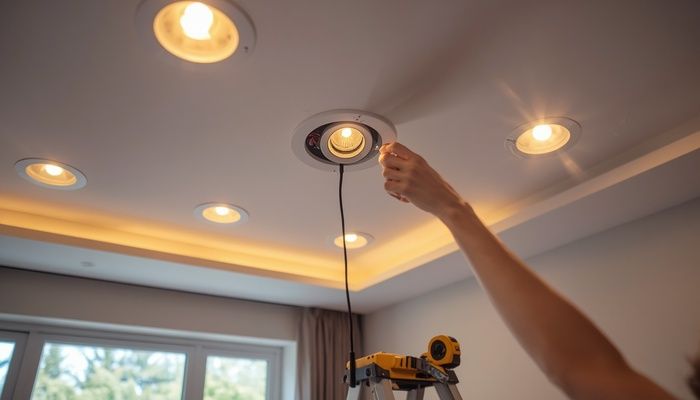
I Cut 12 Holes in My Ceiling Before Realizing I Needed Fire-Rated Lights
The living room in my 1990s house had a single light fixture in the center of the ceiling — one of those brass-and-frosted-glass boob lights that every builder installed for 30 years. The room was dark. The corners were caves. Reading on the couch required a floor lamp that my toddler kept pulling over.
I decided to install six recessed lights — the kind that sit flush with the ceiling, canless LED wafer lights that are only half an inch thick. I mapped out the layout, cut all twelve holes (six for the lights, six for the drywall patches where I’d removed the old fixture box), ran the wiring, and was about to clip the lights in when I read the fine print on the box: “Requires junction box rated for direct contact with insulation.” I had bought standard junction boxes. The lights were going into an insulated attic. Standard junction boxes in contact with insulation are a fire hazard.
I drove back to Home Depot, bought the right boxes, and spent another two hours swapping them out. Here’s what I learned about recessed lighting — the stuff the YouTube videos skip.
Canless vs Can Lights: The Choice Nobody Explains
Old-school recessed lights use a metal “can” — a cylindrical housing that mounts between the ceiling joists and holds the light bulb and trim. They’re bulky (6-8 inches tall), they require at least 7 inches of clearance above the ceiling, and they leak air into the attic.
Modern canless wafer lights (the kind I installed) are LED discs about half an inch thick. They clip into a hole in the drywall with spring-loaded tabs — no housing needed. They cost $15-25 per light (I used Halo HLB6, $22 each at Home Depot), they’re rated for direct contact with insulation, and they install in about three minutes per light after the wiring is done.
The difference that matters: canless lights need a junction box above the ceiling for each light (the driver that powers the LED lives in the box). Can lights have the junction box built into the housing. If you have limited access above the ceiling (finished attic, second floor between joists), canless is easier because you only need to fish a cable, not install an entire housing.
The Ratings on the Box, and Why Mine Were Wrong
The label I had not read is the one that decides whether a fixture can be buried in insulation. The NEC covers it in Article 410.116: a recessed luminaire not marked IC must be spaced at least 1/2 inch from combustible material, and thermal insulation has to be kept 3 inches away from the enclosure — which matters a great deal if you are about to blow a foot of cellulose over that ceiling and off the top of it. A luminaire marked IC is listed for direct contact with insulation and may be buried. A separate marking, usually “airtight” or “AT”, means the housing is sealed against air leaking into the attic. That is a different property entirely, and it is the one that stops your heated air from going up through six new holes in the ceiling.
Canless wafers move the electronics into a remote junction box, and that box falls under NEC 314.29: it must remain accessible without removing any part of the building. Burying an unmarked driver box under a foot of blown insulation, or drywalling over it, is a violation and a genuinely miserable thing to troubleshoot in five years. I flagged each of mine with a strip of orange tape stapled to the nearest truss so the next person can find them.
The rest of the numbers I use now: a 6-inch downlight at 600 to 800 lumens and 2700K to 3000K reads as ordinary warm room light, while 4000K makes a living room look like a dental surgery. And LED dimming needs a dimmer listed for LED loads, with the fixture appearing on that dimmer’s compatibility list — a legacy incandescent dimmer expects a minimum load that LEDs never draw, which is the whole reason for the flicker and the buzz at the bottom of the range.
Where the line is, and I mean this one. Swapping a fixture on an existing circuit is homeowner work in most places. Adding a new branch circuit, adding or changing a breaker, or working inside the panel is not — that is the same reason a whole-house surge protector is an electrician’s job: most jurisdictions require an electrical permit and an inspection for new circuits and rough wiring, and a number of states require a licensed electrician to perform it at all. My six lights went onto the existing switched circuit that already fed the single fixture, and that is precisely what kept the job inside what I was willing to take on. If your plan begins with “I’ll just add a circuit,” stop and call your building department before you buy anything. The permit costs less than the fine, and unpermitted wiring surfaces at resale.
The Layout Mistake I See Everywhere
The most common mistake in recessed lighting layout: spacing lights evenly in a grid without considering what’s below them. You end up with a light directly over a ceiling fan (strobe effect), a light over a walkway instead of a seating area, or dark corners where people actually sit.
The rule I follow now: start with the furniture layout, not the ceiling grid. Place lights where people sit, where the dining table goes, and above countertops. Then fill in to eliminate dark spots. The standard spacing is the ceiling height divided by two — for an 8-foot ceiling, space lights about 4 feet apart. But this is a starting point, not a rule. Over a kitchen island, I space lights 30-36 inches apart because the task lighting needs are higher.
Distance from walls: keep recessed lights at least 2 feet from the wall. Any closer and you get harsh scalloping — bright cones of light washing down the wall. For accent lighting on artwork or a fireplace, that’s what you want. For general room lighting, it looks like a hotel hallway.
What I Actually Spent
Six Halo HLB6 wafer lights at $22 each: $132. Fifteen feet of 14/2 Romex: $11. Six junction boxes (the right ones, fire-rated): $18. A 4-inch hole saw for the drywall cuts: $15. Miscellaneous wire nuts, staples, and a roll of electrical tape: $12. Total: $188.
An electrician quoted me $1,200 for the same job — $200 per light including the fixture. I saved about $1,000 by doing it myself. It took a full day — four hours of layout and cutting, four hours of wiring, two hours of drywall patching (removing the old fixture box left a 6-inch hole in the center of the ceiling).
The living room is no longer a cave. No more floor lamps. No toddler has pulled over a lamp in six months. The lights are on a dimmer (Lutron Diva LED+ dimmer, $28 — do not use a standard dimmer with LED lights, they flicker at low settings), and at 50% they create a warm glow that makes the room feel twice as big as it did with the boob light. That brass fixture is in the garage now. I should throw it away. I probably won’t.

