
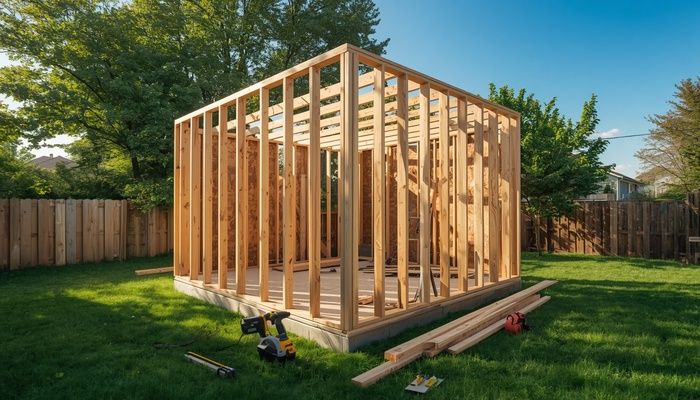
I poured my concrete pad on the hottest day of August. Ninety-six degrees. The mud started setting before I could get it floated flat. I panicked, added water to the mix halfway through — which you’re never supposed to do — and ended up with a slab that looked like a topographical map of Nebraska. Humps, dips, and a low corner that collected water every time it rained.
That was day one of my shed build. It got worse before it got better.
I’d spent months looking at those pristine Tuff Shed catalogs with their perfect gable roofs and crisp white trim. The catalog photos don’t show you what happens when your framing lumber is green and twists after you nail it. They don’t mention that roofing in the rain is like ice skating on sandpaper — you will fall, and the shingles will slide if the felt gets wet underneath. They definitely don’t mention what it’s like to measure your diagonals at the end of the day and realize your 10-by-14 frame is an inch and a quarter out of square.
I built a shed. It took five weekends, not three. It cost $2,800, not $1,800. And it taught me more about carpentry than any book or video ever did.
The Foundation: Get This Wrong and Nothing Else Matters
I had two choices for my foundation: a gravel pad on 4×4 skids, or a poured concrete slab. I chose concrete because I wanted a permanent floor I could roll a lawn tractor onto. Big mistake for a first-timer working alone.
Concrete is not a one-person job. You need at least two people — one running the screed, one working the float — and ideally three if you want it to come out flat. The yard of concrete shows up in a truck and you have maybe 45 minutes before it starts to kick, less on a hot day. I learned this the hard way.
If I were doing it again, I’d go with a gravel pad and pressure-treated skids. Arrow and Tuff Shed both sell pre-cut skid foundation kits for around $200. You level four or six skids on compacted gravel, check your diagonals with a 100-foot tape, and you’re square in an afternoon. Gravel also drains, so you’re not fighting standing water against your floor frame. My concrete pad, with all its low spots, has required resealing twice in four years.
Framing: Your Square Is Lying to You
Every shed build starts with big optimism and a speed square. By hour four, you’ve learned that a speed square checks square in six inches, not sixteen feet. The only way to check a wall frame or a floor deck is with a tape measure across the diagonals. If both measurements match, you’re square. If they don’t, you rack the frame until they do.
I didn’t check the diagonals until after I’d nailed the plywood deck down. The frame was an inch and a quarter out. Rookie move. I had to pull 48 screws and re-rack the entire floor assembly. My neighbor came over around then, looked at what I was doing, and said, “You know they sell pre-built sheds, right?” I didn’t find it funny at the time.
Wall framing went better, mostly because I built each wall flat on the deck and tilted it up. A 14-foot wall section with sheathing weighs about 180 pounds. You can tilt it up solo if you wedge your toe against the bottom plate and walk it up hand-over-hand, but have someone there for the moment it goes past vertical and wants to keep going the other direction. I didn’t, and watched a week’s worth of framing teeter over my back fence before I lunged and caught it by the top plate. Pulled something in my shoulder I still feel when it rains.
Use screws for the sheathing, not nails. I know framers use nails because they’re faster with a nail gun. But I was working alone with a cordless drill and I wanted the ability to back things out when I made mistakes. And you will make mistakes. GRK cabinet screws at $8 a box — I used four boxes. Worth it.
The Roof: Don’t Do This in the Rain
Weekend four, the forecast said 20% chance of showers. I figured those were good odds. At 11 AM, with the OSB sheathing half on and my tar paper still in its wrapper, the sky opened up.
Wet OSB swells. I didn’t know this would be a problem — I figured it’d dry out. It is the single biggest reason I now care which sheet good I buy. It does dry out, but it never goes back to its original thickness. The edges stayed swollen, which meant when I nailed the shingles down the following weekend, the roof deck wasn’t flat. The shingles bridged across the swollen seams, and now, four years later, those bridges have settled into shallow waves you can see from the street. It doesn’t leak. It just looks wrong.
If rain is even possible, tarp everything. Buy the heavy 10-mil tarps, not the blue 2-mil ones that shred in wind. I bought the cheap ones. Two of them blew off in the storm. I was out there at midnight in the rain with a staple gun reattaching plastic to half-framed walls. My wife took a photo from the kitchen window. I’m not allowed to show it to guests anymore.
For the roofing itself, I used GAF Timberline shingles — $32 a bundle at Home Depot, three bundles for a 10×14 roof. The nailing pattern matters: four nails per shingle, placed above the sealant strip, in the pattern GAF prints on the wrapper. I missed the strip on about 15% of my shingles. Every one of those lifted in the first windstorm. I spent a Sunday on a ladder with a tube of roofing cement gluing down corners. Not fun.
The Door and the Final Square Check
A shed door will tell you the truth about your framing. If anything is out of plumb or out of square, the door won’t close right. My door gap was tight at the top and a full 3/8-inch at the bottom. The pre-hung frame was square — the wall wasn’t. I shimmed the hinges and moved on, but every time I look at that door I see my crooked wall.
Total materials ran me about $2,800. That includes the concrete ($400 for the truck, plus rebar and mesh), the lumber (I bought during the 2022 price spike, so my 2x4s were $7 each instead of the usual $3.50), the OSB, the shingles, the door kit, paint, and all the Simpson Strong-Tie connectors I used because I wanted the roof to survive a hurricane.
Would I build another shed? Yeah, probably. But I’d do a gravel pad, not concrete. I’d rent a nail gun instead of driving 3,000 screws by hand — no cordless drill, however good, makes that a pleasant weekend. I’d check my diagonals before I nail anything permanent. And I’d check the weather forecast the night before, not the morning of.
The shed is still standing. It’s dry inside, the door closes, and my mower fits — which is more than I could say for the garage before I sorted out the opener on that door. By those measures, it’s a success. It just doesn’t look anything like the catalog.


