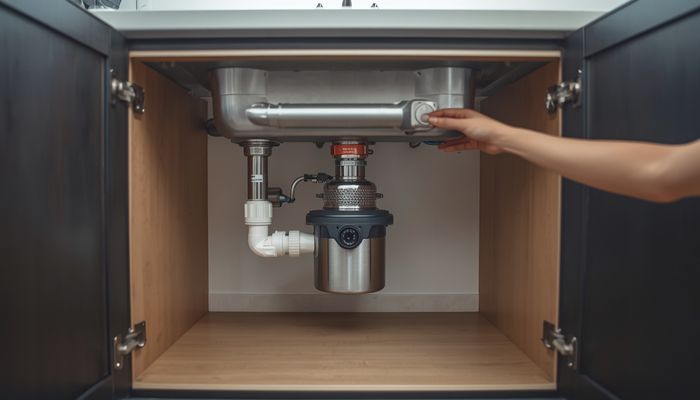
How Garbage Disposals Work and Maintenance Tips
TL;DR: A garbage disposal is an electric grinder mounted under the kitchen sink that shreds food waste into fine particles that flow safely through the drain. Installed cost runs $150-$600 for the unit and $150-$450 for labor, totaling about $400-$1,050. Continuous-feed models are the standard residential choice; batch-feed adds a safety lid. Expect 8-15 years of service with a 1/2 to 1 HP motor. Top brands: InSinkErator, Waste King, and Moen. Replacing an existing disposal is a 1-2 hour DIY job; first-time installs require running an outlet and switch, which is a job for a licensed electrician.
What Is Garbage Disposals?
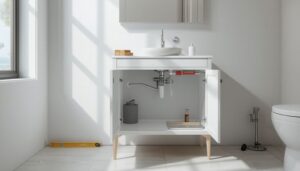
A garbage disposal sits between the sink drain and the P-trap, using a spinning impeller plate (not blades) to fling food waste against a stationary grinding ring. Water flushes the resulting slurry into the drain line. Most homes use 1/2 HP or 3/4 HP units; 1 HP is reserved for high-use households or homes with septic systems. Disposals are wired to a wall switch (continuous-feed) or activated by twisting a stopper (batch-feed). They are not designed for fibrous waste (celery, corn husks), grease, bones over 1/2 inch, or coffee grounds in volume.
How Much Does Garbage Disposals Cost?
Most homeowners spend $400-$1,050 to install a garbage disposal, including the unit and labor. The unit itself runs $80-$200 for a basic 1/3 HP model, $150-$300 for a mainstream 1/2 to 3/4 HP unit, and $300-$600 for a premium 1 HP model. Labor is $150-$450 depending on whether existing wiring and plumbing fit the new unit. Adding a new electrical circuit and switch can add $200-$400.
| Motor Size | Best For | Unit Price | Total Installed |
|---|---|---|---|
| 1/3 HP | Single occupant, light use | $80-$150 | $250-$500 |
| 1/2 HP | 2-4 person households | $120-$220 | $350-$700 |
| 3/4 HP | Large families, harder waste | $180-$350 | $450-$900 |
| 1 HP | Heavy use, septic-compatible | $300-$600 | $650-$1,150 |
Hidden costs to watch for: a new dedicated 15-amp circuit if your kitchen lacks one ($200-$400), an air gap fitting required by code in some states like California ($30-$80 plus install), and a new dishwasher tailpiece if you are connecting a dishwasher drain.
How Long Does Garbage Disposals Last?
A residential garbage disposal lasts 8-15 years depending on motor size and use. Cheaper 1/3 HP units typically fail at 7-10 years; 1 HP stainless-grind-chamber units routinely hit 12-15. Replace immediately if you hear loud humming with no rotation (jammed impeller), see leaks at the body (cracked housing), or smell burning (motor failure). Running cold water during use, avoiding fibrous food, and grinding ice cubes monthly all extend life.
Can I DIY Garbage Disposals?
Replacing an existing disposal that matches your sink mount is a confident-intermediate DIY job. Plan 1-2 hours: unplug or shut the breaker, disconnect the drain and dishwasher hose, twist off the old unit, transfer the mounting ring if compatible, hang the new unit, reconnect plumbing, and restore power. Most modern InSinkErator and Waste King units use the same EZ-mount system, simplifying like-for-like swaps.
First-time installs are not DIY for most homeowners. You need a dedicated 15-amp circuit, a switch above the counter, and often an air gap fitting. Combined plumbing-and-electrical work means two trades or one licensed pro. Budget $300-$500 in labor for a from-scratch install.
What Are the Best Garbage Disposals Options?
The U.S. residential market is dominated by InSinkErator (Emerson) and Waste King (Anaheim Manufacturing). Moen and KitchenAid are also strong. Pick by motor size first, grind chamber material second (stainless lasts longer than galvanized), and warranty third.
| Brand | Notable Model | Motor | Warranty |
|---|---|---|---|
| InSinkErator | Evolution Excel | 1 HP | 7 years |
| InSinkErator | Badger 5 | 1/2 HP | 2 years |
| Waste King | L-8000 | 1 HP | 8 years |
| Moen | GX50C | 1/2 HP | 4 years |
| KitchenAid | KCDB250G | 1/2 HP | 1 year |
For most 2-4 person households, the InSinkErator Evolution Compact or Waste King L-3300 (3/4 HP) hits the sweet spot at $180-$240. Septic owners should pick InSinkErator Evolution Septic Assist, which injects bio-charge enzymes. Avoid 1/3 HP units unless storage is severely constrained.
When Should I Replace or Upgrade Garbage Disposals?
Replace your disposal when you hear repeated grinding-stop-grinding cycles (failing impeller bearings), water leaks from the body seam (not the connections), the reset button trips weekly, the unit is over 10 years old and slow to clear, or repair quotes top 60% of replacement cost. A leak at the top of the unit where it meets the sink usually means the mounting gasket failed and can be re-seated for $0; a leak at the bottom seam is a replacement.
What can I not put in a garbage disposal?
Avoid grease and cooking oil (clogs the drain), bones over 1/2 inch (jams the impeller), fibrous vegetables like celery and corn husks (wrap around the grinder), coffee grounds in volume (sludge up the trap), eggshells in volume (similar), pasta and rice (expand and clog), and any non-food items. A small lemon wedge or ice cubes monthly helps clean the chamber.
Continuous-feed vs batch-feed: which is better?
Continuous-feed disposals run via a wall switch and are the U.S. standard, accounting for over 90% of installs. Batch-feed disposals only run when a magnetic stopper is twisted in place, making them safer for households with children but slower to use. Batch units cost $50-$150 more for the same motor size.
Do garbage disposals work with septic systems?
Yes, but only with a 3/4 HP or larger unit designed for septic use (InSinkErator Evolution Septic Assist is the only model with built-in enzyme injection). Standard disposals are not banned on septic but they increase the solid load on the tank by roughly 30%, requiring more frequent pump-outs (every 2-3 years instead of 3-5).
Why is my disposal humming but not spinning?
The impeller is jammed. Turn off power at the wall switch and breaker, then use a 1/4-inch Allen wrench in the hex hole at the bottom of the unit to rotate the impeller back and forth until it spins freely. Press the red reset button on the bottom, restore power, and test with cold water running. If it hums again under load, the start capacitor is failing and the unit needs replacement.