
What You Need to Know About Fiberglass Insulation
TL;DR: Fiberglass insulation is a lightweight, fire-resistant material made from spun glass fibers. It works by trapping air in millions of tiny pockets, slowing heat transfer. Standard R-values range from R-2.9 to R-4.3 per inch, and installed costs average $0.50–$1.50 per sq ft. It is most commonly used in attics, walls, and basements, but must be installed correctly to avoid moisture and air leakage issues.
What Fiberglass Insulation Means
In home improvement, fiberglass insulation refers to a thermal and acoustic insulation material composed of extremely fine glass fibers bonded together with a binder. It is the most widely used residential insulation in North America. The term “fiberglass” itself describes the manufacturing process: molten glass is spun or blown into fibers, creating a wool-like texture that traps air.
Fiberglass insulation is available in two primary forms:
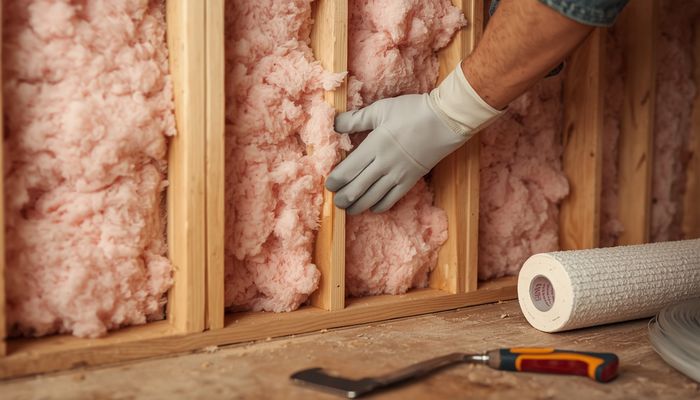
- Batts and rolls – pre-cut panels or long rolls designed to fit standard stud and joist spacing (16 or 24 inches on center).
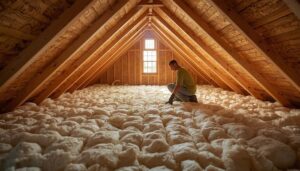
- Loose-fill (blown-in) – small, fluffy particles that are pneumatically blown into attics or hard-to-reach cavities.
The material’s primary job is to resist conductive and convective heat flow. It does not stop air movement by itself — that requires an air barrier. Fiberglass is non-combustible, does not absorb moisture (though it can trap it), and is resistant to mold and pests when kept dry.
How It Works (Step by Step)
Fiberglass insulation works through a simple physical principle: trapped air is a poor conductor of heat. Here is the step-by-step process:
- Fiber formation: Silica sand, limestone, and soda ash are melted at high temperature (~1400°C). The molten glass is forced through tiny spinnerets to create fine fibers.
- Binding and matting: The fibers are coated with a thermosetting resin binder, then compressed and cured into batts or left loose for blowing.
- Installation: Batts are friction-fit between studs, joists, or rafters. Loose-fill is blown to a specified depth and density using a machine.
- Heat transfer reduction: Heat moves by conduction through solid materials. In fiberglass, the glass fibers are poor conductors, and the millions of air pockets (still air has an R-value of about R-0.25 per inch) dramatically slow heat flow.
- Performance in real walls: For full effectiveness, fiberglass must be in full contact with the sheathing or drywall, with no gaps or compression. Even small voids can reduce overall R-value by 20–30%.
Importantly, fiberglass does not stop air infiltration. That is why modern building codes often require an air barrier (e.g., house wrap, taped drywall) on the warm side of the insulation.
Why It Matters
Fiberglass insulation matters for three core reasons: energy savings, comfort, and code compliance.
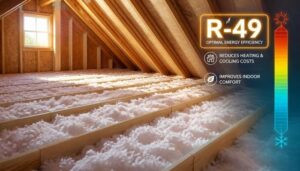
- Energy efficiency: Properly installed fiberglass can reduce heating and cooling costs by 30–50%. The U.S. Department of Energy recommends R-49 to R-60 in attics for most climates.
- Comfort: It keeps floors warmer in winter and ceilings cooler in summer, and reduces noise transmission between rooms.
- Cost-effectiveness: Fiberglass is the cheapest insulation per R-value. Installed costs typically range from $0.50 to $1.50 per square foot, depending on R-value and form.
- Fire safety: Fiberglass is non-combustible and can help slow the spread of flames (Class A fire rating).
Below is a quick reference table for common fiberglass R-values and their applications:
| R-Value | Thickness (inches) | Typical Application | Installed Cost per sq ft |
|---|---|---|---|
| R-13 | 3.5 | 2×4 walls (southern climates) | $0.50 – $0.80 |
| R-15 | 3.5 | 2×4 walls (colder climates) | $0.60 – $0.90 |
| R-19 | 6.25 | 2×6 walls, floors | $0.70 – $1.10 |
| R-30 | 9.5 | Attics, cathedral ceilings | $0.90 – $1.30 |
| R-38 | 12 | Attics (standard) | $1.00 – $1.50 |
| R-49 | 16 | Attics (cold climates) | $1.20 – $1.70 |
Learn More: The U.S. Department of Energy offers detailed guides on all insulation types and their recommended applications. For professional standards, visit the Spray Polyurethane Foam Alliance (SPFA) or the North American Insulation Manufacturers Association (NAIMA).
Note: Costs vary by region, brand, and whether you DIY or hire a pro. Loose-fill is often cheaper per R-value than batts.
Fiberglass Insulation vs Related Terms
Homeowners often confuse fiberglass with other insulation types. Here is a clear comparison:
- Fiberglass vs Mineral Wool (Rockwool): Both are fibrous, but mineral wool is denser, more water-repellent, and has a higher R-value per inch (R-4.0 vs R-3.3 for fiberglass). Mineral wool also provides better soundproofing and is more expensive ($1.50–$2.50/sq ft).
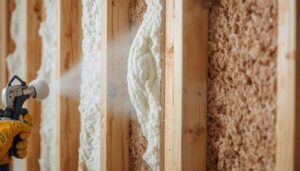
- Fiberglass vs Spray Foam: Spray foam (open or closed-cell) provides both insulation and an air seal. Closed-cell spray foam has R-6.0–R-7.0 per inch but costs $1.50–$3.00 per sq ft. Fiberglass is cheaper but requires separate air sealing.
- Fiberglass vs Cellulose: Cellulose (recycled paper) has similar R-value per inch (R-3.2–R-3.8) but is denser and better at reducing air leakage. Cellulose is treated with borates for fire and pest resistance. Cost is comparable to loose-fill fiberglass.
For most budget-conscious homeowners, fiberglass remains the go-to choice for attics and walls where air sealing is done separately.
Common Misconceptions
Despite its popularity, several myths persist about fiberglass insulation:
- “Fiberglass stops air leaks.” False. Fiberglass is porous and does not block airflow. Without an air barrier, warm moist air can pass through, reducing effectiveness and causing condensation.
- “Higher R-value always means better performance.” Not if installed poorly. Compressed, wet, or gap-filled fiberglass loses 20–50% of its rated R-value. Air sealing and proper installation matter more than R-value alone.
- “Fiberglass is dangerous to breathe long-term.” Old formulations (pre-1990s) were classified as possible carcinogens. Modern fiberglass is made from biosoluble glass fibers that dissolve in lung fluid and are considered safe when installed with proper PPE (mask, gloves, long sleeves).
- “It doesn’t need a vapor barrier.” In most climates, a vapor retarder (kraft facing or separate poly sheet) is required on the warm side of the insulation to prevent moisture migration. Unfaced batts should only be used in dry climates or when a separate vapor barrier is installed.
- “You can’t add fiberglass over existing insulation.” You can, as long as the existing insulation is dry and not compressed. Loose-fill fiberglass is often added over old batts to increase attic R-value.
FAQ
What is the R-value per inch of fiberglass insulation?
Standard fiberglass batts have an R-value of R-3.0 to R-3.3 per inch. High-density batts (e.g., for 2×6 walls) can reach R-4.3 per inch. Loose-fill fiberglass typically ranges from R-2.9 to R-3.2 per inch.
How much does fiberglass insulation cost installed?
Batts: $0.50–$1.50 per sq ft installed. Loose-fill: $0.40–$1.00 per sq ft. DIY batts cost about $0.30–$0.70 per sq ft for materials only.
Can fiberglass insulation get wet?
Fiberglass itself does not absorb water, but it can trap moisture against wood or drywall. Wet fiberglass loses R-value and can promote mold. It must be dried or replaced if saturated.
Is fiberglass insulation safe for DIY installation?
Yes, with precautions. Wear a dust mask (N95 or better), safety glasses, long sleeves, and gloves. The fibers can irritate skin, eyes, and lungs. Work in a well-ventilated area and shower after handling.
What is the best application for fiberglass insulation?
Attics (unfaced or kraft-faced batts), walls (unfaced batts with separate vapor barrier), and floors over unheated spaces. It is not recommended for below-grade basements unless protected by rigid foam or a vapor barrier.
How long does fiberglass insulation last?
Indefinitely if kept dry and undisturbed. It does not settle significantly (unlike cellulose) and does not degrade over time. However, rodent damage or moisture can compromise it.

Does this work well in humid climates? I’m in the South and moisture is always a concern.
This answered questions I didn’t even know I had. Great practical advice here.