
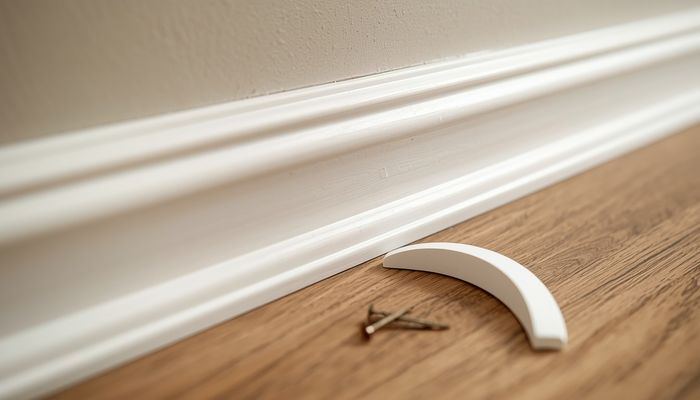
Quarter Round Explained: What It Is and Why It Matters
TL;DR: Quarter round is a small, convex molding shaped like a quarter of a circle, used primarily to cover gaps and transitions between flooring and baseboards or walls. It protects edges, hides imperfections, and gives a finished look to hard surface flooring installations.
What Is Quarter Round?
Quarter round is a type of trim molding with a cross-section that forms a perfect 90-degree arc—exactly one quarter of a full circle. It typically measures between ½ inch and ¾ inch in radius (the distance from the flat back to the curved front). This small, flexible molding is most commonly made from wood (pine, oak, or poplar), MDF (medium-density fiberboard), or flexible PVC for use with tile or vinyl flooring.
In home improvement, quarter round is almost always installed along the bottom of baseboards where they meet the floor. Its curved profile creates a smooth transition between the vertical wall surface and the horizontal flooring, while its flat back sits flush against the baseboard and its flat bottom rests on the flooring.
How Quarter Round Works
Quarter round works by bridging the gap between two surfaces that don’t meet perfectly. Here’s the technical breakdown:
- Shape and dimensions: The molding is cut from a square piece of wood or composite material, then rounded on one corner. Standard sizes include ½” x ½”, ¾” x ¾”, and 1″ x 1″ (the radius matches the width). The flat sides allow it to sit snugly against both the baseboard and the floor.
- Installation method: Quarter round is typically nailed into the baseboard (not the floor) using 1¼” to 2″ finishing nails. This allows the flooring to expand and contract naturally underneath without buckling. For floating floors (like laminate or LVP), this is critical—nailing into the floor would restrict movement and cause damage.
- Corner treatment: Inside corners are cut at 45-degree angles (miter cuts) to create a seamless joint. Outside corners require a 45-degree miter as well, but the cut direction flips. Professional installers often use a coping saw for inside corners to get a tighter fit.
For example, if you install a new laminate floor in a 12′ x 14′ room, you’ll need roughly 52 linear feet of quarter round (the perimeter minus doorways). Standard quarter round comes in 8-foot lengths, so you’d buy 7 pieces.
Why Quarter Round Matters in Home Improvement
Quarter round solves several practical problems that homeowners face during flooring or trim projects:
- Hides expansion gaps: Hard surface floors (hardwood, laminate, LVP, tile) require a ¼” to ½” gap around the perimeter to allow for seasonal expansion. Quarter round covers this gap while still allowing the floor to move freely.
2. Covers uneven cuts: Even professional installers can’t cut flooring perfectly flush to baseboards. Quarter round hides those imperfections without requiring perfect precision.
3. Protects baseboards: The molding acts as a sacrificial barrier—if you bump a vacuum cleaner or mop into the wall, the quarter round takes the damage, not the baseboard.
4. Adds a finished look: Without quarter round, the gap between flooring and baseboard looks unfinished and collects dust, dirt, and debris. A clean installation gives a polished, professional appearance.
Quarter Round vs Related Terms
Homeowners often confuse quarter round with similar trim profiles. Here’s how they compare:
| Feature | Quarter Round | Shoe Molding | Base Shoe (Cove Molding) |
|---|---|---|---|
| Cross-section shape | Perfect 90° arc (quarter circle) | Flatter, more elongated curve | Concave curve (cove shape) |
| Typical size | ½”–¾” radius | ½”–¾” height, narrower width | ½”–1″ height |
| Best use | Covering gaps between baseboard and flooring | Transitioning between dissimilar flooring heights | Hiding gaps at wall-floor junction |
| Installation | Nailed to baseboard | Nailed to floor or subfloor | Nailed to baseboard |
– Shoe molding: Similar to quarter round but flatter and narrower. It’s better for tight spaces where quarter round looks too bulky.
- Base shoe (or cove molding): Has a concave (inward-curving) profile rather than convex. It’s less common for flooring transitions but works well for hiding gaps at the very bottom of walls.
- Baseboard: The wider trim that sits against the wall, usually 3–6 inches tall. Quarter round is installed *below* baseboard, not in place of it.
When to Use Quarter Round
Use quarter round in these specific scenarios:
- After installing new hard surface flooring: If you replace carpet with hardwood, laminate, LVP, or tile, quarter round is almost always needed to cover the expansion gap. Exception: If your existing baseboards were installed *after* the flooring (common in new construction), you may not need it.
- When baseboards are already installed: If you’re adding flooring to a room with existing baseboards, quarter round is the easiest way to finish the edge without removing and reinstalling the baseboards.
- When floors are uneven: Quarter round can flex slightly to follow minor floor irregularities, hiding gaps that would otherwise be visible.
- When you want a budget-friendly finish: Quarter round is inexpensive (typically $0.50–$2.00 per linear foot) and easy to install with basic tools (miter saw, nail gun, measuring tape).
Avoid quarter round if:
- You’re installing wall-to-wall carpet (carpet doesn’t require expansion gaps).
- You have very tall baseboards (6″ or more) where a taller molding like base shoe might look more proportional.
- You prefer a “flush” look where flooring meets baseboard without visible trim (requires perfect cutting and a perfectly level subfloor).
Frequently Asked Questions About Quarter Round
1. Can I paint quarter round?
Yes. Unfinished wood or MDF quarter round can be painted to match your baseboards or walls. For best results, prime first (especially on MDF), then apply two coats of semi-gloss or satin paint. Pre-primed quarter round is also available.
2. Do I need quarter round if my baseboards are already flush with the floor?
If your baseboards sit directly on the subfloor and you’re installing new flooring that raises the floor height (e.g., adding ½” thick laminate), you’ll need quarter round to cover the new gap. If the baseboards were installed after the flooring, you may not need it.
3. How do I cut quarter round for corners?
For inside corners, cut both pieces at 45° angles (one left, one right) so they meet in the corner. For outside corners, cut both at 45° angles in the opposite direction. Always measure from the corner to the wall, not from the end of the previous piece.
4. Can I install quarter round over tile?
Yes, but use flexible PVC quarter round designed for tile, or use construction adhesive instead of nails to avoid cracking tiles. Pre-drill holes if nailing into grout lines.
5. How much quarter round do I need?
Measure the perimeter of the room (all walls except doorways). Add 10% for waste and mistakes. Standard lengths are 8 feet, so divide your total by 8 and round up. For example, a 12′ x 14′ room: perimeter = 52 feet ÷ 8 = 6.5 → buy 7 pieces.
Now that you understand what quarter round is and how it works, check our guide on how to install quarter round like a pro for step-by-step instructions with photos and cutting tips.
Flooring Industry Standards: For official grading standards and installation guidelines, consult the National Wood Flooring Association (NWFA) and the World Floor Covering Association (WFCA). The Family Handyman also offers excellent DIY flooring installation guides.


Thanks for this breakdown. Bookmarked for my upcoming project — exactly what I needed.
Used luxury vinyl in three flips last year. Quick to install and instantly makes a house look updated.