
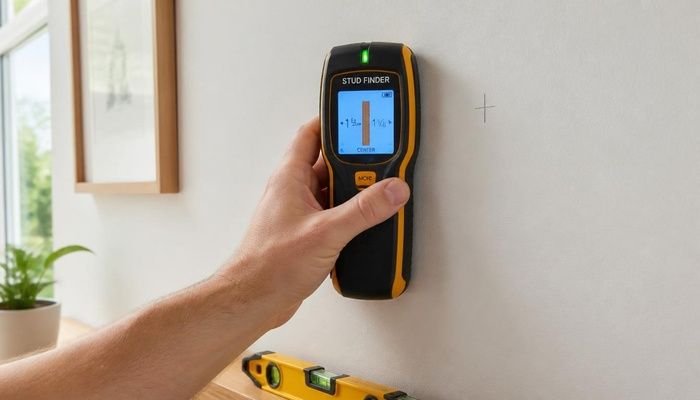
How to Choose the Right Stud Finder
TL;DR: A stud finder locates wood studs, metal studs, AC wiring, and pipes behind drywall, allowing safe mounting of TVs, shelves, and cabinets without guessing. Capacitive (electronic) stud finders dominate the DIY market at $20-$60; magnetic stud finders cost $5-$20 and have no batteries. Premium multi-sense stud finders (Franklin Sensors, Zircon Pro) cost $50-$120 and dramatically reduce false positives. They last 5-15 years. Top brands: Franklin Sensors, Zircon, Bosch, and Stanley.
What Is Stud Finders?
A stud finder detects studs behind drywall by sensing changes in density (capacitive electronic), magnetic attraction (magnetic), or radar reflection (premium multi-scan models). Most consumer units detect 1/2 to 1 inch behind drywall, which covers all standard residential wall construction. Premium units add live AC wiring detection and metal-vs-wood differentiation.
How Much Does Stud Finders Cost?
A budget magnetic stud finder costs $5-$15 (Magnepull, CH Hanson). A standard electronic stud finder costs $20-$60 (Zircon HD55, Stud Sensor SS1). A premium multi-sense model costs $50-$120 (Franklin Sensors ProSensor 710, Zircon MultiScanner 740). Professional-grade units (Bosch GMS 120, Hilti PS 38) run $150-$300 and detect deeper objects.
| Type | Capability | Price |
|---|---|---|
| Magnetic | Finds nail or screw heads | $5-$20 |
| Basic electronic | Stud edges | $20-$40 |
| Mid-range electronic with AC | Stud + live wire | $30-$60 |
| Multi-sense with deep scan | Wood/metal/AC differentiation | $50-$120 |
| Pro radar (Hilti PS 38) | Studs, pipes, wires through 6 in | $300-$600 |
How Long Does Stud Finders Last?
Electronic stud finders last 5-15 years. Battery contacts and the touch-activated sensors can degrade over time. Magnetic stud finders last decades (no electronics). Premium multi-sense units with capacitive arrays last 8-12 years before sensor drift causes false positives.
Can I DIY Stud Finders?
Stud finders are genuinely DIY tools used by any homeowner mounting items to walls. Common use: locate studs for TV mounts, heavy shelving, kitchen cabinets, curtain rods, towel bars in tile, and grab bars in showers. Operating technique: hold the stud finder flat against the wall, slide horizontally, wait for the edge indicator (single-edge models indicate one edge; multi-sense models show the full stud), mark with pencil.
Best practice: locate at least two studs to confirm the standard 16-inch on-center spacing. If two adjacent finds are not at 16-inch spacing, one is likely a false positive (often plumbing, electrical, or a deeper object). Cross-check by measuring 16 inches from a known location like an outlet (which is usually attached to a stud).
What Are the Best Stud Finders Options?
Franklin Sensors ProSensor 710 ($45-$60) is the bestseller and most-recommended consumer stud finder; its multi-sensor array eliminates the edge-finding step and shows the full stud at once. Zircon HD55 is the legacy standard. For pros, Bosch GMS 120 and Hilti detection scanners are the gold standard.
| Brand | Notable Model | Capability | Price |
|---|---|---|---|
| Franklin Sensors | ProSensor 710 | Full-stud detection | $45-$60 |
| Zircon | HD55 | Edge finder + AC scan | $25-$40 |
| Zircon | MultiScanner 740 | Wood/metal/AC, deep scan | $60-$100 |
| Bosch | GMS 120 | Pro-grade | $120-$200 |
| Stanley | FMHT77407 | Magnetic | $10-$20 |
When Should I Replace or Upgrade Stud Finders?
Replace a stud finder when: it produces frequent false positives on smooth walls (sensor drift), the touch-activated power button or display has failed, the battery contacts have corroded beyond cleaning, or you have upgraded to a wall application (radiant heat, thick plaster, metal studs) that exceeds the unit’s depth or material capability. Magnetic finders rarely need replacement; replace electronic units after 8-12 years if accuracy degrades.
Why does my stud finder keep giving false positives?
Most common causes: scanning over a knot or wood density variation in the stud, scanning over electrical wires (some basic models cannot differentiate), scanning over plumbing pipes, or scanning over a damp or just-painted wall (moisture confuses capacitive sensors). Solutions: re-scan after the wall dries, scan parallel paths 6 inches apart to confirm a vertical line of detection, or use a multi-sense unit.
Magnetic vs electronic: which is better?
Magnetic finds the nails and screws holding drywall to the stud, not the stud itself. Reliable but requires moving the magnet around to find each nail. Electronic finds the stud directly through capacitive sensing; faster for full-stud location but needs batteries and can give false positives on damp walls.
How accurate are stud finders?
Consumer electronic stud finders are accurate to within 1/4 to 1/2 inch of the actual stud edge. Multi-sense units are accurate to 1/8 inch. Magnetic finders are accurate to within 1/16 inch but only locate nails (which may be slightly offset from the stud edge). Drive a small test nail or screw before hanging anything heavy.
Can a stud finder detect plumbing pipes or wires?
Mid-range and premium stud finders can detect live AC wiring (warning indicator). Dedicated pipe and rebar detectors exist as separate tools. Standard consumer stud finders do not differentiate between studs and plumbing without the multi-sense feature; assume any 1.5 inch wide detection at a non-standard location is something other than a stud.