Comparing PEX vs Copper Pipe for Your Plumbing Needs
TL;DR: PEX (cross-linked polyethylene) and copper are the two dominant residential water supply pipe materials. PEX is faster to install ($0.50-$2 per foot for materials), freeze-resistant, and corrosion-proof; copper is rigid, recyclable, and proven to last 50-70+ years. Per-foot installed cost: PEX runs $2-$4, copper runs $5-$15. PEX dominates new construction; copper retains favor for exposed runs and high-end remodels. Both can be DIY-installed by a competent homeowner, though local code may require licensed plumbers for any new water main connection.
What Is PEX vs Copper Pipe?
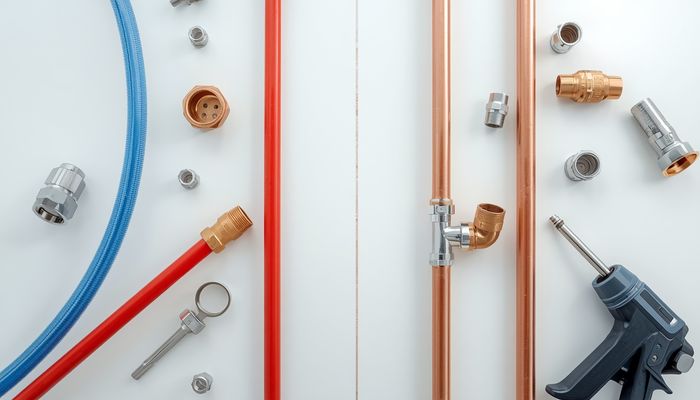
PEX is a flexible plastic pipe (red for hot, blue for cold, white universal) joined with crimp rings, expansion fittings, or push-to-connect fittings. Three PEX subtypes exist: PEX-A (most flexible, expansion-fitted), PEX-B (most common, crimp-fitted), and PEX-C (oldest, less common today). Copper pipe is rigid drawn copper, sold in Type M (thinnest wall, residential standard) and Type L (thicker, premium and commercial), joined by soldered sweat fittings, press fittings, or compression fittings.
Both materials are approved by major U.S. plumbing codes (IPC and UPC) for potable water. Lifespan of properly installed copper is documented at 50-70 years; PEX is rated for 50+ years by manufacturers, with the longest field installations now hitting 25 years without significant failure data.
How Much Does PEX vs Copper Pipe Cost?
Total installed cost: PEX runs $2-$4 per foot, copper runs $5-$15 per foot. For a typical bathroom or kitchen rough-in (30-60 feet), PEX saves $100-$300 in materials and another $100-$400 in labor due to faster installation. For a whole-house repipe (300-600 feet), PEX runs $4,000-$8,000 vs copper $7,000-$15,000.
| Component | PEX | Copper Type L |
|---|---|---|
| Material per linear foot | $0.50-$1.50 | $3-$8 |
| Fittings (each) | $1-$4 | $2-$10 |
| Installed labor per foot | $1.50-$3 | $3-$8 |
| Whole-house repipe (typical home) | $4,000-$8,000 | $7,000-$15,000 |
| DIY tool kit | $80-$250 | $100-$300 |
How Long Does PEX vs Copper Pipe Last?
Copper lasts 50-70 years in most water conditions, with some pre-1980 installs still serviceable at 60+ years. Copper can corrode through in 10-20 years on acidic well water (pH below 6.5) or where heavy chlorine causes pitting. PEX manufacturers warrant 25 years and rate the pipe at 50+ year service life; field data since 1980s European installations supports 30+ year lifespan, but full 50-year confirmation is pending.
Can I DIY PEX vs Copper Pipe?
Both materials are DIY-friendly for competent homeowners. PEX is faster to learn: a $100 crimp tool set, a tube cutter, and a couple practice fittings gets you running in an hour. Copper requires sweat-soldering skills (or a $300-$500 press tool), open-flame work, and very dry pipe surfaces; expect a 2-3 hour learning curve plus practice joints. Push-to-connect fittings (SharkBite) bridge the gap for either material, no soldering or crimping required, at $5-$15 per fitting.
What Are the Best PEX vs Copper Pipe Options?
PEX-A (Uponor Wirsbo, Rehau) is the premium PEX: most flexible, allows expansion-joint fittings that are leak-proof and freeze-resistant. PEX-B (Apollo, Sharkbite, Zurn) is the value standard with crimp fittings. For copper, Type L is the better long-term value over Type M in residential whole-house work. Mixed installs (copper main, PEX branches) are common and code-legal.
| Pipe Type | Joining Method | Best For | Cost |
|---|---|---|---|
| PEX-A | Expansion fittings | Freeze-prone, flexible runs | Highest |
| PEX-B | Crimp rings | General homeowner | Medium |
| Copper Type L | Sweat or press | Visible runs, premium | High |
| Copper Type M | Sweat | Standard residential | Medium |
| CPVC | Solvent weld | Hot water only, rigid | Low |
When Should I Replace or Upgrade PEX vs Copper Pipe?
Repipe with PEX when: your copper is corroding through (multiple pinhole leaks), your galvanized steel is restricting flow due to scale, you are remodeling and the walls are open anyway, or you live in a freeze-prone area and have had burst-pipe history. Choose copper over PEX for exposed runs (basement, mechanical rooms) where rodent damage is a concern, very high-end remodels where visible copper is a design choice, and unusually high water temperature applications (boiler primary loops).
Does PEX leach chemicals into drinking water?
Approved PEX brands (NSF/ANSI 61 and 14 certified) are tested for chemical migration and meet U.S. drinking water standards. Trace levels of MTBE and ETBE may be detectable in the first weeks of new installation; flushing the system mitigates this. PEX should not be used for outdoor exposed runs (UV-sensitive) and should not be installed within 12 inches of recessed cans or other heat sources.
Can rodents chew through PEX?
Yes. Rats and mice can and do chew through PEX pipe, causing leaks. In rodent-prone basements, attics, or crawl spaces, run PEX through conduit or use copper instead. Some PEX brands (Uponor AquaPEX rated for direct burial) are more puncture-resistant but not rodent-proof.
Will PEX burst in a freeze?
PEX expands 3-5 times its diameter before bursting, far more than copper, which gives PEX significant freeze resistance. Trapped water that freezes inside PEX usually causes the pipe to balloon and then return to shape on thaw, without rupture. Fittings remain the failure point, so insulate exposed runs and fittings.
Can I connect PEX directly to a water heater?
Not within 18 inches of the tank. Most plumbing codes require a copper or stainless flex connector for the first 18 inches off the water heater because PEX should not be exposed to temperatures over 200 F that can occur in T&P relief discharge or during heater malfunction.