Miter Saws: Key Uses and Selection Tips
TL;DR: A miter saw (also called a chop saw or drop saw) makes accurate angled crosscuts in wood, plastic, and aluminum. Compound, sliding, and dual-bevel sliding compound miter saws are the three main residential types. Quality 10 or 12 inch sliding compound miter saws cost $250-$650. They last 10-25 years of homeowner use. Top brands: DeWalt, Bosch, Makita, Milwaukee, and Ridgid. Miter saws are genuinely DIY-friendly with proper safety practice; they are essential for trim work, deck framing, and any project requiring repeated angled cuts.
What Is Miter Saws?
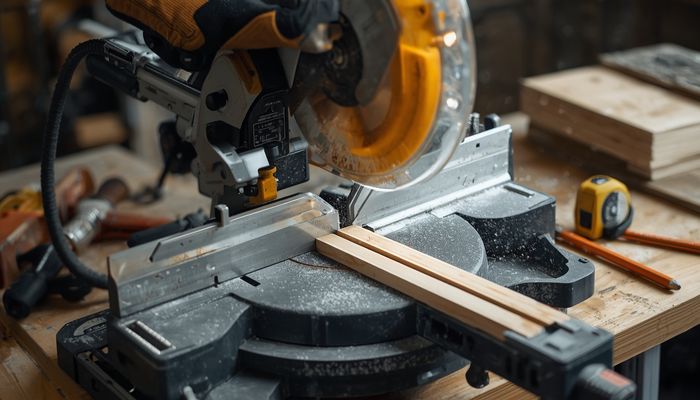
A miter saw is a circular blade mounted to a pivoting arm that brings the blade straight down through a workpiece set against a fence. Three types: compound (bevels left only or both directions), sliding compound (slides forward and back to cut wider stock), and dual-bevel sliding compound (bevels both directions without flipping the workpiece). The blade is typically 10 or 12 inches; 7-1/4 inch saws are compact but limited.
How Much Does Miter Saws Cost?
A quality 10 or 12 inch sliding compound miter saw costs $250-$650 for the saw, plus $50-$200 for a quality stand. Cordless variants in the 18V/20V or 36V platforms cost $300-$800 bare tool. Premium dual-bevel sliding compound saws (DeWalt DWS780, Bosch GCM12SD) run $600-$900 and are the long-term value pick for serious users.
| Tier | Type | Price |
|---|---|---|
| Budget compound (single-bevel) | Single bevel, 10 in | $100-$200 |
| Mid-range sliding compound | Single bevel, 10-12 in | $250-$450 |
| Premium dual-bevel sliding | Dual bevel, 12 in | $500-$900 |
| Cordless sliding compound | 18-36V brushless | $400-$800 |
| Heavy commercial | 15A, 12 in | $700-$1,500 |
How Long Does Miter Saws Last?
Quality miter saws last 10-25 years of homeowner use. The motor brushes wear out at 1,000-2,000 hours of use (replaceable for $20-$40). The bearings typically outlast the motor. The biggest non-wear failure is the laser or LED cut guide; these are non-essential but commonly fail at 5-10 years. A well-cared-for DeWalt or Bosch saw will outlast its owner.
Can I DIY Miter Saws?
Miter saws are genuinely DIY-friendly for any homeowner comfortable with power tools. Use cases: trim and molding (baseboard, crown, casing), deck and fence cuts, framing lumber, and basic furniture building. Key safety practices: secure the workpiece against the fence, keep hands clear of the blade arc, wait for the blade to stop before lifting, and never reach across the blade.
Cutting precise compound miter angles for crown molding requires understanding either the spring angle method (set the saw to specific compound angles) or the flat method (use a crown stop or specialty fence). Practice on scrap before committing to expensive trim pieces. A crown molding stop ($25-$50) makes this dramatically easier.
What Are the Best Miter Saws Options?
DeWalt DWS780 is the volume leader and the saw most pros own. Bosch GCM12SD has the unique glide-arm articulating arm that eliminates rear clearance (works flush against a wall). Makita LS1019L is the precision pick. Milwaukee M18 FUEL is the leading cordless. For most homeowners, a corded DeWalt DWS779 (without laser, otherwise similar to DWS780) at $400-$500 is the value pick.
| Brand | Notable Model | Type | Price |
|---|---|---|---|
| DeWalt | DWS780 | Dual bevel sliding 12 in | $550-$700 |
| DeWalt | DWS779 | Dual bevel sliding 12 in (no laser) | $400-$550 |
| Bosch | GCM12SD | Dual bevel glide 12 in | $600-$800 |
| Makita | LS1019L | Dual bevel sliding 10 in | $500-$700 |
| Milwaukee | M18 FUEL 2734 | Cordless dual bevel sliding 12 in | $700-$1,000 |
When Should I Replace or Upgrade Miter Saws?
Replace a miter saw when: the bevel or miter detents no longer lock precisely (causing inaccurate angles), the blade no longer drops perpendicular to the fence (the table is bent or the pivot is worn), the slide bars are pitted or sticky (cannot be cleaned), the motor brushes are gone and the brushes are no longer available, or the saw simply cannot hold the precision you now need. Most non-precision failures are repairable.
10-inch vs 12-inch miter saw: which should I buy?
12-inch saws cut wider material (typically 8 inches across with the slide, vs 6 inches for a 10-inch sliding). For trim and casual deck work, 10 inch is fine. For 2×10 framing lumber, crown molding wider than 5-1/4 inches, or any wider workpiece, 12-inch is necessary. 12-inch blades are also more expensive ($30-$80) than 10-inch ($20-$60).
Sliding vs non-sliding miter saw: do I need the slide?
Yes for most users. Non-sliding ‘compound miter’ saws can only cut as wide as their blade radius minus the pivot point, typically 4-6 inches. Sliding saws extend forward, allowing 8-12 inch wide crosscuts. For baseboard, deck boards, and most framing, the slide is essential.
Do I need a dual-bevel saw?
Convenience, not necessity. Dual-bevel allows beveling in both directions without flipping the workpiece, which matters for precise crown molding work and matched-grain projects. Single-bevel saves $100-$200 but requires you to flip the workpiece for opposite bevels, which can introduce error.
How do I get clean cuts without splintering?
Use a fine-tooth blade (60-80 tooth for finish work in hardwood, 80-100 tooth for plywood and melamine), back the cut with a sacrificial fence (a piece of MDF clamped to the saw fence), and let the blade cut at its own pace. Forcing the cut causes splintering on the exit side.