
The Day I Admitted Defeat
I stood in my own foyer wearing a winter coat indoors. It was January, the heat was running, and yet the air around my front door felt like a refrigerator had been left open. I could see daylight through the gap on the latch side — not a sliver, a legitimate stripe of sky. A rolled-up bath towel lay crumpled at the threshold where I’d shoved it six months earlier and promptly forgotten. My wife walked past, looked at the towel, looked at me, and said nothing. That was worse than if she’d yelled.
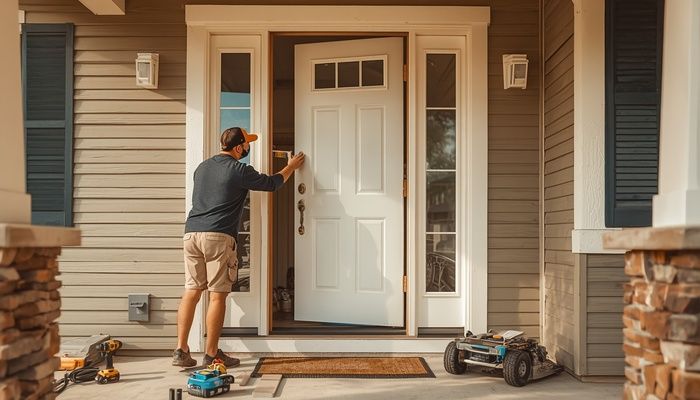
That door was original to the house, installed in 1973. It had outlived two presidents, the invention of the internet, and my patience. I replaced it the following weekend with a fiberglass pre-hung unit, and it changed how the entire front of the house felt — quieter, warmer, and frankly less embarrassing when guests came over. Here’s what I wish I’d known before I started.
Know What You’re Actually Buying
When people say “I need a new door,” they usually mean the slab — the flat panel that swings open. But an entry door is a system. There’s the jamb, which is the frame the slab hangs in. There’s the threshold at the bottom, the weatherstripping around all four sides, the hinges, the lockset, and the deadbolt. If any one piece is worn out, the whole assembly underperforms.
I bought a pre-hung door, which means the slab comes already mounted inside a new jamb, factory-aligned and ready to set into the rough opening. This is the right call if your existing jamb is rotted, out of square, or if daylight is visible even after replacing the weatherstripping — all of which described my situation. A slab-only replacement works if the jamb is solid and square. You buy just the door panel, transfer the hinge locations, bore the hardware holes if needed, and hang it. I once tried a slab-only swap in my first house and bought a panel that was an eighth of an inch too wide. Three hours with a dull block plane later, that door never did shut correctly. Lesson learned.
What I Spent
I went with a Therma-Tru Smooth Star fiberglass door, 36 inches wide, primed white, no sidelites. The door cost about $900. A friend helped me lift it into place, so labor was a case of beer and a promise to return the favor. If I’d hired a finish carpenter, a full-frame replacement runs $400 to $1,500 depending on whether the rough opening needs reframing.
Here’s the pricing landscape I navigated:
| Door Type | Material Cost | Total Installed |
|---|---|---|
| Steel pre-hung 36 in | $200-$600 | $700-$2,000 |
| Fiberglass pre-hung 36 in | $400-$1,500 | $1,200-$3,500 |
| Solid wood pre-hung 36 in | $800-$3,000 | $2,000-$6,000 |
| Pre-hung with sidelites and transom | $1,500-$5,000 | $3,500-$10,000 |
I skipped sidelites. Pretty as they are on a craftsman bungalow, they add up to $1,500 per side and slightly reduce the door’s insulating value. I wanted every dollar in the door itself.
How Long These Things Actually Last
A fiberglass door should give you 30 to 50 years of service. It won’t rot, rust, or swell with summer humidity the way wood does. Steel doors last 25 to 40 years and are the hardest to kick in, but they dent and any scratch through the paint invites rust. Solid wood can survive 30 to 100 years if you refinish it faithfully every three to seven years. Skip the maintenance and you’ll find rot at the base within 15 to 25 years — I watched this happen to my parents’ front door throughout my entire childhood.
The hardware — hinges, lockset, weatherstripping — needs attention every 10 to 20 years no matter what the door is made of, though a storm door in front of it takes some of that weather off. That’s just mechanical wear.
DIY or Hire It Out
Swapping just the slab is a good weekend project for one person. Budget four to eight hours — about what the interior door I hung last weekend took me. The catch is that “standard” doesn’t mean identical. A new 36-by-80 slab will probably need edge planing and hinge adjustments to fit your existing jamb. Don’t assume it drops right in.
A full pre-hung replacement is a bigger job. You’ll pull the old jamb — which involves a reciprocating saw to cut the nails, some careful prying, and then squaring the new unit in the rough opening. You’ll flash and caulk the exterior to keep water out. I did this with a friend who had done it once before. If I’d been solo and this was my first door, I would have hired a carpenter. The margin for error at the threshold — where water intrusion starts — is basically zero.
The Brands I Considered
I looked at Therma-Tru, Pella, JELD-WEN, and ProVia:
| Brand | Series | Material | Installed Price |
|---|---|---|---|
| Therma-Tru | Smooth Star | Fiberglass | $1,500-$3,500 |
| Pella | Encompass | Fiberglass | $1,800-$3,500 |
| Therma-Tru | Classic-Craft | Premium fiberglass | $3,000-$6,000 |
| JELD-WEN | IWP Aurora | Solid wood | $2,500-$7,000 |
I chose the Smooth Star because it was fiberglass — dimensionally stable through every season, zero required refinishing — and the price didn’t make my eyes water.
Fiberglass vs. Steel vs. Wood: My Verdict
Having lived with both wood and fiberglass, I’m firmly in the fiberglass camp. It doesn’t swell in July or shrink in February. It doesn’t need sanding, staining, or painting unless you feel like changing the color. Steel is cheaper and more secure but will dent — my neighbor’s kid proved that with a bicycle handlebar. Wood is beautiful and renewable if you sand and refinish it, but you have to actually do the work. I don’t want another item on my seasonal chore list.
When to Pull the Trigger
You need a new door when you can see daylight around the closed slab even after replacing the weatherstripping. That means something is warped — either the slab, the jamb, or both. Other signs: soft wood at the threshold or jamb base, the door won’t sit flat against the stops, or the gel coat on a fiberglass door has failed and the paint is peeling in sheets.
One thing I discovered after the fact: at the time I did this, Energy Star certified entry doors qualified for the federal Section 25C credit — 30% of the cost, up to $250 per door and $500 per home. I filed and got about $180 back. It covered the new lockset with enough left over for pizza. That credit is gone now: it was terminated for property placed in service after December 31, 2025, so check current IRS guidance, and your state and utility rebate programs, before you count a credit into your budget.
Replacing that door was the best curb-appeal upgrade we’ve done. The foyer is warm now. The towel is back in the linen closet where it belongs. And my wife no longer gives me that look when she walks through the front door.


