
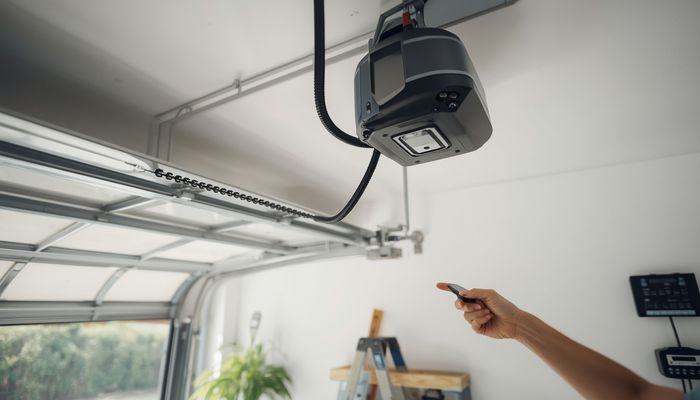
A garage door opener motorizes your existing garage door, opening and closing it via wall button, remote, keypad, or smartphone. Installed cost is $300-$800 for the opener and $150-$400 for labor, totaling $450-$1,200. Modern belt-drive units last 12-20 years; chain-drive last 10-15 years. Top brands: LiftMaster, Chamberlain, Genie, and Ryobi. Replacing an existing opener that uses the same rail and powerhead style is a confident DIY project for a half day; first-time installs and tracks requiring adjustment are typically professional jobs.
How openers differ, and what the drive type changes
A garage door opener consists of a motor (powerhead) mounted to the ceiling, a rail extending toward the door, a trolley that moves along the rail, and a connection arm to the top of the door. The motor drives the trolley via a chain, belt, or screw. Built-in safety reverses use infrared photo sensors near the floor and force-feedback in the motor to stop and reverse when an obstruction is detected.
Opener plus installation, priced honestly
A garage door opener costs $200-$700 for the unit and $150-$400 for installation, totaling $450-$1,200. Belt-drive (quiet) units cost slightly more than chain-drive. Smart features (Wi-Fi, battery backup, camera) add $100-$300. Replacing torsion springs at the same time adds $150-$400.
| Drive Type | Unit Price | Installed Cost | Best For |
|---|---|---|---|
| Chain drive (1/2 HP) | $200-$350 | $350-$700 | Detached garages, budget |
| Belt drive (1/2 HP) | $280-$500 | $450-$900 | Attached garages, quiet |
| Screw drive | $280-$450 | $450-$850 | Less common today |
| Direct drive / jackshaft | $400-$700 | $700-$1,200 | High ceilings, side mount |
| Smart belt with battery backup | $350-$700 | $550-$1,000 | California (code), smart homes |
How long an opener runs before the gear strips
Belt-drive openers last 12-20 years; chain-drive last 10-15 years. The motor and gearbox typically outlast the trolley and chain or belt. Door springs (torsion or extension) attached to the door itself are not part of the opener and last about 10,000 cycles (5-10 years for an average household). Photo eye sensors fail at 7-15 years and are easy DIY replacements.
Swapping an opener yourself
Replacing an existing opener that uses similar rail length is a strong half-day DIY project. Plan 4-6 hours: disconnect and remove the old opener, assemble the new rail and powerhead per instructions, lift the rail into position (a second person helps), attach to the existing ceiling brackets or install new ones, connect to the door bracket, install photo eyes, wire the wall button, program remotes, and test safety reverse.
Torsion spring replacement is genuinely dangerous and not DIY. Springs under tension can release with hundreds of pounds of force, causing serious injury. Always have springs replaced by a professional, even when you are replacing the opener yourself — it belongs in the same category as wiring a surge protector into a live panel: adjacent to a job you can do, but not one of them. Cost: $150-$400 for both springs installed.
Belt, chain, or wall-mount for your garage
LiftMaster (commercial-grade) and Chamberlain (consumer brand of LiftMaster) dominate the U.S. residential market. Genie is the strong number two; Ryobi (Home Depot) is the value upstart. For most homeowners, a Chamberlain B970 or LiftMaster 8500W hits the sweet spot at $300-$450 unit price.
| Brand | Notable Model | Drive Type | Price |
|---|---|---|---|
| LiftMaster | 8500W (jackshaft) | Direct drive | $450-$650 |
| LiftMaster | 8550WLB | Belt with battery | $400-$550 |
| Chamberlain | B970 | Belt with myQ | $280-$400 |
| Genie | StealthDrive Connect | Belt | $280-$400 |
| Ryobi | Ultra-Quiet GD201 | Belt | $280-$400 |
Repair or replace: how to decide
Replace your opener when the motor strains audibly on every lift (failing gearbox), the rail is bent from a closure on an obstruction, the safety reverse fails the test (close on a 2×4 lying flat; should reverse immediately), it is over 15 years old and lacks UL-325 compliant photo eyes, or the remotes have lost programming repeatedly. Federal product safety rules (16 CFR Part 1211, which adopts UL 325) have required external entrapment protection — the photo eyes — on residential openers manufactured since January 1, 1993; pre-1993 openers should be replaced for safety.
Belt drive vs chain drive: which is better?
Belt drive is significantly quieter (around 60 dB vs 70 dB for chain), which matters for attached garages with bedrooms above. Belt drive costs $50-$150 more but typically lasts longer. Chain drive is acceptable for detached garages or workshops where noise does not matter.
Do I need a battery backup garage door opener?
California state law (SB 969, which amended Health and Safety Code Section 19891) has required a battery backup function on residential openers sold or installed there since July 1, 2019. Outside California, it is optional but valuable: power outages happen most often during storms, exactly when you need to get a car in or out. Add $50-$150 for the battery.
How does smart garage door control work?
Modern openers include Wi-Fi (Chamberlain myQ, LiftMaster myQ, Genie Aladdin Connect) that allow open/close via phone, schedule, and integration with Amazon/Google. They report door status (open/closed) and can alert you if the door is left open — the same convenience that made a smart thermostat worth the retrofit. Retrofitting older openers with a separate smart relay (Tailwind, Meross, Linksys) costs $30-$70.
Why does my garage door reverse before closing?
The most common cause is misaligned photo eye sensors (the small lenses on the door tracks near the floor). They should face each other, with steady LEDs on both. Dirty lenses, sun glare on one sensor, or vibration that has tilted a sensor will cause the door to reverse. Clean and realign before assuming the opener has failed.


