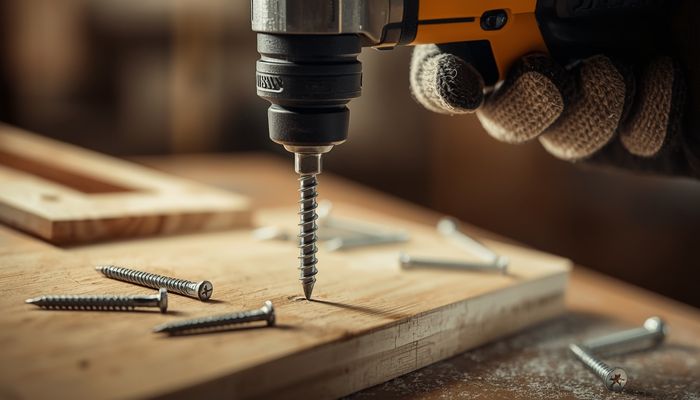
Impact Drivers: When and How to Use Them
TL;DR: An impact driver is a compact, high-torque driver that uses rotational impacts to drive long screws, lag bolts, and structural fasteners without the user fighting torque reaction. Quality 18V or 20V brushless impact drivers cost $90-$250 bare tool, $140-$350 full kit. They last 8-15 years of homeowner use. Top brands: DeWalt, Milwaukee, Makita, Ryobi. Impact drivers complement (not replace) a drill driver: they excel at fasteners but cannot drill round holes with twist bits. Genuinely DIY-friendly for any user comfortable with a drill.
What Is Impact Drivers?
An impact driver is a battery-powered tool with a high-RPM motor connected to a hammer and anvil mechanism. When the driver encounters more torque than the motor can apply directly, the hammer disengages and strikes the anvil rotationally, delivering bursts of high torque (1,500-2,200 in-lbs in 18V models). This impact action drives long fasteners deeply without the user feeling the torque reaction. Impact drivers use a 1/4-inch hex collet, accepting only hex-shank bits (not round drill bits).
How Much Does Impact Drivers Cost?
A quality 18V or 20V brushless impact driver runs $90-$250 bare tool and $140-$350 full kit. Combination drill driver plus impact driver kits cost $200-$450 and are the better value for new users (one battery platform serves both). Premium units like the Milwaukee M18 FUEL Surge are $250-$320 bare and worth it for reduced noise and harder fastening.
| Tier | Voltage | Bare Tool | Full Kit | Combo Kit (drill + impact) |
|---|---|---|---|---|
| Budget brushless | 18V/20V | $70-$120 | $130-$200 | $170-$250 |
| Mid-range homeowner | 18V/20V | $100-$170 | $170-$280 | $230-$380 |
| Premium prosumer | 18V/20V | $150-$280 | $250-$380 | $330-$500 |
| Compact 12V | 12V | $80-$150 | $120-$200 | $170-$280 |
How Long Does Impact Drivers Last?
Quality brushless impact drivers last 8-15 years of homeowner use. The hammer-anvil mechanism is the wear point and typically still functions after 1,500+ hours of impact work. Premium brushless motors (DeWalt PowerDetect, Milwaukee POWERSTATE) carry 3-year warranties and routinely outlast brushed predecessors by 2-3x.
Can I DIY Impact Drivers?
Impact drivers are genuinely DIY-friendly. Driving deck screws, lag bolts, structural framing screws, drywall screws, and self-tapping fasteners is dramatically faster with an impact than a drill. The impact action also reduces stripping of Philips and Torx heads at the fastener. For drilling round holes (twist bits, hole saws, spade bits, augers), use a drill driver; impact drivers can use specialty impact-rated drill bits but transmit harsh torque to the bit and break thinner bits.
What Are the Best Impact Drivers Options?
DeWalt, Milwaukee, Makita are the top tier. Milwaukee M18 FUEL Surge is the technology leader (hydraulic impact mechanism, much quieter). Ryobi 18V One+ is the homeowner budget winner. Commit to a battery platform: switching brands later costs $80-$150 per battery.
| Brand | Notable Model | Max Torque | Kit Price |
|---|---|---|---|
| Milwaukee | M18 FUEL Surge 2760 | 450 in-lbs (hydraulic) | $250-$350 |
| DeWalt | DCF845 Atomic | 1,825 in-lbs | $180-$280 |
| DeWalt | DCF887 | 1,825 in-lbs | $200-$300 |
| Makita | XDT16 | 1,600 in-lbs | $200-$320 |
| Ryobi | HP P238 | 2,200 in-lbs | $130-$200 |
For most homeowners doing decks, framing, fence repair, and shelving, the DeWalt DCF845 Atomic at $180-$240 hits the value sweet spot. The Milwaukee M18 FUEL Surge is the quiet, refined premium pick. For occasional users, the Ryobi HP P238 at $130-$180 in the One+ system is the best dollar value.
When Should I Replace or Upgrade Impact Drivers?
Replace an impact driver when the hex collet no longer retains bits firmly, the trigger no longer modulates speed cleanly, the impact mechanism has lost obvious power (driving the same fasteners takes 2-3x as long), the housing has cracked from a drop, or the motor brushes are worn (brushed models only). Battery failures at 3-5 years are battery replacements ($60-$150), not tool replacements.
Impact driver vs drill driver: which do I need?
Both, ideally. Drill drivers excel at drilling holes, delicate driving, and clutched torque control. Impact drivers excel at driving long fasteners (deck screws, lag bolts) and at high-torque applications where you would otherwise struggle to hold a drill. For a single tool, the drill driver is more versatile.
Can an impact driver drill holes?
Yes, with hex-shank impact-rated drill bits. Standard round-shank twist bits do not fit (impact uses 1/4-inch hex collet). Impact-rated bit sets cost $20-$60 and work well for holes up to about 1/2 inch. For larger holes, hole saws, or sensitive materials, use a drill driver.
Why is my impact driver so loud?
The hammer-anvil mechanism produces 90-110 dBA during impact. Most impact drivers are louder than table saws. The Milwaukee M18 FUEL Surge uses a hydraulic mechanism that runs at 60-70 dBA, comparable to a standard drill. If noise matters (indoor work, late hours, hearing protection), the Surge is worth the premium.
Will an impact driver strip drywall screws?
Properly used, an impact reduces stripping. The pulsed torque allows the bit to maintain seat in the screw head better than a continuous-torque drill. Match the bit to the screw (PH2 for most drywall screws), keep the bit perpendicular to the work, and use the trigger to feather speed near the end of the drive.