
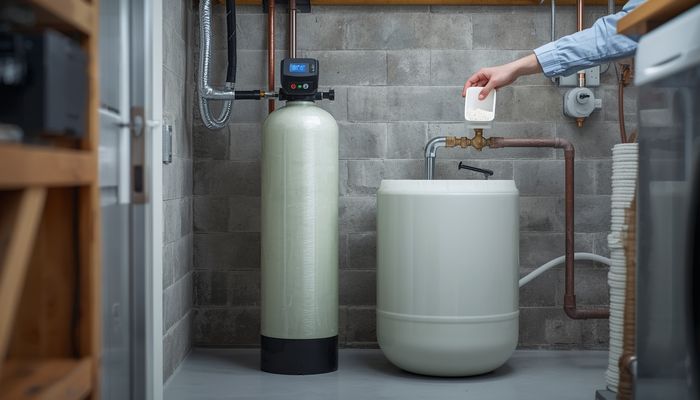
A water softener removes calcium and magnesium hardness from your water supply, protecting fixtures, appliances, and skin — hard water is one of the quieter reasons a water heater dies early. Installed cost is $800-$2,500 for a standard whole-house salt-based softener, $1,500-$3,500 for a high-flow dual-tank unit, and $1,500-$2,500 for a salt-free conditioner. Quality softeners last 10-20 years. Top brands: Culligan, Kinetico, Whirlpool, and Rheem. Replacing a softener with the same tank is a 2-3 hour confident DIY job; first-time installation requires a drain line and electrical outlet near the water main and is typically a plumber install.
Hard water, grains per gallon, and what softening does
A salt-based water softener uses ion exchange to swap dissolved calcium and magnesium ions (hardness) for sodium ions. Water flows through a resin tank filled with millions of polymer beads; when the resin is saturated, the unit periodically regenerates by flushing concentrated salt brine from a separate tank through the resin. Soft water typically tests at 0-1 grain per gallon of hardness; untreated U.S. groundwater averages 7-15 grains per gallon.
Unit, install, and the ongoing salt bill
A standard 32,000-grain whole-house softener costs $400-$900 for the unit and $400-$1,200 installed by a plumber. High-capacity dual-tank softeners run $1,500-$3,500 installed. Salt-free conditioners (template-assisted crystallization) cost $1,000-$2,500 installed but do not technically remove hardness; they prevent scale formation rather than soften water.
| Type | Unit Price | Total Installed |
|---|---|---|
| Basic 32K-grain salt-based | $350-$700 | $700-$1,400 |
| Mid-range 48K-grain | $500-$1,200 | $900-$2,000 |
| Dual-tank high flow | $1,200-$2,500 | $1,500-$3,500 |
| Salt-free conditioner | $700-$1,500 | $1,000-$2,500 |
| Whole-house with iron filter | $1,500-$3,500 | $2,500-$5,000 |
How long the resin bed lasts
Quality salt-based softeners last 10-20 years. The resin itself lasts 15-25 years if not exposed to chlorine in the supply (a carbon prefilter, around $30, meaningfully extends resin life on chlorinated municipal water). The control valve electronics typically need replacement at 8-12 years ($200-$500 part). Brine tanks rarely fail. Salt-free conditioners last 10-15 years; their media (typically TAC ceramic) is replaced every 3-6 years.
Installing one on your own main line
Replacing an existing softener that matches your plumbing connections is a strong DIY project. Plan 2-3 hours: shut off the bypass valve at the head, drain the system, disconnect inlet and outlet plumbing, lift out the old tank, set the new tank in place, reconnect plumbing with new fittings, connect the drain line, configure the head for your hardness and household size, and load with salt.
First-time installation requires plumbing into the cold water line at the point of entry, a 1-inch drain line within 25 feet, and a 120V outlet for the controller. Most homes need the work done by a plumber unless you are comfortable with copper or PEX work and have a drain accessible at the install point.
Sizing a softener to your hardness and household
Kinetico is the premium reliability pick (twin-tank, no electricity, 10-year warranty); Culligan is the household name with strong service network; Whirlpool and Rheem are big-box-friendly value picks. For most homeowners on city water with 10-20 grains hardness, a Whirlpool WHES40 or Rheem Preferred Plus 32K hits the sweet spot at $600-$900.
| Brand | Notable Model | Capacity | Price |
|---|---|---|---|
| Kinetico | Premier Series | Dual tank | $2,500-$4,500 |
| Culligan | HE Series | 32K-64K | $1,500-$3,500 |
| Whirlpool | WHES40 | 40K grain | $600-$900 |
| Rheem | Preferred Plus | 32K-42K grain | $600-$1,000 |
| GE | GXSH40V | 40K grain | $650-$900 |
When to rebed instead of replace
Scale from untreated hard water is also what shortens a tankless heat exchanger’s life, so the two decisions are worth making together. Replace a softener when the resin tank is leaking (small leaks where the head meets the tank are repairable; tank wall leaks are not), the control valve is over 10 years old and frequently fails to regenerate, you see iron-orange staining returning despite a working regen cycle (resin is fouled and beyond cleaning), or the unit cannot keep up with current household water use (sizing was wrong from the start).
Does softened water taste salty?
No. The ion exchange swaps calcium/magnesium for sodium at a rate of about 8 mg per grain of hardness removed. A liter of 10-grain-hardness softened water contains roughly 80 mg of sodium, less than you get from a slice of bread. People on strict sodium-restricted diets can install a potassium chloride softener instead, at a small cost premium.
Salt-based vs salt-free: which actually works?
Salt-based softeners truly remove hardness ions and produce zero-grain water. Salt-free conditioners (template-assisted crystallization) chemically transform calcium so it does not bond to pipes and heating elements; the hardness is still in the water but does not cause scale. Both work, but salt-based softeners deliver the classic silky-soft water feel and full scale prevention.
How often does a softener need salt?
A family of four with 10-grain hardness uses 40-80 pounds of salt monthly. Modern demand-initiated regen models use less than older time-clock models. Refilling the brine tank is a 2-minute task; bags of softener salt cost $7-$12 for 40-50 pounds.
Should I get a water softener for well water?
Yes if hardness exceeds 7 grains per gallon, which describes most North American wells. For wells with iron content over 1 ppm, choose a softener with an iron-specific resin or pair the softener with a dedicated iron filter installed upstream; iron rapidly fouls standard softening resin.