
The Day My Water Heater Died (On Christmas Eve, Of Course)
December 24th, 6 AM. I’m in the basement in my pajamas, standing in two inches of water, staring at a 15-year-old Rheem that had chosen the worst possible moment to give up. My in-laws were arriving in six hours. There would be no hot showers. There would be no hot water for dishes. My wife was already Googling “emergency plumber Christmas Eve rates” — and let me tell you, those numbers will make your eyes water.
I said I’d do it myself. She looked at me like I’d just volunteered to perform open-heart surgery in the garage.
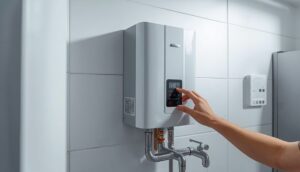
That was my first water heater install. I’ve done three since (different houses, not because the first one exploded — relax), and one house eventually got a tankless unit instead, which is a different animal entirely. And honestly? It’s not as terrifying as it looks. If you can sweat a copper pipe or you’re willing to use SharkBite fittings (no shame — I do), you can do this in a day and save yourself $700 to $1,200 in labor. Here’s everything I learned, including the mistakes I made so you don’t have to.
First: Gas vs Electric Changes Everything
My Christmas Eve disaster was a gas unit. Gas water heaters are heavier (more parts inside), they have a flue that vents through your roof, and you’re literally disconnecting a gas line — which rightfully makes people nervous. If you have a gas unit and you’ve never worked with gas pipe before, I’m going to be straight with you: maybe don’t make this your first DIY project.
Electric is simpler. Disconnect the power, drain the tank, swap the unit, reconnect the wires. No venting, no gas, no carbon monoxide risk. If I had to teach someone from scratch, I’d start them on electric every time. My second install was electric (a Rheem Performance 50-gallon, $589 at Home Depot), and it took me about five hours including the trip to get lunch.
The cost difference: electric units run $400–$900 for a standard 40–50 gallon tank. Gas units with power venting (required if you don’t have a chimney) run $700–$1,400. If you’re replacing an old gas unit and the venting is already there, you’re in luck — that’s the expensive part already done.
What You Actually Need (Not What YouTube Tells You)
YouTube will show you a clean workspace with every tool laid out perfectly. Real life is a cramped basement with a spider problem. Here’s what I actually used on my last install:
Essentials: A decent pipe wrench (I use a 14-inch Husky, $18), an adjustable wrench for the supply lines, a 4-in-1 screwdriver, and a voltage tester if you’re doing electric. Do not skip the voltage tester. “I’m pretty sure I flipped the right breaker” is not a sentence you want on your tombstone.
For the connections: Flexible stainless steel water supply lines (3/4-inch FIP, about $12 each at any hardware store). These are the best $24 you’ll spend — they forgive slight misalignments that would otherwise require re-soldering your copper. Teflon tape or pipe dope (I prefer Gasoila soft-set, $8) for the threaded connections. A tubing cutter if you need to trim copper.
For the drain: A garden hose. That’s it. But make it a dedicated one — you don’t want the same hose you spray pesticides with connected to something that feeds your shower. I keep a $12 green hose in the basement marked “WATER HEATER ONLY” in Sharpie.
The helper: Water heaters weigh 120–150 pounds empty. You cannot muscle a full-sized unit down basement stairs alone. I hired my neighbor’s teenage son for $40 and a pizza. Best money I spent on the whole project.
The Mistake I Made That You Shouldn’t
On my first install, I drained the old tank, disconnected everything, wrestled the old unit out, positioned the new one, connected the water lines, filled the tank — and only then realized I’d forgotten to thread the T&P (temperature and pressure) relief valve pipe. The T&P valve is the safety device on the side of the tank. If pressure builds too high, it opens and shoots scalding water out. That pipe needs to point at the floor (or a drain) — not at your face.
I had to drain the entire tank again to install the pipe. Two hours wasted. Now I thread the T&P pipe onto the valve before the tank even touches the ground.
Another mistake: I didn’t check the height. New water heaters are often taller than old ones because of updated insulation requirements (the 2015 DOE efficiency standards made tanks about 2 inches taller on average). My new Rheem was 61 inches. The old one was 58. That’s fine in a basement with 8-foot ceilings, but if yours is in a closet, measure first. Three inches of extra height in a tight space means you’re drywalling.
The Step-by-Step That Actually Worked
1. Turn everything off. For gas: turn the gas valve to OFF, then turn the control knob on the tank to OFF and PILOT. For electric: flip the double-pole breaker. Verify with your voltage tester.
2. Shut off the cold water supply (the valve on the pipe going INTO the tank). Open a hot water faucet somewhere in the house to break the vacuum.
3. Drain the tank. Connect your garden hose to the drain valve at the bottom of the tank. Run it to a floor drain, sump pit, or outside. Open the drain valve. This will take 30-45 minutes. Sediment at the bottom might clog the valve — if flow stops, open the T&P valve briefly to let air in.
4. Disconnect. Undo the water supply lines (two wrenches — one to hold the fitting, one to turn the nut). For gas: disconnect the union using two pipe wrenches. For electric: remove the junction box cover, disconnect the wires, unscrew the conduit.
5. Remove the old tank. This is the part where you earn the pizza you bought your helper. Drag it out, tip it onto a dolly, get it to the curb.
6. Position the new tank. Set it on a pan if you’re in a finished space. Thread the T&P pipe NOW, before you connect anything else. Level it with shims if needed.
7. Connect everything in reverse. Water lines first (Teflon tape on the threads, hand-tighten then quarter-turn with the wrench — overtightening brass fittings is how you crack them). If using SharkBite push-connect fittings, make sure the pipe is cut square, deburred, and inserted to the full depth marked on the fitting.
8. Fill before powering. Open the cold water supply. Open a hot faucet somewhere. When water flows steadily from that faucet (no sputtering), the tank is full. ONLY THEN do you restore power or relight the pilot. Heating an empty or partially filled electric tank destroys the elements in about 30 seconds. Ask me how I know.
9. Check for leaks. Run your fingers around every connection. Water is sneaky — a pinhole leak you can’t see will rot your floor over six months, and replacing a rotted subfloor costs a great deal more than the fitting you didn’t tighten.
When I’d Actually Call Someone
I’m stubborn. I’ll try almost anything. But I’ve learned where my line is:
If your old unit is gas and you need to run new venting — call a pro. Venting mistakes kill people. If your water heater is in an attic (common in the South) — call a pro because I’m not dragging 150 pounds down a pull-down ladder. If you open the electrical panel and the wiring doesn’t match what you expected — call an electrician, not a YouTube video. And if you’re on the second floor of a condo with HOA rules about liability — don’t be a hero.
For everyone else? This is a solid weekend project. My Christmas Eve disaster wrapped up at 3 PM. The in-laws got hot showers. My wife stopped giving me the look. And I’ve now saved about $3,200 in labor across three installs — which paid for the pizza and then some.